
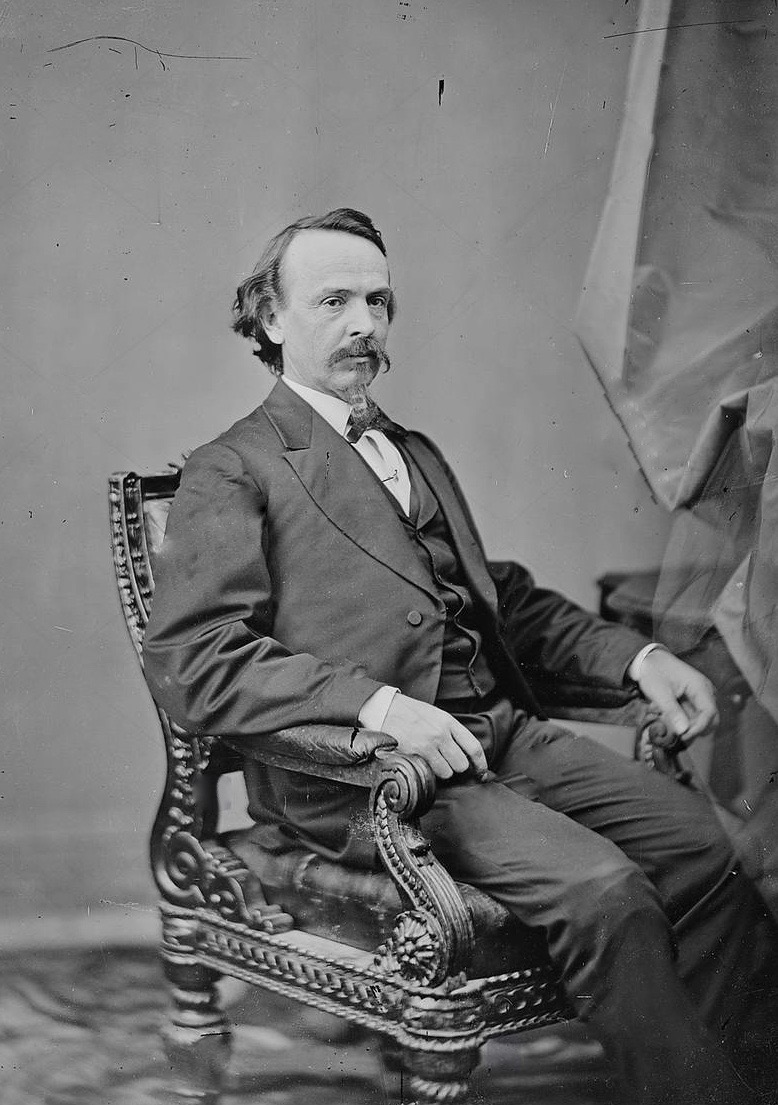
Historical · U.S. House · Indiana · District 5
John Coburn
Former U.S. Representative · Indiana District 5 · 1867–1875 · Republican
John Coburn represented Indiana's District 5 in the United States House of Representatives (1867–1875) for the Republican party. The page below collects sourced biographical facts, term history, committee roles, and provenance for Coburn.
Bioguide ID: C000558
Key facts
- Full name
- John Coburn
- State
- Indiana
- District
- District 5
- Party
- Republican
- House service
- 1867–1875
- First House term
- 1867
- Status
- Left office
- Current term ends
- —
- Born
- 1825
- Bioguide ID
- C000558
- Committee assignments
- —
- Dataset version
- 1.20260606
Biographical narrative
900 words · sourced from the Wikipedia REST extract
John Coburn was a U.S. Representative from Indiana, serving four terms in the House of Representatives during the late 19th century. A member of the Republican Party, Coburn's political career followed a distinguished military service in the Union Army during the American Civil War. His contributions to both military and civic life in Indiana are notable, as he played a significant role in various public service capacities throughout his life.
Early life and career
John Coburn was born on October 27, 1825, in Indianapolis, Indiana, a city that had just become the state capital that same year. He received his early education in the public schools of Indianapolis and later attended Wabash College in Crawfordsville, Indiana, where he graduated in 1846. While at Wabash, Coburn was instrumental in founding the college chapter of the Beta Theta Pi fraternity, which is recognized as the first Greek letter fraternity established on the campus and remains active today.
Following his graduation, Coburn pursued a career in law, gaining admission to the bar in 1849. He began practicing law in Indianapolis, where he quickly became involved in local politics. In 1850, Coburn was elected to the Indiana House of Representatives, marking the beginning of his political career. He later served as a judge of the Court of Common Pleas from 1859 until 1861. However, with the onset of the Civil War, Coburn resigned from his judicial position to enlist in the Union Army.
Coburn's military career began when he became the colonel of the 33rd Indiana Infantry Regiment, which mustered in on September 16, 1861. His regiment was initially deployed to Kentucky, where they participated in various military engagements, including the Battle of Camp Wildcat. Throughout 1862, Coburn's regiment remained active in Kentucky, notably taking part in the strategic seizure of the Cumberland Gap.
In October 1862, Coburn was promoted to command a new brigade within the Union Army of Kentucky, which included his old regiment along with several others. His brigade remained in Kentucky until early 1863, when they were ordered to reinforce the Army of the Cumberland in Tennessee. Coburn’s brigade faced significant challenges, including a reconnaissance mission that led to the Battle of Thompson's Station, where he was ultimately forced to surrender his troops.
After his capture, Coburn spent time in Libby Prison before being exchanged. He later fought alongside Colonel Benjamin Harrison under General William Tecumseh Sherman, participating in several key battles, including the campaign that led to the capture of Atlanta. His military service was recognized when he was nominated for the rank of brevet brigadier general, a position confirmed by the U.S. Senate in March 1866.
In addition to his military service, Coburn was involved in various civic initiatives. He played a crucial role in preserving the Indiana Historical Society and its archives and was active in promoting the establishment of the Soldiers' and Sailors' Orphanage in Knightstown, Indiana. Coburn also contributed to the development of Garfield Park in Indianapolis. He spent his later years residing in the Bates-Hendricks House in Indianapolis with his wife, Caroline Test Coburn, until his death in 1908.
House tenure
Coburn’s congressional career began after he was elected as a Republican to the Fortieth Congress, serving from March 4, 1867, to March 3, 1875. He was re-elected to three subsequent terms, demonstrating a sustained commitment to public service. During his time in the House, Coburn took on leadership roles, including serving as the chairman of the Committee on Public Expenditures during the 41st Congress. He was also a member of the Committee on Military Affairs in both the 42nd and 43rd Congresses, reflecting his background and expertise in military matters.
Throughout his tenure, Coburn was involved in various legislative discussions and decisions that impacted his constituents and the nation. His experience as a soldier likely informed his perspectives on military and veterans' issues, as well as broader public expenditure matters. However, his congressional career came to an end when he was not re-elected in 1874 for the 44th Congress.
Legislative focus and committees
During his time in the House of Representatives, Coburn's legislative focus was shaped by his background in law and military service. His role as chairman of the Committee on Public Expenditures allowed him to influence discussions surrounding government spending and accountability. This position was particularly significant in the post-Civil War era, as the nation was grappling with the financial implications of the war and the need for effective governance.
In addition to his work on public expenditures, Coburn's involvement with the Committee on Military Affairs underscored his ongoing commitment to issues related to the military and veterans. His firsthand experience as a colonel in the Union Army provided him with unique insights into the needs and challenges faced by service members and their families during the Reconstruction era.
After leaving Congress, Coburn continued to serve in public life, being appointed as a justice of the Supreme Court of the Territory of Montana in 1884, a position he held until December 1885. Following his judicial service, he returned to Indianapolis to resume his law practice. Coburn's contributions to both military and civic life in Indiana left a lasting impact, and he is remembered for his service in various capacities until his death on January 28, 1908. He was laid to rest in Crown Hill Cemetery in Indianapolis, where his legacy as a soldier, lawyer, and public servant endures.
Notable legislation
Sponsored and co-sponsored legislation for John Coburn is pending operator curation. The biographical narrative above carries the same provenance trail until per-bill rows are written.
Sources
- [1]https://en.wikipedia.org/wiki/John_Coburn_(Indiana_politician)Wikipedia · retrieved 2026-06-06
Notable quotes
Sourced quotes for John Coburn are pending operator curation. Narrative-scope provenance remains attached below.
Sources
- [1]https://en.wikipedia.org/wiki/John_Coburn_(Indiana_politician)Wikipedia · retrieved 2026-06-06
Key positions
Curated policy positions for John Coburn are pending operator review. The biographical narrative above carries the same provenance trail until per-topic positions are written.
Sources
- [1]https://en.wikipedia.org/wiki/John_Coburn_(Indiana_politician)Wikipedia · retrieved 2026-06-06
Terms served
- 1867–1869U.S. House · Term 1 · Republican
- 1869–1871U.S. House · Term 2 · Republican
- 1871–1873U.S. House · Term 3 · Republican
- 1873–1875U.S. House · Term 4 · Republican
Sources & provenance
Every attributable claim above carries a per-section [N] marker that resolves to the corresponding URL below. Each entry records the upstream provider, the canonical URL, and the timestamp at which the source was retrieved by the ingest pipeline.
Key facts
- https://bioguide.congress.gov/search/bio/C000558bioguide · retrieved 2026-06-06
- https://www.govtrack.us/congress/members/402690govtrack · retrieved 2026-06-06
Biographical narrative
- https://en.wikipedia.org/wiki/John_Coburn_(Indiana_politician)wikipedia · retrieved 2026-06-06
Find your representative
Every U.S. state elects representatives by district. Browse Indiana’s delegation, the full former-representative roster, or explore the role and term length.
Related on The Candidate
- Preceded by David KilgoreEarlier holder of the Indiana District 5 House seat · Republican.Open
- Succeeded by Courtland MatsonLater holder of the Indiana District 5 House seat · Democratic.Open
- Adam Benjamin Jr.Former U.S. Representative · Indiana District 1 · DemocraticOpen
- Alvin HoveyFormer U.S. Representative · Indiana District 1 · RepublicanOpen
- Arthur TaylorFormer U.S. Representative · Indiana District 1 · DemocraticOpen
- Benoni FullerFormer U.S. Representative · Indiana District 1 · DemocraticOpen