
Historical · U.S. House · Indiana · District 6
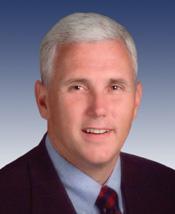
Mike Pence
Former U.S. Representative · Indiana District 6 · 2001–2013 · Republican
Mike Pence represented Indiana's District 6 in the United States House of Representatives (2001–2013) for the Republican party. The page below collects sourced biographical facts, term history, committee roles, and provenance for Pence.
Bioguide ID: P000587
Key facts
- Full name
- Mike Pence
- State
- Indiana
- District
- District 6
- Party
- Republican
- House service
- 2001–2013
- First House term
- 2001
- Status
- Left office
- Current term ends
- —
- Born
- 1959
- Bioguide ID
- P000587
- Committee assignments
- —
- Dataset version
- 1.20260605
Biographical narrative
905 words · sourced from the Wikipedia REST extract
Michael Richard Pence is a former American politician and lawyer who served as a U.S. Representative for Indiana's 6th congressional district from 2001 until 2013. A member of the Republican Party, Pence is also known for his tenure as the 50th governor of Indiana from 2013 to 2017 and as the 48th vice president of the United States from 2017 to 2021 under President Donald Trump. His political career has been marked by a range of legislative initiatives and leadership roles within the Republican Party.
Early life and career
Mike Pence was born on June 7, 1959, in Columbus, Indiana. He is the third son of Ann Jane "Nancy" Cawley and Edward Joseph Pence Jr., who operated a series of gas stations. Pence's father served in the U.S. Army during the Korean War and was awarded the Bronze Star in 1953. This commendation is displayed in Pence's office, alongside a photograph from the award ceremony. His family background includes German and Irish ancestry, with his maternal grandfather, Richard Michael Cawley, having emigrated from Ireland through Ellis Island and later working as a bus driver in Chicago.
Pence graduated from Columbus North High School in 1977. He pursued higher education at Hanover College, where he earned a Bachelor of Arts degree in history in 1981. During his time at Hanover, he became involved in campus life as a member of the Phi Gamma Delta fraternity, eventually serving as the chapter president. Following his undergraduate studies, Pence attended the Robert H. McKinney School of Law at Indiana University–Purdue University Indianapolis, obtaining his Juris Doctor degree in 1986. After completing law school, he worked as an attorney in private practice.
Initially, Pence was politically active as a Democrat, volunteering for the Bartholomew County Democratic Party in 1976 and supporting Jimmy Carter in the 1980 presidential election. However, during his college years, he underwent a significant transformation in both his religious beliefs and political ideology. He left the Catholic Church to become an evangelical Christian and began to align his political views more closely with conservative principles, influenced by the conservatism of Ronald Reagan.
Pence's early attempts to enter politics were marked by two unsuccessful congressional campaigns against Democratic incumbent Philip Sharp in 1988 and 1990. Despite these setbacks, he gained experience in political campaigning and public discourse. His 1990 campaign was particularly notable for its controversial advertisements, which drew criticism but also highlighted his willingness to engage in provocative political messaging. After these initial losses, Pence transitioned to a career as a conservative radio and television talk show host from 1994 to 1999, which helped him build a public profile and connect with a conservative audience.
House tenure
In 2000, Pence successfully ran for the U.S. House of Representatives, representing Indiana's 2nd congressional district. He took office in January 2001 and served in this capacity until 2003, when he transitioned to represent Indiana's 6th congressional district. Throughout his six terms in Congress, Pence established himself as a prominent figure within the Republican Party, taking on leadership roles that allowed him to influence party strategy and legislative priorities.
During his tenure, Pence chaired the Republican Study Committee from 2005 to 2007, a group focused on promoting conservative policies within the House of Representatives. He later served as the chair of the House Republican Conference from 2009 to 2011, where he played a key role in shaping the party's messaging and legislative agenda during a period of significant political polarization in the United States.
Pence's legislative work in the House encompassed a range of issues, including fiscal policy, social issues, and healthcare. He was known for advocating for tax cuts and limited government, reflecting the broader Republican platform. His leadership positions allowed him to engage with fellow Republicans and coordinate efforts to advance conservative legislation.
In January 2013, Pence concluded his service in the House of Representatives, having completed six terms. His time in Congress laid the groundwork for his subsequent political endeavors, including his election as governor of Indiana.
Legislative focus and committees
Throughout his congressional career, Mike Pence focused on several key areas of legislation that aligned with his conservative beliefs. He was an advocate for fiscal responsibility, often supporting measures aimed at reducing government spending and lowering taxes. His commitment to these principles was evident in his leadership roles, where he worked to unify Republican members around a conservative agenda.
Pence's involvement in social issues was also significant during his time in the House. He was a staunch opponent of abortion and supported various anti-abortion measures, reflecting the views of many constituents in his district. Additionally, he was involved in discussions surrounding education policy, advocating for increased funding for private education initiatives.
Pence's leadership of the Republican Study Committee and the House Republican Conference allowed him to influence the party's stance on critical issues. He was known for his ability to articulate conservative positions and rally support among fellow Republicans, which was particularly important during times of legislative challenges.
In summary, Mike Pence's legislative focus during his tenure in the U.S. House of Representatives was characterized by a commitment to conservative principles, fiscal responsibility, and social issues. His leadership roles provided him with a platform to shape the direction of the Republican Party and advocate for policies that aligned with his political beliefs. After leaving Congress, Pence transitioned to the governorship of Indiana, where he continued to implement conservative policies at the state level.
Notable legislation
Sponsored and co-sponsored legislation for Mike Pence is pending operator curation. The biographical narrative above carries the same provenance trail until per-bill rows are written.
Sources
- [1]https://en.wikipedia.org/wiki/Mike_PenceWikipedia · retrieved 2026-06-05
Notable quotes
Sourced quotes for Mike Pence are pending operator curation. Narrative-scope provenance remains attached below.
Sources
- [1]https://en.wikipedia.org/wiki/Mike_PenceWikipedia · retrieved 2026-06-05
Key positions
Curated policy positions for Mike Pence are pending operator review. The biographical narrative above carries the same provenance trail until per-topic positions are written.
Sources
- [1]https://en.wikipedia.org/wiki/Mike_PenceWikipedia · retrieved 2026-06-05
Terms served
- 2001–2003U.S. House · Term 1 · Republican
- 2003–2005U.S. House · Term 2 · Republican
- 2005–2007U.S. House · Term 3 · Republican
- 2007–2009U.S. House · Term 4 · Republican
- 2009–2011U.S. House · Term 5 · Republican
- 2011–2013U.S. House · Term 6 · Republican
Sources & provenance
Every attributable claim above carries a per-section [N] marker that resolves to the corresponding URL below. Each entry records the upstream provider, the canonical URL, and the timestamp at which the source was retrieved by the ingest pipeline.
Key facts
- https://bioguide.congress.gov/search/bio/P000587bioguide · retrieved 2026-06-05
- http://mikepence.house.govhouse.gov · retrieved 2026-06-05
Biographical narrative
- https://en.wikipedia.org/wiki/Mike_Pencewikipedia · retrieved 2026-06-05
Find your representative
Every U.S. state elects representatives by district. Browse Indiana’s delegation, the full former-representative roster, or explore the role and term length.
Related on The Candidate
- Preceded by David EvansEarlier holder of the Indiana District 6 House seat · Democratic.Open
- Succeeded by Luke MesserLater holder of the Indiana District 6 House seat · Republican.Open
- Adam Benjamin Jr.Former U.S. Representative · Indiana District 1 · DemocraticOpen
- Alvin HoveyFormer U.S. Representative · Indiana District 1 · RepublicanOpen
- Arthur TaylorFormer U.S. Representative · Indiana District 1 · DemocraticOpen
- Benoni FullerFormer U.S. Representative · Indiana District 1 · DemocraticOpen