
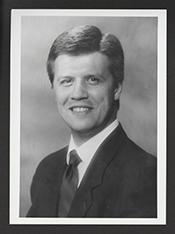
Historical · U.S. House · Indiana · District 8
John Hostettler
Former U.S. Representative · Indiana District 8 · 1995–2007 · Republican
John Hostettler represented Indiana's District 8 in the United States House of Representatives (1995–2007) for the Republican party. The page below collects sourced biographical facts, term history, committee roles, and provenance for Hostettler.
Bioguide ID: H000807
Key facts
- Full name
- John Hostettler
- State
- Indiana
- District
- District 8
- Party
- Republican
- House service
- 1995–2007
- First House term
- 1995
- Status
- Left office
- Current term ends
- —
- Born
- 1961
- Bioguide ID
- H000807
- Committee assignments
- —
- Dataset version
- 1.20260605
Biographical narrative
948 words · sourced from the Wikipedia REST extract
John N. Hostettler is a former American politician who served as a U.S. Representative for Indiana's 8th congressional district from 1995 until 2007. A member of the Republican Party, Hostettler was known for his alignment with social and fiscal conservatism, which resonated with his constituents in a region that has historically leaned Democratic. His tenure in Congress included significant involvement in various legislative initiatives and committee assignments, reflecting his interests in national security, immigration, and social issues. After losing his seat in the 2006 midterm elections, Hostettler continued to engage in political activities, including a bid for a U.S. Senate seat in 2010 and a recent attempt to reclaim his former House seat in 2024.
Early life and career
John N. Hostettler was born on June 19, 1961, in Evansville, Indiana. He has Swiss German and Irish ancestry, which reflects the diverse cultural background of many residents in the region. Hostettler completed his secondary education at North Posey High School, graduating in 1979. He then pursued higher education at the Rose-Hulman Institute of Technology in Terre Haute, Indiana, where he earned a Bachelor of Science degree in Mechanical Engineering in 1983.
Before entering politics, Hostettler's professional background included work in engineering, which provided him with a technical perspective that he would later bring to his legislative responsibilities. His early career laid the groundwork for his understanding of complex issues, particularly those related to technology and infrastructure, which would become relevant during his time in Congress.
House tenure
Hostettler's political career began when he was elected to the U.S. House of Representatives in 1994, becoming a member of the 104th Congress. Over the course of his six terms, he relied heavily on a base of social and fiscal conservatives to maintain his position in a district that, while traditionally Democratic, had a strong undercurrent of social conservatism. His campaigns were marked by distinctive grassroots efforts, including a group of supporters known as the "Red Army" or "Army of Red Volunteers," who would appear at public events wearing red t-shirts emblazoned with his campaign slogan. This visual presence, combined with the active involvement of his family members, contributed to his electoral successes.
Throughout his tenure, Hostettler was known for his independent stance on various issues. He signed the Contract with America, a Republican initiative aimed at reforming government, but notably expressed reservations about certain provisions, including a balanced budget amendment and term limits. His willingness to dissent from party lines was evident when he was one of 40 Republicans to vote against a proposed constitutional amendment for term limits in 1995.
Hostettler's legislative record included a mix of support for conservative social policies and a cautious approach to government spending. For instance, he sponsored a bill aimed at repealing a District of Columbia law that permitted domestic partners to register for health benefits. His voting history also reflected a willingness to oppose party leadership, as demonstrated when he voted against a government shutdown resolution in early 1996, which led to tensions with House Speaker Newt Gingrich.
In June 2005, Hostettler was involved in a controversial debate regarding religious expression in the military, where he defended the rights of evangelical Christians in the context of allegations of coercive proselytizing at the U.S. Air Force Academy. This incident highlighted the intersection of his political beliefs with broader cultural debates in American society.
Despite his efforts to maintain a strong conservative image, Hostettler faced challenges in the political landscape. In the 2006 midterm elections, he lost his bid for a seventh term to Democratic challenger Brad Ellsworth in a significant defeat, marking the end of his congressional career.
Legislative focus and committees
During his time in Congress, Hostettler served on several key committees that shaped his legislative focus. He was a member of the House Armed Services Committee, where he engaged in discussions and decisions related to national defense and military operations. Additionally, he served on the Judiciary Committee, which allowed him to influence legislation concerning legal and constitutional matters.
In the 106th Congress, Hostettler held the position of vice-chairman of the Armed Services Research and Development Subcommittee. His leadership role in this capacity enabled him to advocate for advancements in military technology and research initiatives. In 2003, he was appointed as the Chairman of the Judiciary Committee's Subcommittee on Immigration, Border Security, and Claims, where he focused on issues related to immigration policy and border security, reflecting a growing concern over national security in the post-9/11 era.
Throughout his legislative career, Hostettler introduced and co-sponsored various bills that aligned with his conservative principles. Notably, he co-authored legislation aimed at allowing churches and other religious organizations to engage in political campaigns without jeopardizing their tax-exempt status. Although the bill did not pass, it underscored his commitment to advocating for religious freedoms and the rights of faith-based organizations.
Hostettler's voting record also included notable opposition to significant legislation, such as the Authorization for Use of Military Force Against Iraq Resolution in 2002, where he expressed concerns about the implications of military intervention. His stance on this issue reflected a broader debate within the Republican Party regarding foreign policy and military engagement.
In summary, John N. Hostettler's congressional career was characterized by a commitment to conservative values, active engagement in legislative processes, and a willingness to navigate complex political landscapes. His tenure in the U.S. House of Representatives left a mark on Indiana's 8th congressional district and contributed to ongoing discussions about the role of government, national security, and the intersection of faith and politics in America. After leaving office, Hostettler continued to participate in political activities, including attempts to return to public office, demonstrating his enduring interest in the political arena.
Notable legislation
Sponsored and co-sponsored legislation for John Hostettler is pending operator curation. The biographical narrative above carries the same provenance trail until per-bill rows are written.
Sources
- [1]https://en.wikipedia.org/wiki/John_HostettlerWikipedia · retrieved 2026-06-05
Notable quotes
Sourced quotes for John Hostettler are pending operator curation. Narrative-scope provenance remains attached below.
Sources
- [1]https://en.wikipedia.org/wiki/John_HostettlerWikipedia · retrieved 2026-06-05
Key positions
Curated policy positions for John Hostettler are pending operator review. The biographical narrative above carries the same provenance trail until per-topic positions are written.
Sources
- [1]https://en.wikipedia.org/wiki/John_HostettlerWikipedia · retrieved 2026-06-05
Terms served
- 1995–1997U.S. House · Term 1 · Republican
- 1997–1999U.S. House · Term 2 · Republican
- 1999–2001U.S. House · Term 3 · Republican
- 2001–2003U.S. House · Term 4 · Republican
- 2003–2005U.S. House · Term 5 · Republican
- 2005–2007U.S. House · Term 6 · Republican
Sources & provenance
Every attributable claim above carries a per-section [N] marker that resolves to the corresponding URL below. Each entry records the upstream provider, the canonical URL, and the timestamp at which the source was retrieved by the ingest pipeline.
Key facts
- https://bioguide.congress.gov/search/bio/H000807bioguide · retrieved 2026-06-05
- http://www.house.gov/hostettlerhouse.gov · retrieved 2026-06-05
Biographical narrative
- https://en.wikipedia.org/wiki/John_Hostettlerwikipedia · retrieved 2026-06-05
Find your representative
Every U.S. state elects representatives by district. Browse Indiana’s delegation, the full former-representative roster, or explore the role and term length.
Related on The Candidate
- Preceded by Francis McCloskeyEarlier holder of the Indiana District 8 House seat · Democratic.Open
- Succeeded by Brad EllsworthLater holder of the Indiana District 8 House seat · Democratic.Open
- Adam Benjamin Jr.Former U.S. Representative · Indiana District 1 · DemocraticOpen
- Alvin HoveyFormer U.S. Representative · Indiana District 1 · RepublicanOpen
- Arthur TaylorFormer U.S. Representative · Indiana District 1 · DemocraticOpen
- Benoni FullerFormer U.S. Representative · Indiana District 1 · DemocraticOpen