
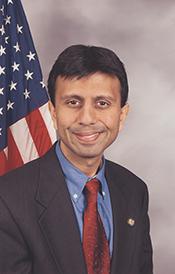
Historical · U.S. House · Louisiana · District 1
Bobby Jindal
Former U.S. Representative · Louisiana District 1 · 2005–2008 · Republican
Bobby Jindal represented Louisiana's District 1 in the United States House of Representatives (2005–2008) for the Republican party. The page below collects sourced biographical facts, term history, committee roles, and provenance for Jindal.
Bioguide ID: J000287
Key facts
- Full name
- Bobby Jindal
- State
- Louisiana
- District
- District 1
- Party
- Republican
- House service
- 2005–2008
- First House term
- 2005
- Status
- Left office
- Current term ends
- —
- Born
- 1971
- Bioguide ID
- J000287
- Committee assignments
- —
- Dataset version
- 1.20260605
Biographical narrative
1,041 words · sourced from the Wikipedia REST extract
Bobby Jindal is a former U.S. Representative from Louisiana, serving in the House of Representatives from 2005 to 2008. A member of the Republican Party, he is notable for being the second Indian American to serve in Congress and the first Indian American Republican. Following his tenure in the House, Jindal became the 55th governor of Louisiana, holding office from 2008 to 2016. His political career has been marked by a focus on health policy and governance, reflecting his background in public health and administration.
Early life and career
Bobby Jindal was born on June 10, 1971, in Baton Rouge, Louisiana. He is the son of Raj and Amar Jindal, who immigrated to the United States from Punjab, India, in 1971. His father, a civil engineer, and his mother, who worked in nuclear physics, both contributed to the academic environment in which Jindal was raised. The family settled near Louisiana State University, where his mother pursued her graduate studies.
Jindal attended Baton Rouge Magnet High School, where he excelled academically and participated in math competitions as a member of Mu Alpha Theta. He also engaged in various entrepreneurial ventures, including a computer newsletter and a retail candy business. After graduating high school in 1988, Jindal enrolled at Brown University. There, he was accepted into the Program in Liberal Medical Education, an eight-year combined baccalaureate-M.D. program. While at Brown, he became active in politics, leading the College Republicans and earning recognition as a USA Today Academic All-Star. He graduated in 1992 with dual honors in biology and public policy.
Following his undergraduate studies, Jindal was accepted to both Harvard Medical School and Yale Law School but chose to attend New College, Oxford, as a Rhodes Scholar. He completed his Master of Letters in political science in 1994, focusing on health policy, with a thesis examining a needs-based approach to healthcare.
After his time at Oxford, Jindal joined the consulting firm McKinsey & Company, where he gained experience in policy analysis. He also interned in the office of U.S. Representative Jim McCrery, working on healthcare policy issues. This early exposure to healthcare policy would later influence his political career.
Jindal's political career began in earnest in the 1990s. In 1996, he was appointed Secretary of the Louisiana Department of Health and Hospitals by Governor Mike Foster. At just 24 years old, he oversaw a significant portion of the state budget and managed a large workforce. During his tenure, he successfully turned around Louisiana's Medicaid program, which had been facing severe financial difficulties. Under his leadership, the program transitioned from a $400 million deficit to achieving surpluses over three consecutive years.
In 1998, Jindal was appointed executive director of the National Bipartisan Commission on the Future of Medicare, where he worked on reform proposals for the Medicare system. The following year, he became the youngest president of the University of Louisiana System, overseeing a large network of higher education institutions.
In 2001, Jindal was nominated by President George W. Bush to serve as Assistant Secretary of Health and Human Services for Planning and Evaluation. He was confirmed unanimously by the Senate and began his service in July of that year, advising the Secretary of Health and Human Services on various policy matters.
House tenure
Bobby Jindal's congressional career began when he was elected to the U.S. House of Representatives in 2004, representing Louisiana's 1st congressional district. He took office in January 2005, becoming the second Indian American to serve in Congress. Jindal's election was notable not only for his heritage but also for his alignment with the Republican Party, making him the first Indian American Republican in Congress.
During his time in the House, Jindal served on several committees and was involved in various legislative initiatives. His background in health policy informed much of his work, and he focused on issues related to healthcare, education, and fiscal responsibility. He was re-elected to a second term in 2006, further solidifying his position within the Republican Party and among his constituents.
Jindal's tenure in the House was characterized by his commitment to addressing healthcare reform and improving the efficiency of government programs. He was known for advocating for policies that aimed to enhance the quality of healthcare services while also managing costs. His legislative efforts reflected a broader Republican agenda focused on reducing government spending and promoting private sector solutions to public policy challenges.
However, Jindal's time in Congress was relatively brief. He concluded his service in January 2008 when he was elected governor of Louisiana. His transition from the House to the governorship marked a significant step in his political career, as he sought to implement his policy priorities on a larger scale.
Legislative focus and committees
During his time in the U.S. House of Representatives, Bobby Jindal's legislative focus was heavily influenced by his background in health policy and administration. He served on committees that allowed him to leverage his expertise, particularly in areas related to healthcare, education, and budgetary matters. His work in these committees enabled him to contribute to discussions and initiatives aimed at reforming various aspects of federal policy.
Jindal's commitment to healthcare reform was evident throughout his congressional tenure. He advocated for policies that aimed to improve access to healthcare services and enhance the overall quality of care. His experience as Secretary of the Louisiana Department of Health and Hospitals provided him with a unique perspective on the challenges facing state and federal healthcare systems.
In addition to healthcare, Jindal was involved in educational initiatives, emphasizing the importance of improving educational outcomes and increasing access to quality education for all students. His legislative efforts often reflected a broader Republican emphasis on accountability and efficiency in government programs.
Throughout his time in the House, Jindal maintained a focus on fiscal responsibility, advocating for policies that aimed to reduce government spending and promote economic growth. His approach to governance was characterized by a belief in the potential of private sector solutions to address public policy challenges.
After serving two terms in the House, Jindal transitioned to the role of governor of Louisiana, where he continued to pursue his policy priorities on a state level. His experiences in Congress informed his approach to governance and shaped his subsequent political career.
Notable legislation
Sponsored and co-sponsored legislation for Bobby Jindal is pending operator curation. The biographical narrative above carries the same provenance trail until per-bill rows are written.
Sources
- [1]https://en.wikipedia.org/wiki/Bobby_JindalWikipedia · retrieved 2026-06-05
Notable quotes
Sourced quotes for Bobby Jindal are pending operator curation. Narrative-scope provenance remains attached below.
Sources
- [1]https://en.wikipedia.org/wiki/Bobby_JindalWikipedia · retrieved 2026-06-05
Key positions
Curated policy positions for Bobby Jindal are pending operator review. The biographical narrative above carries the same provenance trail until per-topic positions are written.
Sources
- [1]https://en.wikipedia.org/wiki/Bobby_JindalWikipedia · retrieved 2026-06-05
Terms served
- 2005–2007U.S. House · Term 1 · Republican
- 2007–2008U.S. House · Term 2 · Republican
Sources & provenance
Every attributable claim above carries a per-section [N] marker that resolves to the corresponding URL below. Each entry records the upstream provider, the canonical URL, and the timestamp at which the source was retrieved by the ingest pipeline.
Key facts
- https://bioguide.congress.gov/search/bio/J000287bioguide · retrieved 2026-06-05
- http://www.house.gov/jindalhouse.gov · retrieved 2026-06-05
Biographical narrative
- https://en.wikipedia.org/wiki/Bobby_Jindalwikipedia · retrieved 2026-06-05
Find your representative
Every U.S. state elects representatives by district. Browse Louisiana’s delegation, the full former-representative roster, or explore the role and term length.
Related on The Candidate
- Preceded by Robert Livingston Jr.Earlier holder of the Louisiana District 1 House seat · Republican.Open
- Adolph MeyerFormer U.S. Representative · Louisiana District 1 · DemocraticOpen
- Albert EstopinalFormer U.S. Representative · Louisiana District 1 · DemocraticOpen
- Benjamin FlandersFormer U.S. Representative · Louisiana District 1 · UnionistOpen
- Carleton HuntFormer U.S. Representative · Louisiana District 1 · DemocraticOpen
- Republican PartyFederal candidates and office holders on the Republican line.Open