
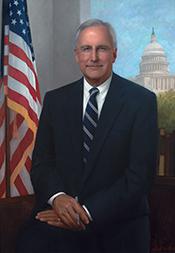
Historical · U.S. House · Louisiana · District 1
Robert Livingston Jr.
Former U.S. Representative · Louisiana District 1 · 1977–1999 · Republican
Robert Livingston Jr. represented Louisiana's District 1 in the United States House of Representatives (1977–1999) for the Republican party. The page below collects sourced biographical facts, term history, committee roles, and provenance for Jr..
Bioguide ID: L000371
Key facts
- Full name
- Robert Livingston Jr.
- State
- Louisiana
- District
- District 1
- Party
- Republican
- House service
- 1977–1999
- First House term
- 1977
- Status
- Left office
- Current term ends
- —
- Born
- 1943
- Bioguide ID
- L000371
- Committee assignments
- —
- Dataset version
- 1.20260605
Biographical narrative
970 words · sourced from the Wikipedia REST extract
Robert Linlithgow Livingston Jr. is a former American politician and lobbyist who served as a U.S. Representative for Louisiana's 1st congressional district from 1977 until 1999. A member of the Republican Party, Livingston gained prominence during his tenure, particularly as the chairman of the House Appropriations Committee from 1995 to 1999. He was briefly in line to succeed Newt Gingrich as Speaker of the House but declined the position amid personal controversies. After leaving Congress, Livingston transitioned to a career in lobbying and authored a memoir detailing his experiences in politics.
Early life and career
Bob Livingston was born on April 30, 1943, in Colorado Springs, Colorado. He comes from a prominent family with deep historical roots in American politics. His lineage includes notable figures such as Philip Livingston, a signer of the Declaration of Independence, and Chancellor Robert R. Livingston, who co-authored the Declaration and played a significant role in the Louisiana Purchase. Livingston's family history also connects him to French Admiral François Joseph Paul de Grasse, a key figure in the American Revolutionary War.
Livingston's early life was marked by a diverse religious upbringing. His parents divorced when he was young, leading him to be raised first as a Roman Catholic and later as an Episcopalian. He eventually returned to Roman Catholicism, influenced by his wife's faith. He married Bonnie Robichaux in 1965, and they have three biological sons and an adopted daughter, along with nine grandchildren. Tragically, the family faced the loss of their son Richard in 2006 due to an accident.
Livingston pursued higher education at Tulane University, where he was a member of the Delta Kappa Epsilon fraternity. He graduated from Tulane University Law School in 1968 and began his legal career by joining the law practice of David C. Treen, who would later become Louisiana's first Republican congressman and governor since Reconstruction. This association provided Livingston with valuable connections within the Republican Party during a time when it was still gaining a foothold in Louisiana politics.
From 1970 to 1976, Livingston held various legal positions, including working for U.S. Attorney Gerald J. Gallinghouse and Orleans Parish District Attorney Harry Connick Sr. He also served as the head of the organized crime unit for the Louisiana State Attorney General's office. These roles helped him build a reputation and network that would later assist him in his political career.
House tenure
Livingston's political career began in earnest when he resigned from his position as head of the organized crime unit in 1976 to pursue a congressional seat in Louisiana's 1st District. This district encompasses a significant portion of New Orleans and its suburbs. At the time, the seat was held by Democrat F. Edward Hébert, who had served for 36 years. When Hébert announced his retirement, Livingston sought the Republican nomination but faced a challenging primary and general election.
In his initial attempt to secure the seat, Livingston lost to Democrat Richard Tonry, partly due to the entry of a third-party candidate who siphoned off votes. However, following allegations of electoral misconduct against Tonry, he was forced to resign. In a subsequent special election, Livingston won the seat with a majority of the votes, marking a significant milestone as the first Republican to represent a substantial portion of New Orleans since Reconstruction.
Livingston's electoral success continued throughout his congressional career. He won a full term in 1978 with a significant majority and was reelected eleven times, often with overwhelming support from his constituents. His district became increasingly Republican over the years, particularly after redistricting efforts that shifted demographics in his favor. Notably, he faced no opposition in several elections, including those in 1986, 1996, and 1998.
During his tenure in the House, Livingston was known for his strong connections within the Republican Party and his ability to navigate the political landscape effectively. He served on various committees, ultimately rising to the position of chairman of the Appropriations Committee, where he played a crucial role in shaping federal budgetary policies.
Legislative focus and committees
Throughout his time in Congress, Livingston focused on a range of legislative issues, particularly those related to fiscal policy and government spending. As chairman of the Appropriations Committee from 1995 to 1999, he was instrumental in overseeing the allocation of federal funds and ensuring that the interests of his constituents were represented in budgetary decisions. His leadership in this role allowed him to influence significant appropriations bills and funding initiatives.
Livingston's legislative priorities often aligned with the broader goals of the Republican Party during the 1990s, particularly in relation to reducing government spending and promoting fiscal responsibility. He was a vocal supporter of efforts to impeach President Bill Clinton, reflecting the partisan tensions that characterized the era. His involvement in the impeachment proceedings underscored his commitment to holding the executive branch accountable, a stance that resonated with many of his constituents.
Despite his significant contributions to the House, Livingston's career was not without controversy. He was poised to succeed Newt Gingrich as Speaker of the House but chose to decline the position amid personal revelations that could have affected his political standing. This decision marked a turning point in his career, leading to his eventual departure from Congress in 1999.
After leaving the House, Livingston transitioned to a career in lobbying, leveraging his extensive experience and connections in Washington, D.C. He has remained active in political circles and has written a memoir detailing his experiences in American politics, providing insights into the challenges and triumphs he encountered throughout his career.
Livingston's legacy in Congress is characterized by his long service, leadership roles, and the impact he had on appropriations and fiscal policy during a transformative period in American politics. His career reflects the complexities of navigating the political landscape and the evolving dynamics of party politics in the United States.
Notable legislation
Sponsored and co-sponsored legislation for Robert Livingston Jr. is pending operator curation. The biographical narrative above carries the same provenance trail until per-bill rows are written.
Sources
- [1]https://en.wikipedia.org/wiki/Bob_LivingstonWikipedia · retrieved 2026-06-05
Notable quotes
Sourced quotes for Robert Livingston Jr. are pending operator curation. Narrative-scope provenance remains attached below.
Sources
- [1]https://en.wikipedia.org/wiki/Bob_LivingstonWikipedia · retrieved 2026-06-05
Key positions
Curated policy positions for Robert Livingston Jr. are pending operator review. The biographical narrative above carries the same provenance trail until per-topic positions are written.
Sources
- [1]https://en.wikipedia.org/wiki/Bob_LivingstonWikipedia · retrieved 2026-06-05
Terms served
- 1977–1979U.S. House · Term 1 · Republican
- 1979–1981U.S. House · Term 2 · Republican
- 1981–1983U.S. House · Term 3 · Republican
- 1983–1985U.S. House · Term 4 · Republican
- 1985–1987U.S. House · Term 5 · Republican
- 1987–1989U.S. House · Term 6 · Republican
- 1989–1991U.S. House · Term 7 · Republican
- 1991–1993U.S. House · Term 8 · Republican
- 1993–1995U.S. House · Term 9 · Republican
- 1995–1997U.S. House · Term 10 · Republican
- 1997–1999U.S. House · Term 11 · Republican
- 1999–1999U.S. House · Term 12 · Republican
Sources & provenance
Every attributable claim above carries a per-section [N] marker that resolves to the corresponding URL below. Each entry records the upstream provider, the canonical URL, and the timestamp at which the source was retrieved by the ingest pipeline.
Key facts
- https://bioguide.congress.gov/search/bio/L000371bioguide · retrieved 2026-06-05
- https://www.govtrack.us/congress/members/406863govtrack · retrieved 2026-06-05
Biographical narrative
- https://en.wikipedia.org/wiki/Bob_Livingstonwikipedia · retrieved 2026-06-05
Find your representative
Every U.S. state elects representatives by district. Browse Louisiana’s delegation, the full former-representative roster, or explore the role and term length.
Related on The Candidate
- Preceded by Felix HébertEarlier holder of the Louisiana District 1 House seat · Democratic.Open
- Succeeded by Bobby JindalLater holder of the Louisiana District 1 House seat · Republican.Open
- Adolph MeyerFormer U.S. Representative · Louisiana District 1 · DemocraticOpen
- Albert EstopinalFormer U.S. Representative · Louisiana District 1 · DemocraticOpen
- Benjamin FlandersFormer U.S. Representative · Louisiana District 1 · UnionistOpen
- Republican PartyFederal candidates and office holders on the Republican line.Open