
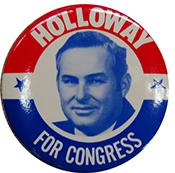
Historical · U.S. House · Louisiana · District 8
Clyde Holloway
Former U.S. Representative · Louisiana District 8 · 1987–1993 · Republican
Clyde Holloway represented Louisiana's District 8 in the United States House of Representatives (1987–1993) for the Republican party. The page below collects sourced biographical facts, term history, committee roles, and provenance for Holloway.
Bioguide ID: H000729
Key facts
- Full name
- Clyde Holloway
- State
- Louisiana
- District
- District 8
- Party
- Republican
- House service
- 1987–1993
- First House term
- 1987
- Status
- Left office
- Current term ends
- —
- Born
- 1943
- Bioguide ID
- H000729
- Committee assignments
- —
- Dataset version
- 1.20260605
Biographical narrative
1,075 words · sourced from the Wikipedia REST extract
Clyde Holloway was an American politician and businessman who served as a U.S. Representative for Louisiana's 8th congressional district from 1987 until 1993. A member of the Republican Party, Holloway's political career was marked by his involvement in local business ventures, his controversial stances on education and desegregation, and his subsequent service on the Louisiana Public Service Commission. His life and career reflected the complexities of Louisiana's political landscape during a time of significant social change.
Early life and career
Clyde Cecil Holloway was born on November 28, 1943, in Louisiana to James and Ever Holloway. He was the fourth of seven children in his family, which provided him with a strong sense of community and family values that would later influence his political career. After completing his education, Holloway ventured into the business world, establishing the Clyde Holloway Nursery in 1968 alongside his wife, Catherine K. Holloway. This nursery became a significant part of their lives and served as a foundation for their entrepreneurial endeavors.
In addition to the nursery, the couple operated the Forest Hill Speedway for over twenty years. This involvement in local business not only provided them with financial stability but also helped Holloway build connections within the community. His experiences as a small business owner likely shaped his views on economic issues and government regulation, which would later inform his legislative priorities.
Holloway first gained public attention in the early 1980s when he became a prominent figure in an anti-bussing movement in Rapides Parish. This movement arose in response to a federal court's desegregation order aimed at integrating local schools. Holloway led a group of concerned white parents who opposed the court's decision, arguing that it would negatively impact their children's education. In a controversial act, he and his supporters seized a local elementary school that was slated for closure and operated it independently for their children. This act of defiance drew significant media attention and highlighted the tensions surrounding desegregation in the South during this period.
His public statements during this time were polarizing. Holloway expressed skepticism about the federal government's willingness to enforce desegregation, suggesting that federal marshals would not intervene in local matters. His rhetoric and actions drew both support and criticism, as many viewed his approach as a betrayal of the principles of equality and justice. Following his failure to halt the desegregation order, Holloway and his wife established the Forrest Hill Academy, a private school that served as a segregation academy, which they operated until its closure in 2004.
Holloway's early political endeavors included a campaign for Congress in which he ran against incumbent Gillis Long. Despite his efforts, he lost the election by a significant margin, garnering less than half of the votes. This initial defeat did not deter him from pursuing a political career, and he continued to engage with the community on various issues.
House tenure
Clyde Holloway successfully won election to the U.S. House of Representatives in 1986, representing Louisiana's 8th congressional district as a Republican. His tenure in Congress began in 1987 and lasted until January 3, 1993. During this time, he was re-elected two additional times, demonstrating a degree of support from his constituents despite the controversies that surrounded his earlier political activities.
Holloway's time in the House was characterized by his alignment with the Republican Party's values and priorities. His legislative efforts often reflected the interests of his constituents, particularly those in rural Louisiana. As a member of Congress, he participated in various debates and discussions on issues ranging from education to economic development, aiming to address the needs of his district.
In 1992, Holloway faced redistricting, which altered the boundaries of his congressional district. This change placed him in Louisiana's 6th congressional district, where he ran for re-election. Although he initially won the first round of voting against Richard Baker, he ultimately lost in the runoff election, receiving a narrow percentage of the vote. This defeat marked the end of his congressional career, but it did not signify the conclusion of his involvement in public service.
In addition to his congressional service, Holloway sought higher office in the 1991 gubernatorial race. He participated in the jungle primary, where multiple candidates compete without party affiliation. However, he finished a distant fourth, trailing behind notable figures such as Governor Buddy Roemer, former Ku Klux Klan wizard David Duke, and Edwin Edwards, who ultimately won the election. This gubernatorial bid reflected Holloway's continued ambition in Louisiana politics, even as he faced challenges in securing electoral victories.
Legislative focus and committees
During his time in the U.S. House of Representatives, Clyde Holloway was involved in various legislative initiatives and committee assignments that aligned with his political beliefs and the interests of his constituents. While specific details regarding the bills he sponsored or supported are not available, it is known that he focused on issues pertinent to his district, including economic development, education, and local governance.
Holloway's background as a small business owner likely influenced his approach to economic policy. He may have advocated for legislation that supported small businesses, reduced regulations, and promoted economic growth within Louisiana. His experiences in the nursery and speedway businesses provided him with insights into the challenges faced by entrepreneurs, which may have informed his legislative priorities.
Education was another critical area of focus for Holloway, particularly given his controversial history with desegregation and the establishment of the Forrest Hill Academy. His views on education were shaped by his experiences and the political climate of Louisiana during his early career. While he faced criticism for his earlier actions, it is possible that he sought to address educational issues from a different perspective during his congressional tenure.
Holloway's involvement in local governance and public service extended beyond his time in Congress. After leaving the House, he continued to serve the public as a member of the Louisiana Public Service Commission, a role he held from 2009 until his death in 2016. He eventually became the chairman of the commission, overseeing critical regulatory functions related to utilities and public services in Louisiana.
Clyde Holloway passed away on October 16, 2016, leaving behind a complex legacy shaped by his business endeavors, political career, and public service. His life reflected the evolving political landscape of Louisiana, marked by both challenges and opportunities for engagement in public affairs. He was buried with a memorial arrangement at Forest Hill Town Hall, honoring his contributions to the community he served.
Notable legislation
Sponsored and co-sponsored legislation for Clyde Holloway is pending operator curation. The biographical narrative above carries the same provenance trail until per-bill rows are written.
Sources
- [1]https://en.wikipedia.org/wiki/Clyde_C._HollowayWikipedia · retrieved 2026-06-05
Notable quotes
Sourced quotes for Clyde Holloway are pending operator curation. Narrative-scope provenance remains attached below.
Sources
- [1]https://en.wikipedia.org/wiki/Clyde_C._HollowayWikipedia · retrieved 2026-06-05
Key positions
Curated policy positions for Clyde Holloway are pending operator review. The biographical narrative above carries the same provenance trail until per-topic positions are written.
Sources
- [1]https://en.wikipedia.org/wiki/Clyde_C._HollowayWikipedia · retrieved 2026-06-05
Terms served
- 1987–1989U.S. House · Term 1 · Republican
- 1989–1991U.S. House · Term 2 · Republican
- 1991–1993U.S. House · Term 3 · Republican
Sources & provenance
Every attributable claim above carries a per-section [N] marker that resolves to the corresponding URL below. Each entry records the upstream provider, the canonical URL, and the timestamp at which the source was retrieved by the ingest pipeline.
Key facts
- https://bioguide.congress.gov/search/bio/H000729bioguide · retrieved 2026-06-05
- https://www.govtrack.us/congress/members/405580govtrack · retrieved 2026-06-05
Biographical narrative
- https://en.wikipedia.org/wiki/Clyde_C._Hollowaywikipedia · retrieved 2026-06-05
Find your representative
Every U.S. state elects representatives by district. Browse Louisiana’s delegation, the full former-representative roster, or explore the role and term length.
Related on The Candidate
- Preceded by Catherine LongEarlier holder of the Louisiana District 8 House seat · Democratic.Open
- Adolph MeyerFormer U.S. Representative · Louisiana District 1 · DemocraticOpen
- Albert EstopinalFormer U.S. Representative · Louisiana District 1 · DemocraticOpen
- Benjamin FlandersFormer U.S. Representative · Louisiana District 1 · UnionistOpen
- Bobby JindalFormer U.S. Representative · Louisiana District 1 · RepublicanOpen
- Republican PartyFederal candidates and office holders on the Republican line.Open