
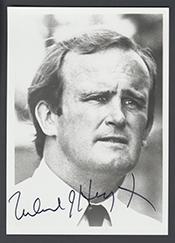
Historical · U.S. House · Massachusetts · District 6
Michael Harrington
Former U.S. Representative · Massachusetts District 6 · 1969–1979 · Democratic
Michael Harrington represented Massachusetts's District 6 in the United States House of Representatives (1969–1979) for the Democratic party. The page below collects sourced biographical facts, term history, committee roles, and provenance for Harrington.
Bioguide ID: H000230
Key facts
- Full name
- Michael Harrington
- State
- Massachusetts
- District
- District 6
- Party
- Democratic
- House service
- 1969–1979
- First House term
- 1969
- Status
- Left office
- Current term ends
- —
- Born
- 1936
- Bioguide ID
- H000230
- Committee assignments
- —
- Dataset version
- 1.20260605
Biographical narrative
839 words · sourced from the Wikipedia REST extract
Michael J. Harrington is a former U.S. Representative who served Massachusetts's 6th congressional district as a member of the Democratic Party. His tenure in the House of Representatives spanned from 1969 to 1979, during which he was known for his opposition to the Vietnam War and his involvement in various legislative issues. Harrington's political career was preceded by a background in law and local government, and he has remained active in civic matters following his retirement from Congress.
Early life and career
Michael Joseph Harrington was born on September 2, 1936. He is the son of Joseph B. Harrington, who had a notable career as a state senator, mayor of Salem, and a judge. This familial background likely influenced Harrington's early interest in public service and law. He completed his secondary education at St. John's Preparatory School in Danvers, Massachusetts, graduating in 1954. Harrington then pursued higher education at Harvard University, where he earned a Bachelor of Arts degree in 1958. Following this, he attended Harvard Law School, obtaining his Juris Doctor degree in 1961.
Harrington's political career began at the local level when he served on the Salem City Council from 1960 to 1963. His involvement in local governance laid the groundwork for his subsequent election to the Massachusetts State Legislature in 1964, where he served until 1969. His experience in state politics provided him with a solid foundation for his future role in the U.S. Congress.
In 1969, Harrington entered the national political arena by winning a special election to fill the vacancy left by the death of U.S. Representative William H. Bates. He successfully defeated Republican state Senator William L. Saltonstall, securing 52% of the vote. This victory was significant as it marked the first time a Democrat had won the 6th Congressional District since 1875, reflecting a shift in the political landscape of the region.
House tenure
Harrington's first term in the House of Representatives began in 1969, and he would go on to serve a total of five terms until his retirement in 1979. His election came during a period of considerable national turmoil, particularly due to the ongoing Vietnam War. Harrington was vocal in his opposition to the war, which resonated with many constituents who were disillusioned with U.S. involvement in Vietnam. His stance on this issue was a defining aspect of his political identity and contributed to his electoral success.
During his time in Congress, Harrington was involved in various legislative initiatives and discussions. He was known for advocating for transparency and accountability in government operations. For instance, in 1975, he called on House Speaker Carl Albert to convene a committee to investigate what he described as a secrecy system that had obscured serious violations of the law by the CIA. This move highlighted his commitment to oversight and ethical governance, particularly concerning intelligence operations.
Harrington's tenure was marked by a focus on civil liberties and social justice, aligning with the broader Democratic platform of the time. He was part of a generation of lawmakers who sought to address issues related to civil rights, social welfare, and government accountability. His efforts in Congress contributed to the ongoing dialogue about the role of government in American society and the importance of protecting individual rights.
Legislative focus and committees
Throughout his congressional career, Harrington served on various committees that aligned with his interests and the needs of his constituents. His legislative focus included issues related to civil rights, social justice, and government oversight. He was particularly concerned with the implications of U.S. foreign policy, especially in Latin America, where he sought to shed light on the actions of the CIA and other governmental bodies.
Harrington's advocacy for transparency was evident when he publicly addressed the CIA's involvement in foreign political affairs. His efforts to expose the agency's spending to influence Chilean politics in the early 1970s garnered attention and sparked discussions about the ethical implications of such actions. This commitment to accountability was a hallmark of his legislative approach, demonstrating his belief in the necessity of oversight in government operations.
After serving five terms in the House, Harrington chose not to seek re-election in 1978, concluding his congressional career in January 1979. Following his departure from Congress, he transitioned into the private sector, becoming a real estate developer. His post-congressional career included a brief attempt to secure the Democratic nomination for Massachusetts State Treasurer in 1990.
In the years following his retirement, Harrington faced legal challenges, including charges in 2000 for making false statements to financial institutions. This resulted in a suspension of his law license for three years and a financial penalty. Despite these challenges, he has remained engaged in civic activities and is a member of the ReFormers Caucus of Issue One, an organization focused on promoting political reform.
Harrington resides in Beverly, Massachusetts, where he continues to be involved in community and civic matters. His career reflects a commitment to public service and a dedication to addressing the pressing issues of his time, both in Congress and beyond.
Notable legislation
Sponsored and co-sponsored legislation for Michael Harrington is pending operator curation. The biographical narrative above carries the same provenance trail until per-bill rows are written.
Sources
- [1]https://en.wikipedia.org/wiki/Michael_J._HarringtonWikipedia · retrieved 2026-06-05
Notable quotes
Sourced quotes for Michael Harrington are pending operator curation. Narrative-scope provenance remains attached below.
Sources
- [1]https://en.wikipedia.org/wiki/Michael_J._HarringtonWikipedia · retrieved 2026-06-05
Key positions
Curated policy positions for Michael Harrington are pending operator review. The biographical narrative above carries the same provenance trail until per-topic positions are written.
Sources
- [1]https://en.wikipedia.org/wiki/Michael_J._HarringtonWikipedia · retrieved 2026-06-05
Terms served
- 1969–1971U.S. House · Term 1 · Democratic
- 1971–1973U.S. House · Term 2 · Democratic
- 1973–1975U.S. House · Term 3 · Democratic
- 1975–1977U.S. House · Term 4 · Democratic
- 1977–1979U.S. House · Term 5 · Democratic
Sources & provenance
Every attributable claim above carries a per-section [N] marker that resolves to the corresponding URL below. Each entry records the upstream provider, the canonical URL, and the timestamp at which the source was retrieved by the ingest pipeline.
Key facts
- https://bioguide.congress.gov/search/bio/H000230bioguide · retrieved 2026-06-05
- https://www.govtrack.us/congress/members/405108govtrack · retrieved 2026-06-05
Biographical narrative
- https://en.wikipedia.org/wiki/Michael_J._Harringtonwikipedia · retrieved 2026-06-05
Find your representative
Every U.S. state elects representatives by district. Browse Massachusetts’s delegation, the full former-representative roster, or explore the role and term length.
Related on The Candidate
- Preceded by George BatesEarlier holder of the Massachusetts District 6 House seat · Republican.Open
- Succeeded by Nicholas MavroulesLater holder of the Massachusetts District 6 House seat · Democratic.Open
- Abbott LawrenceFormer U.S. Representative · Massachusetts District 1 · WhigOpen
- Allen TreadwayFormer U.S. Representative · Massachusetts District 1 · RepublicanOpen
- Artemas Ward Jr.Former U.S. Representative · Massachusetts District 1 · FederalistOpen
- Ashley WrightFormer U.S. Representative · Massachusetts District 1 · RepublicanOpen