
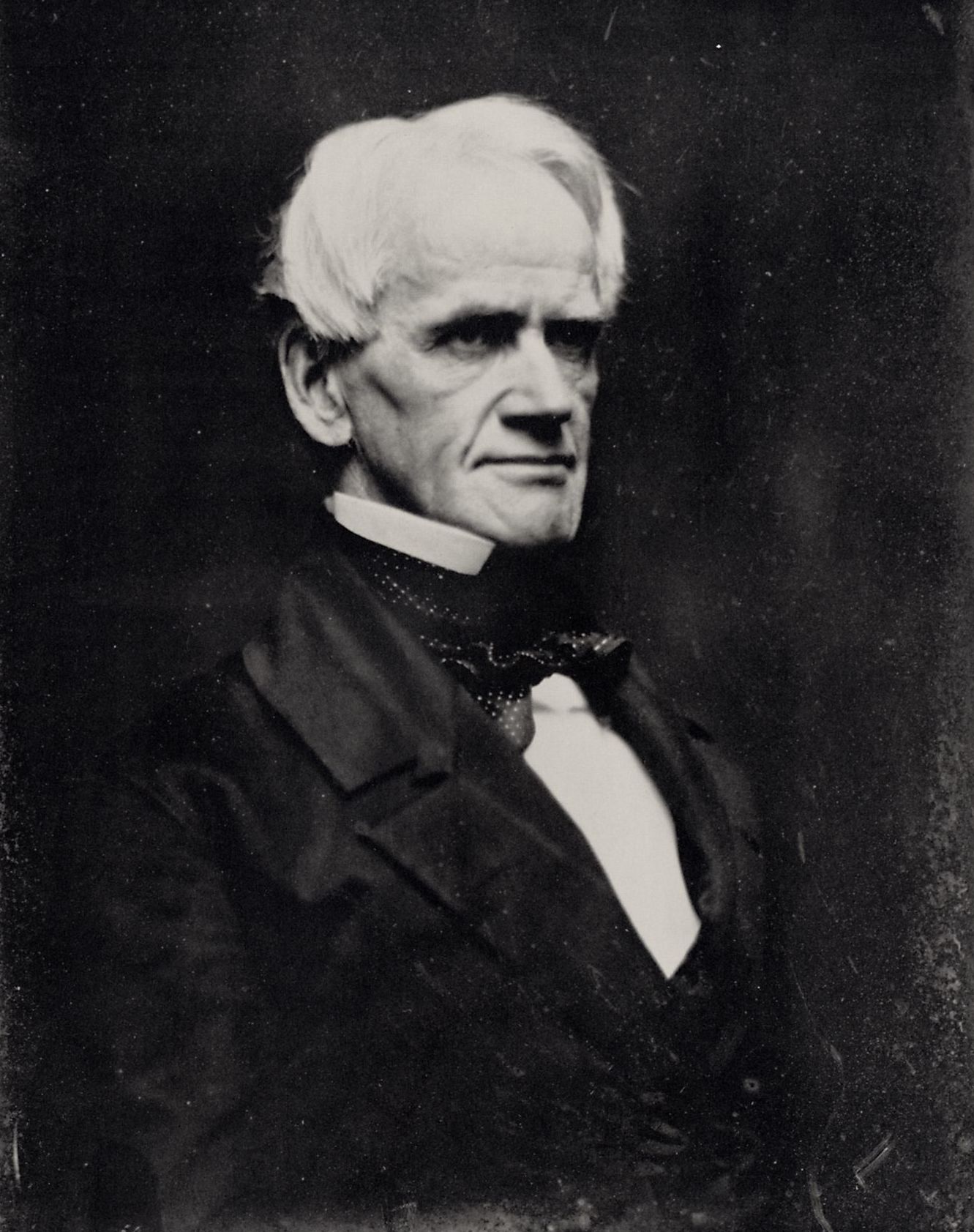
Historical · U.S. House · Massachusetts · District 8
Horace Mann
Former U.S. Representative · Massachusetts District 8 · 1847–1853 · Free Soil
Horace Mann represented Massachusetts's District 8 in the United States House of Representatives (1847–1853) for the Free Soil party. The page below collects sourced biographical facts, term history, committee roles, and provenance for Mann.
Bioguide ID: M000102
Key facts
- Full name
- Horace Mann
- State
- Massachusetts
- District
- District 8
- Party
- Free Soil
- House service
- 1847–1853
- First House term
- 1847
- Status
- Left office
- Current term ends
- —
- Born
- 1796
- Bioguide ID
- M000102
- Committee assignments
- —
- Dataset version
- 1.20260606
Biographical narrative
899 words · sourced from the Wikipedia REST extract
Horace Mann was an influential American educational reformer, abolitionist, and politician who served as a U.S. Representative for Massachusetts's 8th congressional district. A member of the Free Soil Party, Mann's tenure in the House of Representatives spanned from 1848 to 1853. He is often referred to as the "Father of American Education" due to his significant contributions to the establishment of public education systems in the United States. His advocacy for universal public education and the training of professional teachers laid the groundwork for modern educational practices and policies.
Early life and career
Horace Mann was born on May 4, 1796, in Franklin, Massachusetts. He was a descendant of Samuel Mann and grew up in a family that valued education, despite his own limited formal schooling during his early years. From the age of ten to twenty, Mann attended school for only a few weeks each year, yet he took advantage of the Franklin Public Library, which was notable as the first public library in America. This early exposure to literature and learning fostered his belief in the importance of education as a fundamental aspect of a healthy childhood.
At the age of twenty, Mann enrolled at Brown University, where he distinguished himself academically and graduated as valedictorian in 1819. His oration at graduation focused on the theme of the progressive nature of humanity. Following his graduation, Mann briefly studied law in Wrentham, Massachusetts, and also served as a tutor in Latin and Greek at Brown University. He furthered his legal education at Litchfield Law School and was admitted to the bar in 1823 in Dedham, Massachusetts.
Mann's legal career included notable cases, such as defending James Allen in a robbery trial, where he successfully argued for reasonable doubt, resulting in a hung jury. His early involvement in the Massachusetts legislature began in 1827, where he became an advocate for education, public charities, and social reforms, including the suppression of alcohol and lotteries. During his time in the legislature, Mann was instrumental in establishing an asylum in Worcester and served as chairman of its board of trustees. His legislative career continued as he was elected to the Massachusetts State Senate in 1835, where he focused on infrastructure improvements, including funding for railroads and canals.
Mann's personal life included two marriages. His first wife, Charlotte Messer, passed away in 1832, a loss that profoundly affected him. In 1843, he married Mary Tyler Peabody, and the couple had three sons. Their family life was marked by a shared commitment to education and social reform.
House tenure
Horace Mann's congressional career began when he was elected to the United States House of Representatives in 1848. He served three terms, concluding his service on March 3, 1853. During his time in the House, Mann was a member of the Free Soil Party, which opposed the expansion of slavery into the territories of the United States. His political activities were closely aligned with his commitment to social justice and educational reform.
Mann's tenure in Congress was characterized by his advocacy for educational initiatives and his efforts to promote the values of the Free Soil Party. He sought to address issues related to public education, recognizing the critical role that education played in fostering a democratic society. His legislative efforts were informed by his extensive experience in education reform at the state level, where he had already established himself as a leading figure in the movement for public schooling.
Mann's work in the House was part of a broader commitment to social reform, which included his opposition to slavery and his support for the rights of marginalized groups. His time in Congress allowed him to further his vision of a more equitable society through education and legislative action.
Legislative focus and committees
Throughout his congressional career, Horace Mann maintained a strong focus on education and social reform. His background as an educational reformer informed his legislative priorities, and he sought to promote policies that would expand access to education for all children in the United States. Mann's advocacy for public education was rooted in the belief that a well-educated populace was essential for the health of democracy and the economy.
Mann's efforts in the House included support for measures that would establish and fund public schools, as well as initiatives aimed at training professional teachers. His experiences as Secretary of the Massachusetts Board of Education had provided him with a comprehensive understanding of the challenges and opportunities in the field of education, and he sought to apply this knowledge at the national level.
In addition to his focus on education, Mann was also involved in broader social issues, including the abolition of slavery. His commitment to the principles of the Free Soil Party reflected his belief in the importance of social justice and equality. Mann's legislative work was characterized by a desire to create a more inclusive society, where education was accessible to all, regardless of background or circumstance.
After leaving Congress, Mann continued to influence the field of education as President of Antioch College from 1852 until his death in 1859. His legacy as a pioneer of public education and a champion for social reform remains significant in American history. Mann's contributions to the establishment of public education systems and his advocacy for the rights of all individuals have had a lasting impact on the educational landscape of the United States.
Notable legislation
Sponsored and co-sponsored legislation for Horace Mann is pending operator curation. The biographical narrative above carries the same provenance trail until per-bill rows are written.
Sources
- [1]https://en.wikipedia.org/wiki/Horace_MannWikipedia · retrieved 2026-06-06
Notable quotes
Sourced quotes for Horace Mann are pending operator curation. Narrative-scope provenance remains attached below.
Sources
- [1]https://en.wikipedia.org/wiki/Horace_MannWikipedia · retrieved 2026-06-06
Key positions
Curated policy positions for Horace Mann are pending operator review. The biographical narrative above carries the same provenance trail until per-topic positions are written.
Sources
- [1]https://en.wikipedia.org/wiki/Horace_MannWikipedia · retrieved 2026-06-06
Terms served
- 1847–1849U.S. House · Term 1 · Whig
- 1849–1851U.S. House · Term 2 · Whig
- 1851–1853U.S. House · Term 3 · Free Soil
Sources & provenance
Every attributable claim above carries a per-section [N] marker that resolves to the corresponding URL below. Each entry records the upstream provider, the canonical URL, and the timestamp at which the source was retrieved by the ingest pipeline.
Key facts
- https://bioguide.congress.gov/search/bio/M000102bioguide · retrieved 2026-06-06
- https://www.govtrack.us/congress/members/407126govtrack · retrieved 2026-06-06
Biographical narrative
- https://en.wikipedia.org/wiki/Horace_Mannwikipedia · retrieved 2026-06-06
Find your representative
Every U.S. state elects representatives by district. Browse Massachusetts’s delegation, the full former-representative roster, or explore the role and term length.
Related on The Candidate
- Preceded by William CalhounEarlier holder of the Massachusetts District 8 House seat · Whig.Open
- Succeeded by Tappan WentworthLater holder of the Massachusetts District 8 House seat · Whig.Open
- Abbott LawrenceFormer U.S. Representative · Massachusetts District 1 · WhigOpen
- Allen TreadwayFormer U.S. Representative · Massachusetts District 1 · RepublicanOpen
- Artemas Ward Jr.Former U.S. Representative · Massachusetts District 1 · FederalistOpen
- Ashley WrightFormer U.S. Representative · Massachusetts District 1 · RepublicanOpen