
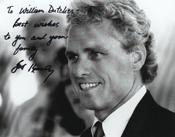
Historical · U.S. House · Massachusetts · District 8
Joseph Kennedy II
Former U.S. Representative · Massachusetts District 8 · 1987–1999 · Democratic
Joseph Kennedy II represented Massachusetts's District 8 in the United States House of Representatives (1987–1999) for the Democratic party. The page below collects sourced biographical facts, term history, committee roles, and provenance for II.
Bioguide ID: K000110
Key facts
- Full name
- Joseph Kennedy II
- State
- Massachusetts
- District
- District 8
- Party
- Democratic
- House service
- 1987–1999
- First House term
- 1987
- Status
- Left office
- Current term ends
- —
- Born
- 1952
- Bioguide ID
- K000110
- Committee assignments
- —
- Dataset version
- 1.20260605
Biographical narrative
1,003 words · sourced from the Wikipedia REST extract
Joseph P. Kennedy II is a former U.S. Representative who served Massachusetts's 8th congressional district from 1987 until 1999. A member of the prominent Kennedy family, he is the son of Robert F. Kennedy and Ethel Kennedy, and the nephew of former President John F. Kennedy. Kennedy is known for his involvement in various legislative initiatives aimed at improving housing and consumer credit access, as well as his leadership in nonprofit energy initiatives prior to his congressional career.
Early life and career
Joseph Patrick Kennedy II was born on September 24, 1952, in the Brighton neighborhood of Boston, Massachusetts. He was the second of eleven children born to Robert F. Kennedy, a former U.S. Attorney General, and Ethel Kennedy. His family is well-known in American political history, with his uncle John F. Kennedy having served as President and his uncle Ted Kennedy as a long-serving U.S. Senator. Joseph was named after his grandfather, Joseph P. Kennedy Sr., and his uncle, Joseph P. Kennedy Jr., who died during World War II.
Kennedy's early life was marked by a series of challenges, including a troubled youth characterized by a quick temper and conflicts with peers. He experienced significant personal loss when his father was assassinated in 1968, an event that profoundly impacted him and his family. Kennedy's educational journey was unconventional; he was expelled from several private schools and ultimately dropped out of Milton Academy when he was not permitted to take time off to assist with his uncle Ted's Senate campaign. He later completed his high school education at Manter Hall, a tutoring school in Cambridge, Massachusetts, in 1971.
After high school, Kennedy briefly attended the University of California, Berkeley, but left before completing his studies. Following a serious car accident in 1973, he returned to academia and earned a Bachelor of Arts degree from the University of Massachusetts Boston in 1976. During his time away from college, he worked on a federally funded program aimed at combating tuberculosis in San Francisco's African American community, where he received commendation for his contributions.
In 1979, Kennedy founded Citizens Energy Corporation, a nonprofit organization designed to provide discounted heating oil to low-income and elderly families in Massachusetts. This initiative arose during an oil crisis, and by the mid-1980s, the organization was assisting approximately 250,000 families. Under Kennedy's leadership, Citizens Energy later evolved to focus on renewable energy solutions while continuing to support low-income families.
House tenure
Kennedy entered the political arena when he ran for the U.S. House of Representatives in 1986, following the announcement of retirement by long-serving incumbent Tip O'Neill. The 8th congressional district, a Democratic stronghold encompassing areas of Boston and Cambridge, was historically significant, having been represented by his uncle John F. Kennedy. Kennedy faced a competitive primary against several notable Democrats, including state senator George Bachrach and state representative Mel King. With endorsements from influential figures such as O'Neill and The Boston Globe, he secured the Democratic nomination with a majority of the primary vote. In the subsequent general election, he won decisively, marking the beginning of his six terms in Congress.
During his time in the House, Kennedy was active in various legislative efforts aimed at addressing economic and social issues. His work included initiatives to expand access to credit for working Americans, enabling them to purchase homes and start businesses. He advocated for transparency in bank lending practices, particularly in economically disadvantaged neighborhoods, which revealed systemic discrimination in mortgage approvals based on race and income. This advocacy led to significant studies by the Federal Reserve that highlighted disparities in lending practices.
Kennedy was instrumental in the creation of hundreds of thousands of affordable housing units across the nation. He introduced tax credits designed to stimulate private investment in housing developments, particularly in light of substantial cuts to federal housing assistance during the 1980s. His leadership extended to chairing the House Banking subcommittee on consumer credit and insurance, where he held hearings to address the lack of access to insurance in low-income areas.
In addition to housing and credit issues, Kennedy proposed a balanced-budget amendment to the U.S. Constitution, aiming to address rising deficits and promote economic growth. He also worked on overhauling federal public housing laws, empowering local housing authorities to improve standards while safeguarding the needs of public housing residents.
Kennedy's legislative focus included biotechnology, where he co-chaired the U.S. congressional biotechnology caucus. He advocated for the preservation and expansion of federal research and development funding to foster technological innovation and job creation. Furthermore, he introduced the "Mom and Pop Protection Act," which aimed to assist small corner-store owners in enhancing safety measures within their establishments.
Legislative focus and committees
Throughout his tenure in the U.S. House of Representatives, Kennedy served on several committees that aligned with his legislative priorities. His work on the House Banking Committee allowed him to influence policies related to consumer credit, housing, and insurance. He utilized his position to advocate for reforms that would benefit low-income families and promote equitable access to financial resources.
Kennedy's commitment to social justice and economic equity was evident in his legislative initiatives. He sought to address systemic issues that affected marginalized communities, particularly in the realms of housing and financial services. His efforts to increase the availability of affordable housing and improve lending practices were part of a broader agenda aimed at fostering economic opportunity for all Americans.
In addition to his legislative work, Kennedy's background in nonprofit leadership and community service informed his approach to governance. His experiences with Citizens Energy Corporation provided him with insights into the challenges faced by low-income families, which he translated into actionable policies during his time in Congress.
Kennedy's congressional career concluded in January 1999, after serving six terms in the House. His legislative contributions and focus on consumer rights, housing, and social equity left a lasting impact on the policies he championed. Following his departure from Congress, Kennedy continued to engage in business and philanthropic endeavors, building on the legacy of service established by his family.
Notable legislation
Sponsored and co-sponsored legislation for Joseph Kennedy II is pending operator curation. The biographical narrative above carries the same provenance trail until per-bill rows are written.
Sources
- [1]https://en.wikipedia.org/wiki/Joseph_P._Kennedy_IIWikipedia · retrieved 2026-06-05
Notable quotes
Sourced quotes for Joseph Kennedy II are pending operator curation. Narrative-scope provenance remains attached below.
Sources
- [1]https://en.wikipedia.org/wiki/Joseph_P._Kennedy_IIWikipedia · retrieved 2026-06-05
Key positions
Curated policy positions for Joseph Kennedy II are pending operator review. The biographical narrative above carries the same provenance trail until per-topic positions are written.
Sources
- [1]https://en.wikipedia.org/wiki/Joseph_P._Kennedy_IIWikipedia · retrieved 2026-06-05
Terms served
- 1987–1989U.S. House · Term 1 · Democratic
- 1989–1991U.S. House · Term 2 · Democratic
- 1991–1993U.S. House · Term 3 · Democratic
- 1993–1995U.S. House · Term 4 · Democratic
- 1995–1997U.S. House · Term 5 · Democratic
- 1997–1999U.S. House · Term 6 · Democratic
Sources & provenance
Every attributable claim above carries a per-section [N] marker that resolves to the corresponding URL below. Each entry records the upstream provider, the canonical URL, and the timestamp at which the source was retrieved by the ingest pipeline.
Key facts
- https://bioguide.congress.gov/search/bio/K000110bioguide · retrieved 2026-06-05
- https://www.govtrack.us/congress/members/406277govtrack · retrieved 2026-06-05
Biographical narrative
- https://en.wikipedia.org/wiki/Joseph_P._Kennedy_IIwikipedia · retrieved 2026-06-05
Find your representative
Every U.S. state elects representatives by district. Browse Massachusetts’s delegation, the full former-representative roster, or explore the role and term length.
Related on The Candidate
- Preceded by Tip O’Neill Jr.Earlier holder of the Massachusetts District 8 House seat · Democratic.Open
- Abbott LawrenceFormer U.S. Representative · Massachusetts District 1 · WhigOpen
- Allen TreadwayFormer U.S. Representative · Massachusetts District 1 · RepublicanOpen
- Artemas Ward Jr.Former U.S. Representative · Massachusetts District 1 · FederalistOpen
- Ashley WrightFormer U.S. Representative · Massachusetts District 1 · RepublicanOpen
- Democratic PartyFederal candidates and office holders on the Democratic line.Open