
Historical · U.S. House · Michigan · District 12
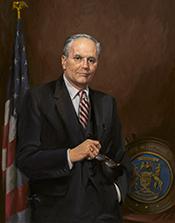
John Dingell
Former U.S. Representative · Michigan District 12 · 1955–2015 · Democratic
John Dingell represented Michigan's District 12 in the United States House of Representatives (1955–2015) for the Democratic party. The page below collects sourced biographical facts, term history, committee roles, and provenance for Dingell.
Bioguide ID: D000355
Key facts
- Full name
- John Dingell
- State
- Michigan
- District
- District 12
- Party
- Democratic
- House service
- 1955–2015
- First House term
- 1955
- Status
- Left office
- Current term ends
- —
- Born
- 1926
- Bioguide ID
- D000355
- Committee assignments
- —
- Dataset version
- 1.20260605
Biographical narrative
950 words · sourced from the Wikipedia REST extract
John D. Dingell was a prominent American politician who served as a U.S. Representative for Michigan's 12th congressional district from 1955 until 2015. A member of the Democratic Party, Dingell is recognized as the longest-serving member of Congress in the history of the United States, with a tenure that spanned six decades. His legislative career was marked by significant contributions to various landmark laws, particularly in the areas of healthcare, civil rights, and environmental protection. Dingell's legacy is characterized by his deep commitment to public service and his influence on American legislative processes.
Early life and career
John David Dingell Jr. was born on July 8, 1926, in Colorado Springs, Colorado. He was the son of Grace Bigler and John Dingell Sr., who was a member of Congress himself. The family relocated to Michigan when Dingell was young, as his father sought treatment for tuberculosis. John Dingell Sr. became the first representative of Michigan's newly established 15th District in 1932, setting the stage for his son's future in politics.
Dingell's early education included attendance at Georgetown Preparatory School and the House Page School, where he served as a page in the U.S. House of Representatives from 1938 to 1943. His time in the House allowed him to witness significant historical events, including President Franklin D. Roosevelt's speech following the bombing of Pearl Harbor. In 1944, at the age of 18, Dingell enlisted in the United States Army, where he achieved the rank of second lieutenant. He was slated to participate in the first wave of a planned invasion of Japan, but the use of atomic bombs to end the war ultimately altered those plans.
Following his military service, Dingell pursued higher education at Georgetown University in Washington, D.C. He earned a Bachelor of Science degree in chemistry in 1949 and later a Juris Doctor in 1952. His early career included various roles, such as a lawyer in private practice, a research assistant to a U.S. District Court judge, a congressional employee, a forest ranger, and an assistant prosecuting attorney for Wayne County. His diverse experiences laid a strong foundation for his subsequent political career.
House tenure
Dingell was sworn into the U.S. House of Representatives on December 13, 1955, succeeding his father. Over the course of his 30 congressional terms, he became a significant figure in American politics. His tenure was marked by a commitment to progressive policies and social welfare measures. Dingell was a long-standing member of the House Energy and Commerce Committee, where he served as chair during two separate periods, from 1981 to 1995 and again from 2007 to 2009. He also held the title of Dean of the House of Representatives from 1995 until his retirement in 2015.
Throughout his time in Congress, Dingell was instrumental in the passage of numerous key pieces of legislation. He played a critical role in the enactment of the Medicare Act, which expanded healthcare access for seniors, as well as the Water Quality Act of 1965 and the Clean Water Act of 1972, both of which aimed to improve environmental standards. Additionally, Dingell was involved in the development of the Endangered Species Act of 1973 and the Clean Air Act of 1990, reflecting his commitment to environmental protection.
Dingell's legislative efforts extended to civil rights as well. He supported several significant civil rights bills, including the Civil Rights Act of 1964, which aimed to end segregation and discrimination based on race, color, religion, sex, or national origin. His voting record included support for the 1957 Civil Rights Act, the Civil Rights Act of 1960, and the Voting Rights Act of 1965, showcasing his dedication to advancing civil rights in America.
In 2014, Dingell announced that he would not seek reelection for a 31st term, concluding his historic tenure in Congress. His wife, Debbie Dingell, successfully ran for his seat in the subsequent election. Dingell's contributions to American politics were recognized when he was awarded the Presidential Medal of Freedom by President Barack Obama in the same year.
Legislative focus and committees
Dingell's legislative focus was characterized by a commitment to social welfare and progressive policies, reflecting the values of his constituents in Michigan's working-class district. He was a strong advocate for organized labor and consistently supported measures aimed at improving the lives of working families. Throughout his career, Dingell introduced legislation for a national health insurance system, a continuation of the efforts initiated by his father during his own congressional tenure.
While Dingell was generally classified as a moderately liberal member of the Democratic Party, he also held positions that resonated with the more conservative elements of his constituency. For example, he supported the Vietnam War until 1971 and took a moderate stance on issues such as abortion. His approach to environmental legislation often sought to balance the need for clean air and water with the economic realities faced by Michigan's manufacturing sector.
Dingell's relationship with the National Rifle Association (NRA) was notable; he opposed gun control measures and received high ratings from the organization for many years. He played a significant role in ensuring that firearms were exempt from the Consumer Product Safety Act of 1972, which limited the authority of the Consumer Product Safety Commission over defective guns. This exemption remained a point of contention, particularly following his retirement, as his wife introduced legislation to remove it.
Throughout his extensive career, Dingell's legislative initiatives and committee work reflected a deep commitment to the principles of social justice, environmental protection, and healthcare access. His legacy as a long-serving member of Congress is marked by his influence on pivotal legislation that shaped American society in the latter half of the 20th century and into the 21st century.
Notable legislation
Sponsored and co-sponsored legislation for John Dingell is pending operator curation. The biographical narrative above carries the same provenance trail until per-bill rows are written.
Sources
- [1]https://en.wikipedia.org/wiki/John_DingellWikipedia · retrieved 2026-06-05
Notable quotes
Sourced quotes for John Dingell are pending operator curation. Narrative-scope provenance remains attached below.
Sources
- [1]https://en.wikipedia.org/wiki/John_DingellWikipedia · retrieved 2026-06-05
Key positions
Curated policy positions for John Dingell are pending operator review. The biographical narrative above carries the same provenance trail until per-topic positions are written.
Sources
- [1]https://en.wikipedia.org/wiki/John_DingellWikipedia · retrieved 2026-06-05
Terms served
- 1955–1957U.S. House · Term 1 · Democratic
- 1957–1959U.S. House · Term 2 · Democratic
- 1959–1961U.S. House · Term 3 · Democratic
- 1961–1963U.S. House · Term 4 · Democratic
- 1963–1965U.S. House · Term 5 · Democratic
- 1965–1967U.S. House · Term 6 · Democratic
- 1967–1969U.S. House · Term 7 · Democratic
- 1969–1971U.S. House · Term 8 · Democratic
- 1971–1973U.S. House · Term 9 · Democratic
- 1973–1975U.S. House · Term 10 · Democratic
- 1975–1977U.S. House · Term 11 · Democratic
- 1977–1979U.S. House · Term 12 · Democratic
- 1979–1981U.S. House · Term 13 · Democratic
- 1981–1983U.S. House · Term 14 · Democratic
- 1983–1985U.S. House · Term 15 · Democratic
- 1985–1987U.S. House · Term 16 · Democratic
- 1987–1989U.S. House · Term 17 · Democratic
- 1989–1991U.S. House · Term 18 · Democratic
- 1991–1993U.S. House · Term 19 · Democratic
- 1993–1995U.S. House · Term 20 · Democratic
- 1995–1997U.S. House · Term 21 · Democratic
- 1997–1999U.S. House · Term 22 · Democratic
- 1999–2001U.S. House · Term 23 · Democratic
- 2001–2003U.S. House · Term 24 · Democratic
- 2003–2005U.S. House · Term 25 · Democratic
- 2005–2007U.S. House · Term 26 · Democratic
- 2007–2009U.S. House · Term 27 · Democratic
- 2009–2011U.S. House · Term 28 · Democratic
- 2011–2013U.S. House · Term 29 · Democratic
- 2013–2015U.S. House · Term 30 · Democratic
Sources & provenance
Every attributable claim above carries a per-section [N] marker that resolves to the corresponding URL below. Each entry records the upstream provider, the canonical URL, and the timestamp at which the source was retrieved by the ingest pipeline.
Key facts
- https://bioguide.congress.gov/search/bio/D000355bioguide · retrieved 2026-06-05
- http://dingell.house.govhouse.gov · retrieved 2026-06-05
Biographical narrative
- https://en.wikipedia.org/wiki/John_Dingellwikipedia · retrieved 2026-06-05
Find your representative
Every U.S. state elects representatives by district. Browse Michigan’s delegation, the full former-representative roster, or explore the role and term length.
Related on The Candidate
- Preceded by Frank HookEarlier holder of the Michigan District 12 House seat · Democratic.Open
- Alexander BuelFormer U.S. Representative · Michigan District 1 · DemocraticOpen
- Alfred LuckingFormer U.S. Representative · Michigan District 1 · DemocraticOpen
- Alpheus WilliamsFormer U.S. Representative · Michigan District 1 · DemocraticOpen
- Bart StupakFormer U.S. Representative · Michigan District 1 · DemocraticOpen
- Democratic PartyFederal candidates and office holders on the Democratic line.Open