
Historical · U.S. House · Michigan · District 13
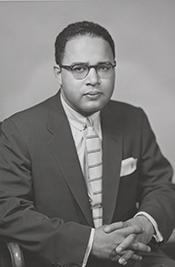
Charles Diggs Jr.
Former U.S. Representative · Michigan District 13 · 1955–1981 · Democratic
Charles Diggs Jr. represented Michigan's District 13 in the United States House of Representatives (1955–1981) for the Democratic party. The page below collects sourced biographical facts, term history, committee roles, and provenance for Jr..
Bioguide ID: D000344
Key facts
- Full name
- Charles Diggs Jr.
- State
- Michigan
- District
- District 13
- Party
- Democratic
- House service
- 1955–1981
- First House term
- 1955
- Status
- Left office
- Current term ends
- —
- Born
- 1922
- Bioguide ID
- D000344
- Committee assignments
- —
- Dataset version
- 1.20260605
Biographical narrative
1,064 words · sourced from the Wikipedia REST extract
Charles C. Diggs Jr. was an influential American politician from Michigan who served as a U.S. Representative for the 13th congressional district from 1955 until his resignation in 1980. A member of the Democratic Party, Diggs was notable for being the first African American elected to Congress from Michigan. His political career was marked by significant involvement in the civil rights movement, where he played a pivotal role in advocating for social justice and equality. Additionally, he was a founding member and the first chairman of the Congressional Black Caucus, an organization aimed at addressing the issues facing African Americans. Despite his contributions, Diggs's career was marred by legal troubles that ultimately led to his resignation from Congress.
Early life and career
Charles Coles Diggs Jr. was born on December 2, 1922, in Detroit, Michigan. He was the only child of Mayme E. Jones Diggs and Charles Diggs Sr. His upbringing in Detroit, a city with a rich African American heritage, shaped his understanding of the social and racial dynamics that would later inform his political career. Diggs pursued higher education at several institutions, including the University of Michigan, Detroit College of Law, and Fisk University, where he developed a foundation in law and public service.
His military service in the United States Army from 1943 to 1945 during World War II further enriched his life experiences. After returning from military service, Diggs transitioned into the family business, becoming a funeral director at the House of Diggs, which was reputed to be one of Michigan's largest funeral homes. This role not only connected him to his family's legacy but also exposed him to the community's needs and concerns, which would later influence his political ambitions.
Diggs's political career began in earnest when he was elected to the Michigan Senate, representing the 3rd district from 1951 to 1954. His tenure in the state legislature was notable for its alignment with his father's earlier service in the same position, establishing a family tradition of public service. Diggs's entry into the U.S. House of Representatives came in 1954 when he won the Democratic primary against incumbent George D. O'Brien for Michigan's 13th congressional district. His victory marked a significant milestone, as he became the first African American to represent Michigan in Congress.
House tenure
Diggs was sworn into the 84th Congress on January 3, 1955, and he would go on to serve a total of 13 terms in the House of Representatives, a tenure that lasted until his resignation on June 3, 1980. His early years in Congress coincided with a transformative period in American history, particularly in the realm of civil rights. Diggs quickly established himself as a vocal advocate for civil rights, leveraging his position to address issues of racial inequality and injustice.
One of the defining moments of Diggs's early congressional career occurred in 1955 when he attended the trial of two white men accused of murdering Emmett Till, a 14-year-old African American boy from Chicago. This trial garnered national attention and highlighted the pervasive racism in the United States. Diggs's presence at the trial underscored his commitment to civil rights and his willingness to confront racial injustice directly. His engagement in such high-profile cases helped to galvanize public opinion and contributed to the growing momentum of the civil rights movement.
In addition to his advocacy for civil rights, Diggs was instrumental in the formation of the Congressional Black Caucus, which aimed to address the unique challenges faced by African Americans. He served as the first chairman of this influential group, which provided a platform for African American legislators to collaborate on issues affecting their constituents. Under his leadership, the caucus became a significant force in Congress, advocating for policies that promoted social justice and equity.
Throughout his tenure, Diggs was known for his strong stance against apartheid in South Africa. In 1969, he was appointed chairman of the Subcommittee on Africa of the Committee on Foreign Affairs, where he used his position to advocate for the end of apartheid and support liberation movements in Africa. His commitment to this cause was evident in his public statements and writings, including an 'Action Manifesto' that criticized U.S. corporate investments in South Africa, which he argued supported the oppressive regime. His outspoken views on apartheid led to his being banned from South Africa, a testament to his impact on international human rights issues.
Legislative focus and committees
During his time in Congress, Diggs was involved in a variety of legislative efforts, focusing primarily on civil rights, foreign affairs, and social justice. His work on the Subcommittee on Africa allowed him to address critical issues related to colonialism and racial oppression in various African nations. He was particularly vocal about the need for the United States to take a stronger stance against apartheid, arguing that American corporations were complicit in the oppression of the South African majority through their investments.
Diggs's advocacy extended beyond international issues; he was also a prominent voice in domestic civil rights discussions. He participated in numerous campaigns and initiatives aimed at improving the lives of African Americans and other marginalized groups. His leadership in the Congressional Black Caucus was marked by significant actions, including a boycott of President Nixon's State of the Union Address, which was a protest against the administration's failure to address the concerns of African Americans. This action highlighted the caucus's commitment to holding the executive branch accountable for its policies and actions.
Despite his substantial contributions to civil rights and social justice, Diggs's career faced significant challenges due to legal issues. In 1978, he was charged with mail fraud related to allegations of taking kickbacks from staff whose salaries he had raised. He was convicted on multiple counts and subsequently censured by the House of Representatives. Diggs maintained his innocence throughout the legal proceedings and continued to serve in Congress while awaiting sentencing. Ultimately, he resigned from his position in June 1980 and served 14 months of a three-year prison sentence.
Charles C. Diggs Jr. passed away on August 24, 1998, from a stroke in Washington, D.C. His legacy as a trailblazer for African Americans in politics and a dedicated advocate for civil rights remains significant in the history of American governance. He is interred at Detroit Memorial Park in Warren, Michigan, where his contributions to civil rights and public service continue to be remembered.
Notable legislation
Sponsored and co-sponsored legislation for Charles Diggs Jr. is pending operator curation. The biographical narrative above carries the same provenance trail until per-bill rows are written.
Sources
- [1]https://en.wikipedia.org/wiki/Charles_DiggsWikipedia · retrieved 2026-06-05
Notable quotes
Sourced quotes for Charles Diggs Jr. are pending operator curation. Narrative-scope provenance remains attached below.
Sources
- [1]https://en.wikipedia.org/wiki/Charles_DiggsWikipedia · retrieved 2026-06-05
Key positions
Curated policy positions for Charles Diggs Jr. are pending operator review. The biographical narrative above carries the same provenance trail until per-topic positions are written.
Sources
- [1]https://en.wikipedia.org/wiki/Charles_DiggsWikipedia · retrieved 2026-06-05
Terms served
- 1955–1957U.S. House · Term 1 · Democratic
- 1957–1959U.S. House · Term 2 · Democratic
- 1959–1961U.S. House · Term 3 · Democratic
- 1961–1963U.S. House · Term 4 · Democratic
- 1963–1965U.S. House · Term 5 · Democratic
- 1965–1967U.S. House · Term 6 · Democratic
- 1967–1969U.S. House · Term 7 · Democratic
- 1969–1971U.S. House · Term 8 · Democratic
- 1971–1973U.S. House · Term 9 · Democratic
- 1973–1975U.S. House · Term 10 · Democratic
- 1975–1977U.S. House · Term 11 · Democratic
- 1977–1979U.S. House · Term 12 · Democratic
- 1979–1981U.S. House · Term 13 · Democratic
Sources & provenance
Every attributable claim above carries a per-section [N] marker that resolves to the corresponding URL below. Each entry records the upstream provider, the canonical URL, and the timestamp at which the source was retrieved by the ingest pipeline.
Key facts
- https://bioguide.congress.gov/search/bio/D000344bioguide · retrieved 2026-06-05
- https://www.govtrack.us/congress/members/403462govtrack · retrieved 2026-06-05
Biographical narrative
- https://en.wikipedia.org/wiki/Charles_Diggswikipedia · retrieved 2026-06-05
Find your representative
Every U.S. state elects representatives by district. Browse Michigan’s delegation, the full former-representative roster, or explore the role and term length.
Related on The Candidate
- Preceded by George O’BrienEarlier holder of the Michigan District 13 House seat · Democratic.Open
- Succeeded by Lynn RiversLater holder of the Michigan District 13 House seat · Democratic.Open
- Alexander BuelFormer U.S. Representative · Michigan District 1 · DemocraticOpen
- Alfred LuckingFormer U.S. Representative · Michigan District 1 · DemocraticOpen
- Alpheus WilliamsFormer U.S. Representative · Michigan District 1 · DemocraticOpen
- Bart StupakFormer U.S. Representative · Michigan District 1 · DemocraticOpen