
Historical · U.S. House · Michigan · District 13
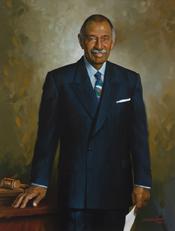
John Conyers Jr.
Former U.S. Representative · Michigan District 13 · 1965–2017 · Democratic
John Conyers Jr. represented Michigan's District 13 in the United States House of Representatives (1965–2017) for the Democratic party. The page below collects sourced biographical facts, term history, committee roles, and provenance for Jr..
Bioguide ID: C000714
Key facts
- Full name
- John Conyers Jr.
- State
- Michigan
- District
- District 13
- Party
- Democratic
- House service
- 1965–2017
- First House term
- 1965
- Status
- Left office
- Current term ends
- —
- Born
- 1929
- Bioguide ID
- C000714
- Committee assignments
- —
- Dataset version
- 1.20260605
Biographical narrative
840 words · sourced from the Wikipedia REST extract
John Conyers, Jr. was an American politician who served as a U.S. Representative for Michigan's 13th congressional district from 1965 until his resignation in 2017. A member of the Democratic Party, Conyers was notable for being the longest-serving African American member of Congress in history, as well as the sixth-longest serving member overall. His tenure in the House of Representatives spanned over five decades, during which he became a prominent figure in American politics, particularly in civil rights and progressive legislation.
Early life and career
John Conyers was born on May 16, 1929, in Detroit, Michigan. He was the son of Lucille Janice Simpson and John James Conyers, a labor leader. Growing up in a politically active family, Conyers was influenced by the labor movement and civil rights from an early age. He completed his secondary education at Northwestern High School in Detroit before embarking on a military career. Conyers served in the Michigan National Guard from 1948 to 1950 and then in the U.S. Army from 1950 to 1954, where he was deployed to Korea as an officer in the U.S. Army Corps of Engineers during the Korean War. His military service earned him combat and merit citations.
Following his military service, Conyers pursued higher education, earning a Bachelor of Arts degree in 1957 and a Bachelor of Laws (LL.B.) in 1958 from Wayne State University. After being admitted to the bar, he worked as an aide to Congressman John Dingell and served as counsel to various labor unions in the Detroit area. He also held a position as a referee for Michigan's workmen's compensation department from 1961 to 1963. Conyers became actively involved in the civil rights movement, participating in significant events such as the voter registration drive known as Freedom Day in Selma, Alabama, in 1963.
House tenure
Conyers entered the U.S. House of Representatives in 1965 after winning a special election for an open seat in Michigan's 1st congressional district. He achieved a significant victory over his Republican opponent, garnering a substantial majority of the vote. Over the years, he successfully secured re-election multiple times, often with increasing margins. Following the 1990 U.S. census, Michigan underwent redistricting, resulting in Conyers's district being renumbered as the 14th district. In 1992, he won re-election in this new district, which included parts of the western suburbs of Detroit.
Throughout his congressional career, Conyers was re-elected a total of twenty-five times, serving in his twenty-sixth term at the time of his resignation. His electoral performance remained strong, with his lowest re-election percentage occurring in 2010, when he received 77% of the vote against a Republican challenger. In 2013, the district was renamed the 13th district, which Conyers continued to represent until his departure from Congress.
Conyers's long tenure in the House made him a notable figure in American politics. He was recognized as the dean of the House of Representatives, a title given to the longest-serving current member. By the end of his career, he was the last remaining member of Congress who had served since the presidency of Lyndon B. Johnson. His political career was marked by significant legislative accomplishments and a commitment to civil rights.
Legislative focus and committees
Throughout his time in Congress, Conyers was known for his progressive stance on various issues. He was one of the founding members of the Congressional Black Caucus (CBC), established in 1969 to enhance the legislative influence of African American lawmakers. Conyers served as the dean of the CBC and was recognized for his efforts to address the legislative concerns of Black and minority citizens.
Conyers was assigned to the influential House Judiciary Committee shortly after entering Congress, a position he held for many years. His role on this committee allowed him to participate in critical legislative discussions and decisions, particularly those related to civil rights, social justice, and healthcare reform. He served as the ranking Democratic member of the Judiciary Committee from 1995 to 2007 and again from 2011 to 2017. Additionally, he held the position of chairman of the committee from 2007 to 2011 and chaired the House Oversight Committee from 1989 to 1995.
Conyers was known for his advocacy of a single-payer healthcare system, sponsoring the United States National Health Care Act. He also played a pivotal role in establishing Martin Luther King Jr. Day as a federal holiday and was the first congressperson to introduce legislation advocating for reparations for the descendants of African American slaves. His legislative focus often aligned with progressive values, and he was recognized as one of the most liberal members of Congress.
Despite his long and impactful career, Conyers's tenure came to an end amid allegations of sexual harassment and misconduct, which led to his resignation from Congress on December 5, 2017. His departure marked the end of an era for a politician who had dedicated much of his life to public service and civil rights advocacy. Conyers passed away on October 27, 2019, leaving behind a complex legacy shaped by decades of political engagement and legislative efforts.
Notable legislation
Sponsored and co-sponsored legislation for John Conyers Jr. is pending operator curation. The biographical narrative above carries the same provenance trail until per-bill rows are written.
Sources
- [1]https://en.wikipedia.org/wiki/John_ConyersWikipedia · retrieved 2026-06-05
Notable quotes
Sourced quotes for John Conyers Jr. are pending operator curation. Narrative-scope provenance remains attached below.
Sources
- [1]https://en.wikipedia.org/wiki/John_ConyersWikipedia · retrieved 2026-06-05
Key positions
Curated policy positions for John Conyers Jr. are pending operator review. The biographical narrative above carries the same provenance trail until per-topic positions are written.
Sources
- [1]https://en.wikipedia.org/wiki/John_ConyersWikipedia · retrieved 2026-06-05
Terms served
- 1965–1967U.S. House · Term 1 · Democratic
- 1967–1969U.S. House · Term 2 · Democratic
- 1969–1971U.S. House · Term 3 · Democratic
- 1971–1973U.S. House · Term 4 · Democratic
- 1973–1975U.S. House · Term 5 · Democratic
- 1975–1977U.S. House · Term 6 · Democratic
- 1977–1979U.S. House · Term 7 · Democratic
- 1979–1981U.S. House · Term 8 · Democratic
- 1981–1983U.S. House · Term 9 · Democratic
- 1983–1985U.S. House · Term 10 · Democratic
- 1985–1987U.S. House · Term 11 · Democratic
- 1987–1989U.S. House · Term 12 · Democratic
- 1989–1991U.S. House · Term 13 · Democratic
- 1991–1993U.S. House · Term 14 · Democratic
- 1993–1995U.S. House · Term 15 · Democratic
- 1995–1997U.S. House · Term 16 · Democratic
- 1997–1999U.S. House · Term 17 · Democratic
- 1999–2001U.S. House · Term 18 · Democratic
- 2001–2003U.S. House · Term 19 · Democratic
- 2003–2005U.S. House · Term 20 · Democratic
- 2005–2007U.S. House · Term 21 · Democratic
- 2007–2009U.S. House · Term 22 · Democratic
- 2009–2011U.S. House · Term 23 · Democratic
- 2011–2013U.S. House · Term 24 · Democratic
- 2013–2015U.S. House · Term 25 · Democratic
- 2015–2017U.S. House · Term 26 · Democratic
- 2017–2017U.S. House · Term 27 · Democratic
Sources & provenance
Every attributable claim above carries a per-section [N] marker that resolves to the corresponding URL below. Each entry records the upstream provider, the canonical URL, and the timestamp at which the source was retrieved by the ingest pipeline.
Key facts
- https://bioguide.congress.gov/search/bio/C000714bioguide · retrieved 2026-06-05
- https://conyers.house.govhouse.gov · retrieved 2026-06-05
Biographical narrative
- https://en.wikipedia.org/wiki/John_Conyerswikipedia · retrieved 2026-06-05
Find your representative
Every U.S. state elects representatives by district. Browse Michigan’s delegation, the full former-representative roster, or explore the role and term length.
Related on The Candidate
- Preceded by George O’BrienEarlier holder of the Michigan District 13 House seat · Democratic.Open
- Succeeded by Brenda JonesLater holder of the Michigan District 13 House seat · Democratic.Open
- Alexander BuelFormer U.S. Representative · Michigan District 1 · DemocraticOpen
- Alfred LuckingFormer U.S. Representative · Michigan District 1 · DemocraticOpen
- Alpheus WilliamsFormer U.S. Representative · Michigan District 1 · DemocraticOpen
- Bart StupakFormer U.S. Representative · Michigan District 1 · DemocraticOpen