
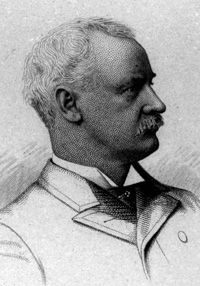
Historical · U.S. House · Michigan · District 3
Edward Lacey
Former U.S. Representative · Michigan District 3 · 1881–1885 · Republican
Edward Lacey represented Michigan's District 3 in the United States House of Representatives (1881–1885) for the Republican party. The page below collects sourced biographical facts, term history, committee roles, and provenance for Lacey.
Bioguide ID: L000009
Key facts
- Full name
- Edward Lacey
- State
- Michigan
- District
- District 3
- Party
- Republican
- House service
- 1881–1885
- First House term
- 1881
- Status
- Left office
- Current term ends
- —
- Born
- 1835
- Bioguide ID
- L000009
- Committee assignments
- —
- Dataset version
- 1.20260606
Biographical narrative
968 words · sourced from the Wikipedia REST extract
Edward Lacey was a notable American politician who served as a U.S. Representative for Michigan's 3rd congressional district during the early 1880s. A member of the Republican Party, Lacey's political career included two terms in the House of Representatives, where he contributed to legislative processes and party organization. Following his congressional service, he held a significant position as the Comptroller of the Currency, appointed by President Benjamin Harrison. Lacey's life spanned from November 26, 1835, to October 2, 1916, during which he engaged in various business and political endeavors that shaped his community and state.
Early life and career
Edward Lacey was born in Chili, New York, on November 26, 1835. His family relocated to Branch County, Michigan, in October 1842, seeking new opportunities in the burgeoning Midwest. Shortly thereafter, in March 1843, they moved again, this time to Eaton County, Michigan. Lacey's early education took place in local public schools, where he laid the foundation for his future pursuits. He furthered his education at Olivet College, a private liberal arts institution in Michigan, which contributed to his intellectual development and prepared him for a career in both business and politics.
Throughout his early years, Lacey engaged in various business pursuits, which likely provided him with valuable experience in management and finance. His professional journey included a significant period in Kalamazoo, Michigan, from 1853 to 1857, where he was involved in the local economy. Following this, he moved to Charlotte, Michigan, where he became more deeply entrenched in public service and local governance. Lacey served as the register of deeds for Eaton County from 1860 to 1864, a role that involved maintaining public records and managing important documents for the county.
Lacey's political career began to take shape as he became more active in local governance. In 1871, he was elected mayor of Charlotte, demonstrating his leadership capabilities and commitment to public service. His influence extended beyond local politics; he was appointed as a trustee of the Michigan Asylum for the Insane from 1874 to 1880, where he contributed to the management of mental health services in the state. Additionally, Lacey played a role in the Republican Party at the national level as a delegate to the Republican National Convention in 1876, further solidifying his political connections and influence.
House tenure
Edward Lacey's congressional career began when he was elected as a Republican to represent Michigan's 3rd congressional district in the Forty-seventh Congress. His first term commenced on March 4, 1881, and he was subsequently re-elected to the Forty-eighth Congress, serving until March 3, 1885. During his time in the House of Representatives, Lacey participated in various legislative activities and contributed to discussions on issues relevant to his constituents and the nation.
As a member of Congress, Lacey was part of a legislative body that faced significant challenges and changes during the post-Civil War era. This period was marked by economic transformation, social upheaval, and the ongoing struggle for civil rights. Lacey's role as a Congressman involved not only representing the interests of his district but also navigating the complexities of national legislation. His tenure coincided with the rise of industrialization in the United States, which brought about new economic opportunities and challenges.
Despite his contributions, Lacey chose not to seek re-election in 1884, concluding his congressional career after two terms. His decision to step away from the House may have been influenced by various factors, including personal aspirations, political dynamics, or a desire to pursue other opportunities. Following his time in Congress, Lacey continued to be active in the Republican Party, serving as chairman of the Michigan Republican Party from 1882 to 1884, where he played a crucial role in party organization and strategy during a pivotal time in American politics.
Legislative focus and committees
While specific details regarding the legislation Lacey supported during his congressional tenure are not provided, it can be inferred that, as a Republican representative, he likely focused on issues pertinent to his party's platform at the time. The Republican Party during the late 19th century was characterized by its support for business interests, infrastructure development, and a commitment to maintaining a strong national government. Lacey's background in banking and business may have influenced his legislative priorities, aligning him with policies that promoted economic growth and stability.
In addition to his legislative work, Lacey's role as a party leader and chairman of the Michigan Republican Party would have involved significant engagement with party members and constituents. This position allowed him to influence party strategy and candidate selection, as well as to foster relationships with other political leaders. His experience in local governance and his understanding of the needs of his constituents likely informed his approach to leadership within the party.
Following his congressional service, Lacey was appointed by President Benjamin Harrison to the position of Comptroller of the Currency on April 17, 1889. This role was critical in overseeing the nation's banking system and ensuring the stability of financial institutions. Lacey was reappointed to this position in December 1889 and served until his resignation in 1892. His tenure as Comptroller allowed him to apply his banking expertise on a national scale, contributing to the regulation and oversight of the financial sector during a time of significant economic change.
After resigning from his position as Comptroller, Lacey moved to Chicago, where he returned to the banking industry. His career trajectory reflects a blend of public service and private enterprise, showcasing his adaptability and commitment to both sectors. Edward Lacey passed away on October 2, 1916, in Evanston, Illinois, and is interred in Maple Hill Cemetery in Charlotte, Michigan. His life and career exemplify the interconnectedness of local and national politics in the late 19th century, as well as the evolving role of public officials in addressing the challenges of their time.
Notable legislation
Sponsored and co-sponsored legislation for Edward Lacey is pending operator curation. The biographical narrative above carries the same provenance trail until per-bill rows are written.
Sources
- [1]https://en.wikipedia.org/wiki/Edward_S._LaceyWikipedia · retrieved 2026-06-06
Notable quotes
Sourced quotes for Edward Lacey are pending operator curation. Narrative-scope provenance remains attached below.
Sources
- [1]https://en.wikipedia.org/wiki/Edward_S._LaceyWikipedia · retrieved 2026-06-06
Key positions
Curated policy positions for Edward Lacey are pending operator review. The biographical narrative above carries the same provenance trail until per-topic positions are written.
Sources
- [1]https://en.wikipedia.org/wiki/Edward_S._LaceyWikipedia · retrieved 2026-06-06
Terms served
- 1881–1883U.S. House · Term 1 · Republican
- 1883–1885U.S. House · Term 2 · Republican
Sources & provenance
Every attributable claim above carries a per-section [N] marker that resolves to the corresponding URL below. Each entry records the upstream provider, the canonical URL, and the timestamp at which the source was retrieved by the ingest pipeline.
Key facts
- https://bioguide.congress.gov/search/bio/L000009bioguide · retrieved 2026-06-06
- https://www.govtrack.us/congress/members/406519govtrack · retrieved 2026-06-06
Biographical narrative
- https://en.wikipedia.org/wiki/Edward_S._Laceywikipedia · retrieved 2026-06-06
Find your representative
Every U.S. state elects representatives by district. Browse Michigan’s delegation, the full former-representative roster, or explore the role and term length.
Related on The Candidate
- Preceded by Jonas McGowanEarlier holder of the Michigan District 3 House seat · Republican.Open
- Succeeded by James O’DonnellLater holder of the Michigan District 3 House seat · Republican.Open
- Alexander BuelFormer U.S. Representative · Michigan District 1 · DemocraticOpen
- Alfred LuckingFormer U.S. Representative · Michigan District 1 · DemocraticOpen
- Alpheus WilliamsFormer U.S. Representative · Michigan District 1 · DemocraticOpen
- Bart StupakFormer U.S. Representative · Michigan District 1 · DemocraticOpen