
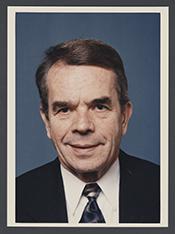
Historical · U.S. House · Michigan · District 5
Dale Kildee
Former U.S. Representative · Michigan District 5 · 1977–2013 · Democratic
Dale Kildee represented Michigan's District 5 in the United States House of Representatives (1977–2013) for the Democratic party. The page below collects sourced biographical facts, term history, committee roles, and provenance for Kildee.
Bioguide ID: K000172
Key facts
- Full name
- Dale Kildee
- State
- Michigan
- District
- District 5
- Party
- Democratic
- House service
- 1977–2013
- First House term
- 1977
- Status
- Left office
- Current term ends
- —
- Born
- 1929
- Bioguide ID
- K000172
- Committee assignments
- —
- Dataset version
- 1.20260605
Biographical narrative
955 words · sourced from the Wikipedia REST extract
Dale E. Kildee was an American politician who served as a U.S. Representative for Michigan's 5th congressional district from 1977 until his retirement in 2013. A member of the Democratic Party, Kildee represented a district that included notable cities such as Flint, Saginaw, and Bay City. Throughout his lengthy political career, he was known for his advocacy on various issues, particularly those affecting Native American communities. Kildee's tenure in the House of Representatives spanned 18 terms, making him a prominent figure in Michigan politics and a significant voice in national legislative discussions.
Early life and career
Dale Edward Kildee was born on September 16, 1929, in Flint, Michigan, to Timothy and Norma Kildee. He was the fourth of five children in his family. Kildee's early education took place in Flint, where he attended St. Mary's High School. During his senior year, he received the American Legion Medal of Citizenship, an honor that recognized his exemplary character and contributions to his school and community. After graduating from high school in 1947, Kildee pursued higher education, earning a Bachelor of Arts degree from Sacred Heart Seminary in Detroit in 1952.
Following his undergraduate studies, Kildee obtained a teacher's certificate from the University of Detroit in 1955. He later engaged in graduate studies in history and political science at the University of Peshawar in Pakistan, supported by a Rotary Foundation Fellowship from 1958 to 1959. Kildee completed his academic journey with a Master of Arts degree from the University of Michigan in 1961.
Kildee began his professional career in education, teaching at the University of Detroit Jesuit High School and Academy from 1954 to 1956. After returning to Flint, he continued teaching Latin until 1964. His involvement in education laid a foundation for his later political career, as he became increasingly engaged in public service and community issues.
Kildee's political career began in earnest when he was elected to the Michigan State House of Representatives, where he served the 81st district from 1965 to 1974. His legislative experience continued when he was elected to the Michigan State Senate, serving from 1975 to 1976. These roles provided him with valuable insights into the workings of government and the needs of his constituents, setting the stage for his future in the U.S. Congress.
House tenure
Dale Kildee's entry into the U.S. House of Representatives came in 1977, following the resignation of incumbent Democratic Representative Donald Riegle, who had been appointed to the U.S. Senate. Kildee won the general election decisively, securing approximately 70% of the vote. Over the course of his congressional career, Kildee was re-elected 17 times, consistently winning a significant majority of the votes in his district. His electoral success was marked by a strong base of support in Genesee County, where he often received upwards of 70% of the vote, although he faced more competitive races in certain years, such as 1992, 1994, and 2010.
During his time in the House, Kildee was known for his commitment to various issues, particularly those affecting education and Native American rights. In 1997, he played a pivotal role in founding the House's Native American Caucus, which aimed to address the unique challenges faced by Native American communities and advocate for their interests in Congress. His dedication to these issues was a defining aspect of his legislative career.
Kildee's tenure was also characterized by his involvement in health care reform. In 2010, he publicly announced his support for the Senate version of the Health Care reform bill, which did not include the Stupak Amendment that sought to restrict federal funding for abortion services. His willingness to navigate complex political landscapes demonstrated his commitment to advancing health care access while balancing the diverse views within his party.
Legislative focus and committees
Throughout his congressional career, Dale Kildee served on several key committees that shaped his legislative focus. He was a senior member of the House Committee on Education and the Workforce, where he contributed to discussions and initiatives related to education policy and labor relations. Within this committee, he held the position of ranking Democrat on the Subcommittee on Education Reform, as well as being a member of the Subcommittee on Employer-Employee Relations. His work in these roles underscored his commitment to improving educational opportunities and addressing workforce issues.
In addition to his work on education, Kildee was a member of the House Committee on Resources, where he served on the Subcommittee on National Parks and Public Lands and the Subcommittee on Forests and Forest Health. His involvement in these committees reflected his interest in environmental issues and the management of natural resources, particularly as they pertained to public lands and conservation efforts.
From 1993 onward, Kildee co-chaired the Congressional Automotive Caucus, an organization focused on promoting the interests of the automotive industry, which is a significant sector in Michigan's economy. His leadership in this caucus highlighted his dedication to supporting local industries and advocating for policies that would benefit workers and businesses in the automotive sector.
Kildee's legislative contributions were further enhanced by his co-chairmanship of the Native American Caucus, which he helped establish in 1997. This caucus served as a platform for addressing the needs and concerns of Native American tribes and communities, advocating for policies that would promote their rights and welfare.
In summary, Dale E. Kildee's political career was marked by a long tenure in the U.S. House of Representatives, where he focused on education, health care, and Native American issues. His extensive experience in state and federal government, combined with his commitment to his constituents, made him a notable figure in Michigan politics. Kildee passed away on October 13, 2021, leaving behind a legacy of public service and advocacy for the communities he represented.
Notable legislation
Sponsored and co-sponsored legislation for Dale Kildee is pending operator curation. The biographical narrative above carries the same provenance trail until per-bill rows are written.
Sources
- [1]https://en.wikipedia.org/wiki/Dale_KildeeWikipedia · retrieved 2026-06-05
Notable quotes
Sourced quotes for Dale Kildee are pending operator curation. Narrative-scope provenance remains attached below.
Sources
- [1]https://en.wikipedia.org/wiki/Dale_KildeeWikipedia · retrieved 2026-06-05
Key positions
Curated policy positions for Dale Kildee are pending operator review. The biographical narrative above carries the same provenance trail until per-topic positions are written.
Sources
- [1]https://en.wikipedia.org/wiki/Dale_KildeeWikipedia · retrieved 2026-06-05
Terms served
- 1977–1979U.S. House · Term 1 · Democratic
- 1979–1981U.S. House · Term 2 · Democratic
- 1981–1983U.S. House · Term 3 · Democratic
- 1983–1985U.S. House · Term 4 · Democratic
- 1985–1987U.S. House · Term 5 · Democratic
- 1987–1989U.S. House · Term 6 · Democratic
- 1989–1991U.S. House · Term 7 · Democratic
- 1991–1993U.S. House · Term 8 · Democratic
- 1993–1995U.S. House · Term 9 · Democratic
- 1995–1997U.S. House · Term 10 · Democratic
- 1997–1999U.S. House · Term 11 · Democratic
- 1999–2001U.S. House · Term 12 · Democratic
- 2001–2003U.S. House · Term 13 · Democratic
- 2003–2005U.S. House · Term 14 · Democratic
- 2005–2007U.S. House · Term 15 · Democratic
- 2007–2009U.S. House · Term 16 · Democratic
- 2009–2011U.S. House · Term 17 · Democratic
- 2011–2013U.S. House · Term 18 · Democratic
Sources & provenance
Every attributable claim above carries a per-section [N] marker that resolves to the corresponding URL below. Each entry records the upstream provider, the canonical URL, and the timestamp at which the source was retrieved by the ingest pipeline.
Key facts
- https://bioguide.congress.gov/search/bio/K000172bioguide · retrieved 2026-06-05
- http://www.house.gov/kildeehouse.gov · retrieved 2026-06-05
Biographical narrative
- https://en.wikipedia.org/wiki/Dale_Kildeewikipedia · retrieved 2026-06-05
Find your representative
Every U.S. state elects representatives by district. Browse Michigan’s delegation, the full former-representative roster, or explore the role and term length.
Related on The Candidate
- Preceded by Richard Vander VeenEarlier holder of the Michigan District 5 House seat · Democratic.Open
- Alexander BuelFormer U.S. Representative · Michigan District 1 · DemocraticOpen
- Alfred LuckingFormer U.S. Representative · Michigan District 1 · DemocraticOpen
- Alpheus WilliamsFormer U.S. Representative · Michigan District 1 · DemocraticOpen
- Bart StupakFormer U.S. Representative · Michigan District 1 · DemocraticOpen
- Democratic PartyFederal candidates and office holders on the Democratic line.Open