
Historical · U.S. House · Michigan · District 5
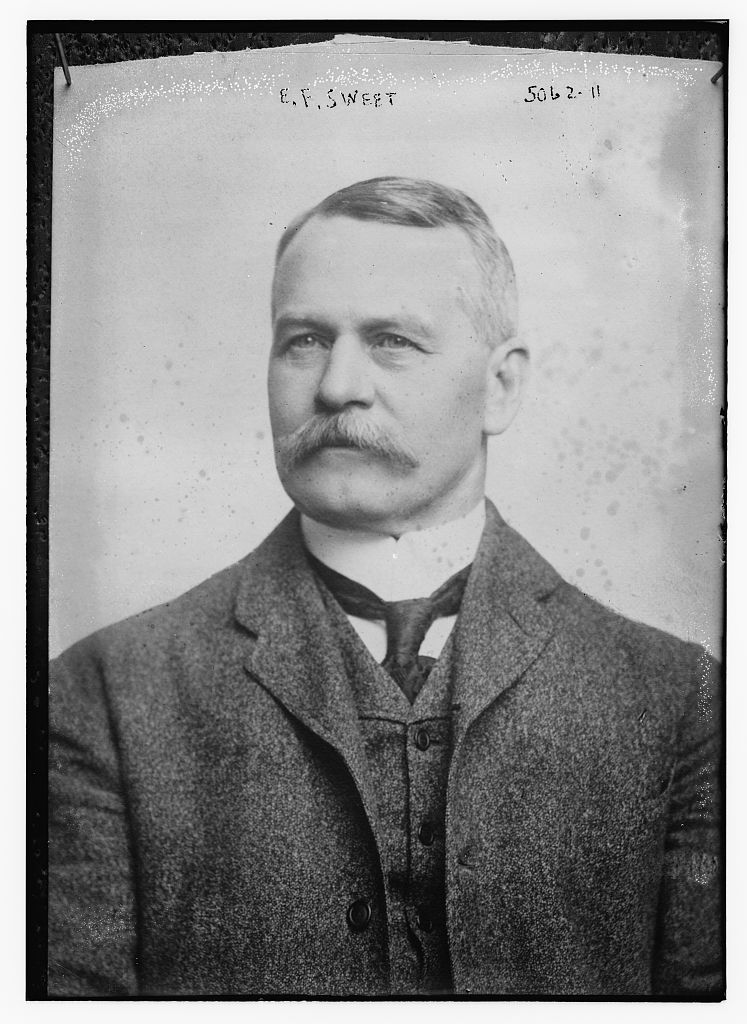
Edwin Sweet
Former U.S. Representative · Michigan District 5 · 1911–1913 · Democratic
Edwin Sweet represented Michigan's District 5 in the United States House of Representatives (1911–1913) for the Democratic party. The page below collects sourced biographical facts, term history, committee roles, and provenance for Sweet.
Bioguide ID: S001107
Key facts
- Full name
- Edwin Sweet
- State
- Michigan
- District
- District 5
- Party
- Democratic
- House service
- 1911–1913
- First House term
- 1911
- Status
- Left office
- Current term ends
- —
- Born
- 1847
- Bioguide ID
- S001107
- Committee assignments
- —
- Dataset version
- 1.20260606
Biographical narrative
841 words · sourced from the Wikipedia REST extract
Edwin Sweet was a prominent American politician who served as a U.S. Representative from Michigan's 5th congressional district. A member of the Democratic Party, he held office from 1911 to 1913. Following his congressional tenure, Sweet continued to engage in public service, notably as Assistant Secretary of Commerce under President Woodrow Wilson. His career spanned various roles in law, local government, and federal administration, reflecting a commitment to civic duty and leadership.
Early life and career
Edwin Forrest Sweet was born on November 21, 1847, in Dansville, New York. He was the son of Sidney Sweet and Hannah Sweet (née Redmond). Sweet received his early education in the local common schools and attended Dansville Seminary. He later graduated from the literary department of Yale College in 1871, where he was involved in the prestigious secret society Skull and Bones and was a member of the Delta Kappa Epsilon fraternity.
After completing his education, Sweet embarked on an extensive tour of Europe and the Holy Land. His travels took him through several major cities, including Liverpool, London, Paris, and Rome, and he spent time in Egypt and Palestine. He returned to New York City exactly one year after his departure, having gained a wealth of experiences from his journey.
In January 1873, Sweet entered the law department at the University of Michigan in Ann Arbor, graduating in 1874. He was subsequently admitted to the bar and began his legal career as a clerk in the law firm of Hughes, O'Brien & Smiley in Grand Rapids, Michigan. By April 1876, he had established his own law firm, Stuart & Sweet.
Sweet's involvement in public service began in the late 19th century when he served on the board of education for Grand Rapids from 1899 to 1906. His commitment to the community was further demonstrated during his tenure as Mayor of Grand Rapids from 1904 to 1906. These roles laid the groundwork for his future political career.
House tenure
Edwin Sweet's congressional career began when he was elected as a Democrat to the 62nd United States Congress, representing Michigan's 5th congressional district. He took office on March 4, 1911, succeeding the incumbent Republican, Gerrit J. Diekema. During his time in Congress, Sweet participated in the legislative process and contributed to discussions on various issues facing the nation.
His term in the House of Representatives lasted until March 3, 1913. After completing his first term, he sought re-election but was defeated in the general election by Republican candidate Carl E. Mapes. Although his time in Congress was relatively brief, it marked a significant chapter in his political journey.
Following his departure from Congress, Sweet continued to serve in various capacities within the federal government. In 1913, he was appointed by President Woodrow Wilson to the position of Assistant Secretary of Commerce, a role he held until 1921. This appointment allowed him to influence economic policy and contribute to the administration's objectives during a transformative period in American history.
Legislative focus and committees
During his tenure in the House of Representatives, Edwin Sweet was involved in a range of legislative activities, although specific details regarding the bills he sponsored or the committees he served on are not extensively documented. His election as a Democrat in a district that had previously been represented by a Republican suggests that he may have focused on issues that resonated with his constituents, particularly in the context of the early 20th century, when economic and social changes were prominent.
After leaving Congress, Sweet's public service continued to evolve. He ran for Governor of Michigan in 1916 but was unsuccessful in his bid, losing to Republican Albert Sleeper. In the years that followed, he served as vice chairman of the Federal Electric Railways Commission from 1919 to 1920, further demonstrating his ongoing commitment to public service and infrastructure development.
Sweet's involvement in local governance persisted as well; he returned to Grand Rapids, where he served on the board of education from 1923 to 1926 and was a member of the city commission from 1926 to 1928. His various roles in both local and federal government reflect a sustained engagement with the political landscape of his time.
In addition to his political career, Sweet was also an entrepreneur. In the early 1880s, he invested in the Sweet Ranch in Dickey County, North Dakota, and is recognized as the founder of Fullerton, North Dakota, which was named in honor of his father-in-law.
Edwin Sweet's personal life included his marriage to Sophia Fuller Sweet in 1876. They had two children, Carroll Fuller Sweet and George Philo Sweet. After retiring from public life in 1928, Sweet moved to Ojai, California, where he lived until his death on April 2, 1935. He was interred in Oakhill Cemetery in Grand Rapids, Michigan.
Sweet's legacy is marked by his contributions to both local and national governance, reflecting a career dedicated to public service and community engagement. His life and work remain a part of the historical narrative of Michigan's political landscape in the early 20th century.
Notable legislation
Sponsored and co-sponsored legislation for Edwin Sweet is pending operator curation. The biographical narrative above carries the same provenance trail until per-bill rows are written.
Sources
- [1]https://en.wikipedia.org/wiki/Edwin_F._SweetWikipedia · retrieved 2026-06-06
Notable quotes
Sourced quotes for Edwin Sweet are pending operator curation. Narrative-scope provenance remains attached below.
Sources
- [1]https://en.wikipedia.org/wiki/Edwin_F._SweetWikipedia · retrieved 2026-06-06
Key positions
Curated policy positions for Edwin Sweet are pending operator review. The biographical narrative above carries the same provenance trail until per-topic positions are written.
Sources
- [1]https://en.wikipedia.org/wiki/Edwin_F._SweetWikipedia · retrieved 2026-06-06
Terms served
- 1911–1913U.S. House · Term 1 · Democratic
Sources & provenance
Every attributable claim above carries a per-section [N] marker that resolves to the corresponding URL below. Each entry records the upstream provider, the canonical URL, and the timestamp at which the source was retrieved by the ingest pipeline.
Key facts
- https://bioguide.congress.gov/search/bio/S001107bioguide · retrieved 2026-06-06
- https://www.govtrack.us/congress/members/410559govtrack · retrieved 2026-06-06
Biographical narrative
- https://en.wikipedia.org/wiki/Edwin_F._Sweetwikipedia · retrieved 2026-06-06
Find your representative
Every U.S. state elects representatives by district. Browse Michigan’s delegation, the full former-representative roster, or explore the role and term length.
Related on The Candidate
- Preceded by Gerrit DiekemaEarlier holder of the Michigan District 5 House seat · Republican.Open
- Succeeded by Carl MapesLater holder of the Michigan District 5 House seat · Republican.Open
- Alexander BuelFormer U.S. Representative · Michigan District 1 · DemocraticOpen
- Alfred LuckingFormer U.S. Representative · Michigan District 1 · DemocraticOpen
- Alpheus WilliamsFormer U.S. Representative · Michigan District 1 · DemocraticOpen
- Bart StupakFormer U.S. Representative · Michigan District 1 · DemocraticOpen