
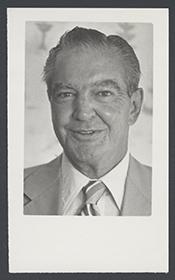
Historical · U.S. House · Michigan · District 5
Harold Sawyer
Former U.S. Representative · Michigan District 5 · 1977–1985 · Republican
Harold Sawyer represented Michigan's District 5 in the United States House of Representatives (1977–1985) for the Republican party. The page below collects sourced biographical facts, term history, committee roles, and provenance for Sawyer.
Bioguide ID: S000087
Key facts
- Full name
- Harold Sawyer
- State
- Michigan
- District
- District 5
- Party
- Republican
- House service
- 1977–1985
- First House term
- 1977
- Status
- Left office
- Current term ends
- —
- Born
- 1920
- Bioguide ID
- S000087
- Committee assignments
- —
- Dataset version
- 1.20260605
Biographical narrative
938 words · sourced from the Wikipedia REST extract
Harold S. Sawyer was an American attorney and politician who served as a U.S. Representative for Michigan's 5th congressional district from 1977 until 1985. A member of the Republican Party, Sawyer succeeded in reclaiming a district that had a long history of Republican representation, notably held by Gerald R. Ford before his vice-presidential appointment. Throughout his congressional career, Sawyer was involved in various legislative matters and served on significant committees, including one that investigated high-profile assassinations in American history.
Early life and career
Harold Samuel Sawyer was born on March 21, 1920, in San Francisco, California. He grew up in the San Francisco Bay Area, where he attended local public schools. Sawyer pursued higher education at Marin Junior College, which is now known as the College of Marin, located in Kentfield, California. He furthered his studies at the University of California, Berkeley, graduating in 1940. Following his undergraduate education, he attended the University of California, Hastings College of the Law, where he earned his Juris Doctor degree in 1943.
Upon completing his law degree, Sawyer served in the United States Navy during World War II. After the war, he relocated to Grand Rapids, Michigan, where he established a successful private law practice. His legal career laid the groundwork for his future political endeavors. Sawyer's involvement in public service began to take shape in the late 1960s when he became a member of the Michigan Law Revision Commission, a position he held from 1968 to 1976. His experience in law and governance deepened during this time, providing him with insights into the legislative process.
In 1975, Sawyer was appointed as the prosecuting attorney for Kent County, a role that further solidified his reputation in the legal community and prepared him for a career in politics. His political aspirations culminated in 1976 when he ran for the U.S. House of Representatives. In a significant electoral victory, Sawyer defeated the incumbent Democrat Richard Vander Veen, reclaiming Michigan's 5th congressional district for the Republican Party. This district had a storied history of Republican representation, having been held by Ford until his elevation to the vice presidency. Sawyer's election was notably aided by the presence of Ford at the top of the ticket during the presidential election.
House tenure
Harold Sawyer's congressional career began with his election to the Ninety-fifth Congress, where he took office on January 3, 1977. He was subsequently re-elected to three additional terms, serving until January 3, 1985. During his time in office, Sawyer faced a challenging political landscape. His initial victory in 1976 was followed by a narrow re-election in 1978, where he defeated Democratic challenger Dale Sprik by a mere 0.7 percent, translating to a difference of approximately 1,100 votes. This close contest highlighted the competitive nature of the district, which had shifted politically since Ford's tenure.
In a rematch with Sprik in 1980, Sawyer improved his standing, winning by a margin of seven points. His electoral success continued in 1982 when he faced former state representative Stephen Monsma, securing 53 percent of the vote. Notably, these elections marked a significant moment in the district's political history, as they represented the last instances in the 20th century where a Democrat managed to secure 40 percent of the vote in the district, which was later renumbered as the 3rd district in 1993.
Throughout his tenure, Sawyer was involved in various legislative activities and served on important committees. One of the most notable was his participation in the House Select Committee on Assassinations, which investigated the assassinations of prominent figures such as John F. Kennedy and Martin Luther King Jr. Sawyer's role on this committee was marked by his dissenting opinion regarding the committee's findings. He expressed skepticism about the conclusions drawn from the investigations, particularly regarding the suggestion that Kennedy was "probably assassinated as a result of a conspiracy." His critical stance on the committee's findings underscored his independent thinking and willingness to challenge prevailing narratives.
Legislative focus and committees
During his time in Congress, Harold Sawyer focused on various legislative issues pertinent to his constituents and the broader national landscape. His legal background informed his approach to governance, and he was known for his analytical perspective on legislative matters. Sawyer's involvement in the House Select Committee on Assassinations was a significant aspect of his congressional career, as it dealt with complex and sensitive topics that resonated with many Americans.
In addition to his work on the committee, Sawyer's legislative focus encompassed a range of issues relevant to his district and the state of Michigan. He was part of a Republican majority during much of his tenure, which influenced the legislative agenda and priorities of the House. His role in Congress allowed him to advocate for policies that aligned with the interests of his constituents, particularly those related to legal and public safety matters, given his background in law.
Sawyer's tenure in the House of Representatives concluded on January 3, 1985, after serving four terms. His departure marked the end of a significant chapter in Michigan's political history, particularly for the 5th congressional district, which had seen a notable shift in representation during his time in office. Following his congressional career, Sawyer continued to be involved in various community and civic activities.
Harold S. Sawyer passed away on April 2, 2003, due to throat cancer at his home in Algoma Township, Michigan. He was interred in Rockford Cemetery, located in Rockford, Michigan. His life and career remain a part of the historical narrative of Michigan's political landscape, reflecting the complexities and challenges of serving in the U.S. Congress during a transformative period in American history.
Notable legislation
Sponsored and co-sponsored legislation for Harold Sawyer is pending operator curation. The biographical narrative above carries the same provenance trail until per-bill rows are written.
Sources
- [1]https://en.wikipedia.org/wiki/Harold_S._SawyerWikipedia · retrieved 2026-06-05
Notable quotes
Sourced quotes for Harold Sawyer are pending operator curation. Narrative-scope provenance remains attached below.
Sources
- [1]https://en.wikipedia.org/wiki/Harold_S._SawyerWikipedia · retrieved 2026-06-05
Key positions
Curated policy positions for Harold Sawyer are pending operator review. The biographical narrative above carries the same provenance trail until per-topic positions are written.
Sources
- [1]https://en.wikipedia.org/wiki/Harold_S._SawyerWikipedia · retrieved 2026-06-05
Terms served
- 1977–1979U.S. House · Term 1 · Republican
- 1979–1981U.S. House · Term 2 · Republican
- 1981–1983U.S. House · Term 3 · Republican
- 1983–1985U.S. House · Term 4 · Republican
Sources & provenance
Every attributable claim above carries a per-section [N] marker that resolves to the corresponding URL below. Each entry records the upstream provider, the canonical URL, and the timestamp at which the source was retrieved by the ingest pipeline.
Key facts
- https://bioguide.congress.gov/search/bio/S000087bioguide · retrieved 2026-06-05
- https://www.govtrack.us/congress/members/409599govtrack · retrieved 2026-06-05
Biographical narrative
- https://en.wikipedia.org/wiki/Harold_S._Sawyerwikipedia · retrieved 2026-06-05
Find your representative
Every U.S. state elects representatives by district. Browse Michigan’s delegation, the full former-representative roster, or explore the role and term length.
Related on The Candidate
- Preceded by Richard Vander VeenEarlier holder of the Michigan District 5 House seat · Democratic.Open
- Succeeded by James BarciaLater holder of the Michigan District 5 House seat · Democratic.Open
- Alexander BuelFormer U.S. Representative · Michigan District 1 · DemocraticOpen
- Alfred LuckingFormer U.S. Representative · Michigan District 1 · DemocraticOpen
- Alpheus WilliamsFormer U.S. Representative · Michigan District 1 · DemocraticOpen
- Bart StupakFormer U.S. Representative · Michigan District 1 · DemocraticOpen