
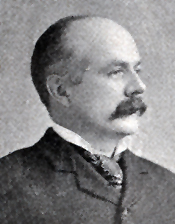
Historical · U.S. House · Michigan · District 6
David Aitken
Former U.S. Representative · Michigan District 6 · 1893–1897 · Republican
David Aitken represented Michigan's District 6 in the United States House of Representatives (1893–1897) for the Republican party. The page below collects sourced biographical facts, term history, committee roles, and provenance for Aitken.
Bioguide ID: A000068
Key facts
- Full name
- David Aitken
- State
- Michigan
- District
- District 6
- Party
- Republican
- House service
- 1893–1897
- First House term
- 1893
- Status
- Left office
- Current term ends
- —
- Born
- 1853
- Bioguide ID
- A000068
- Committee assignments
- —
- Dataset version
- 1.20260606
Biographical narrative
904 words · sourced from the Wikipedia REST extract
David Aitken was an American lawyer and politician who served as a U.S. Representative for Michigan's 6th congressional district from 1893 to 1897. A member of the Republican Party, Aitken's political career was marked by his involvement in local governance and his tenure in the U.S. House of Representatives, where he held significant committee responsibilities. Following his congressional service, he continued to engage in public service and legal practice, leaving a legacy in his community.
Early life and career
David Aitken was born on September 5, 1853, on a farm located in Flint Township, Michigan, which is situated in Genesee County. His upbringing in a rural setting provided him with a foundational understanding of the agricultural and economic issues facing his community. Aitken's father, Robert P. Aitken, was also involved in public service, having served in the Michigan House of Representatives from 1865 to 1868. This familial connection to politics likely influenced Aitken's own aspirations in public life.
Aitken received his early education in the district schools of Flint and attended the local high school, where he developed a strong academic foundation. After completing his education, he took on the role of a teacher in a district school within Genesee County from 1871 to 1872. This experience in education not only contributed to his personal development but also deepened his understanding of the needs and challenges faced by families in his community.
In 1872, Aitken moved to New Jersey, where he began working as a bookkeeper. This position allowed him to gain valuable experience in finance and accounting, skills that would later serve him well in his legal and political careers. Aitken's interest in law led him to study in New York City, where he pursued legal education and was admitted to the bar in 1878. Upon returning to Flint, he commenced his legal practice, establishing himself as a lawyer in the community.
Aitken's early career included significant local government roles. He served as Flint's city clerk from 1883 to 1886, where he was responsible for maintaining public records and overseeing municipal operations. Following this role, he was appointed city attorney, serving from 1886 to 1890. His experiences in these positions provided him with a deep understanding of municipal law and governance, further preparing him for his future political endeavors.
House tenure
David Aitken's political career reached a new height when he was elected as a Republican to the U.S. House of Representatives, representing Michigan's 6th District. His first term in Congress began on March 4, 1893, during the 53rd Congress, and he was subsequently re-elected for the 54th Congress, serving until March 3, 1897. During his time in the House, Aitken was involved in various legislative activities and contributed to discussions on issues pertinent to his constituents and the nation.
One of Aitken's notable roles during his congressional tenure was his position as chairman of the House Committee on Mines and Mining in the 54th Congress. This committee was responsible for overseeing legislation related to mining operations, safety regulations, and the economic impact of mining on local and national levels. Aitken's leadership in this committee reflected his commitment to addressing the interests of Michigan, a state with a significant mining industry.
Despite his contributions to Congress, Aitken chose not to seek renomination for a third term. Instead, he opted to run for Governor of Michigan in 1896. This decision marked a shift in his political ambitions, as he sought to expand his influence beyond the congressional level. However, he was unsuccessful in this gubernatorial bid, losing to Hazen S. Pingree. Following this electoral defeat, Aitken returned to his legal practice, where he continued to serve his community.
Legislative focus and committees
Throughout his congressional career, Aitken's legislative focus was shaped by the economic and social issues facing his constituents in Michigan. His role as chairman of the House Committee on Mines and Mining underscored his commitment to the mining sector, which was vital to Michigan's economy during the late 19th century. This committee's work involved addressing concerns related to labor conditions, safety standards, and the economic implications of mining practices. Aitken's leadership in this area demonstrated his intent to advocate for both the industry and the workers involved.
In addition to his committee responsibilities, Aitken's legislative actions reflected the broader Republican agenda of the time, which included support for economic development, infrastructure improvements, and regulatory measures aimed at fostering growth. His background in law and local governance provided him with a unique perspective on the intersection of policy and community needs, allowing him to contribute meaningfully to legislative discussions.
After concluding his congressional service, Aitken remained active in public life. He served as the mayor of Flint in 1905 and 1906, further solidifying his commitment to local governance and community service. His tenure as mayor allowed him to apply his legal expertise and political experience to address the challenges facing Flint, a city undergoing significant changes during the early 20th century.
David Aitken passed away on May 26, 1930, in Flint, Michigan. He was interred in his family's plot at Glenwood Cemetery, a site of historical significance in the area. Aitken's contributions to both local and national politics are remembered, and his boyhood home in Flint Township is recognized for its historical value, having been listed on The National Register of Historic Places. His legacy as a public servant continues to be acknowledged in the context of Michigan's political history.
Notable legislation
Sponsored and co-sponsored legislation for David Aitken is pending operator curation. The biographical narrative above carries the same provenance trail until per-bill rows are written.
Sources
- [1]https://en.wikipedia.org/wiki/David_D._AitkenWikipedia · retrieved 2026-06-06
Notable quotes
Sourced quotes for David Aitken are pending operator curation. Narrative-scope provenance remains attached below.
Sources
- [1]https://en.wikipedia.org/wiki/David_D._AitkenWikipedia · retrieved 2026-06-06
Key positions
Curated policy positions for David Aitken are pending operator review. The biographical narrative above carries the same provenance trail until per-topic positions are written.
Sources
- [1]https://en.wikipedia.org/wiki/David_D._AitkenWikipedia · retrieved 2026-06-06
Terms served
- 1893–1895U.S. House · Term 1 · Republican
- 1895–1897U.S. House · Term 2 · Republican
Sources & provenance
Every attributable claim above carries a per-section [N] marker that resolves to the corresponding URL below. Each entry records the upstream provider, the canonical URL, and the timestamp at which the source was retrieved by the ingest pipeline.
Key facts
- https://bioguide.congress.gov/search/bio/A000068bioguide · retrieved 2026-06-06
- https://www.govtrack.us/congress/members/400728govtrack · retrieved 2026-06-06
Biographical narrative
- https://en.wikipedia.org/wiki/David_D._Aitkenwikipedia · retrieved 2026-06-06
Find your representative
Every U.S. state elects representatives by district. Browse Michigan’s delegation, the full former-representative roster, or explore the role and term length.
Related on The Candidate
- Preceded by Byron StoutEarlier holder of the Michigan District 6 House seat · Democratic.Open
- Succeeded by Samuel SmithLater holder of the Michigan District 6 House seat · Republican.Open
- Alexander BuelFormer U.S. Representative · Michigan District 1 · DemocraticOpen
- Alfred LuckingFormer U.S. Representative · Michigan District 1 · DemocraticOpen
- Alpheus WilliamsFormer U.S. Representative · Michigan District 1 · DemocraticOpen
- Bart StupakFormer U.S. Representative · Michigan District 1 · DemocraticOpen