
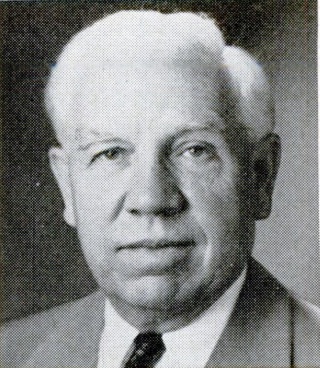
Historical · U.S. House · Michigan · District 6
Kit Clardy
Former U.S. Representative · Michigan District 6 · 1953–1955 · Republican
Kit Clardy represented Michigan's District 6 in the United States House of Representatives (1953–1955) for the Republican party. The page below collects sourced biographical facts, term history, committee roles, and provenance for Clardy.
Bioguide ID: C000416
Key facts
- Full name
- Kit Clardy
- State
- Michigan
- District
- District 6
- Party
- Republican
- House service
- 1953–1955
- First House term
- 1953
- Status
- Left office
- Current term ends
- —
- Born
- 1892
- Bioguide ID
- C000416
- Committee assignments
- —
- Dataset version
- 1.20260605
Biographical narrative
963 words · sourced from the Wikipedia REST extract
Kit Clardy was an American politician who served as a U.S. Representative for Michigan's 6th congressional district from 1953 to 1955. A member of the Republican Party, Clardy is often remembered for his alignment with the anti-communist sentiments of the era, particularly those associated with Senator Joseph McCarthy. His political career was marked by his involvement in the House Committee on Un-American Activities, where he played a significant role in controversial hearings that reflected the intense political climate of the early 1950s.
Early life and career
Kit Francis Clardy was born on June 17, 1892, in Butler, Missouri. His early years were spent in various locations as his family moved first to Kansas City, Missouri, and later to a farm near Liberty, Missouri, in 1907. Clardy's education began in the local schools of Butler and Kansas City, and he continued his studies in Liberty. He later attended William Jewell College, a private liberal arts college in Liberty, where he laid the groundwork for his future academic and professional pursuits.
In 1925, Clardy graduated from the University of Michigan Law School in Ann Arbor, a significant achievement that allowed him to enter the legal profession. Upon his admission to the bar the same year, he began practicing law in Ionia, Michigan, where he worked from 1925 to 1927. His legal career quickly progressed, and he took on a role as the assistant attorney general of Michigan from 1927 to 1931. This position provided him with valuable experience in state legal matters and governance.
Following his tenure as assistant attorney general, Clardy was appointed as a member and later chairman of the Michigan Public Utilities Commission, serving from 1931 to 1934. This role involved overseeing the regulation of public utilities in Michigan, which further solidified his reputation in the political and legal arenas. In 1934, he returned to private legal practice, where he continued to build his career until he entered the political sphere more directly.
House tenure
Clardy's political aspirations took a significant turn in the late 1940s and early 1950s. In 1950, he sought the Republican nomination for the U.S. House of Representatives for Michigan's 6th congressional district but was unsuccessful, losing to the incumbent William W. Blackney in the primary election. However, in 1952, following Blackney's retirement, Clardy successfully secured the Republican nomination and subsequently won the general election against Democrat Donald Hayworth. His victory marked the beginning of his single term in the 83rd Congress, which lasted from January 3, 1953, until January 3, 1955.
During his time in Congress, Clardy became known for his strong anti-communist stance, aligning himself with the sentiments of Senator Joseph McCarthy, who was a prominent figure in the Red Scare of the 1950s. Clardy's involvement with the House Committee on Un-American Activities (HUAC) was particularly notable. In May 1954, he conducted hearings in Lansing, Michigan, where the committee subpoenaed several professors from the University of Michigan, including Chandler Davis, Mark Nickerson, and Clement Markert. These hearings were part of a broader effort to investigate alleged communist influences in American institutions, particularly in education.
Clardy's conduct during these hearings was marked by controversy. He reportedly displayed aggressive behavior towards witnesses, which contributed to a hostile environment. In another hearing held in Flint, Michigan, Clardy's actions were described as inciting violence against the witnesses. His remarks during these proceedings reflected a deep-seated animosity towards perceived communist sympathizers, and his conduct was criticized for fostering a climate of fear and intimidation. The repercussions of these hearings were severe, with reports of mob violence against individuals associated with the accused, leading to significant unrest in the community.
Despite his active involvement in Congress and his alignment with the anti-communist movement, Clardy's political career faced challenges. In the 1954 general election, he was defeated by Donald Hayworth, the same opponent he had previously bested. Following this loss, Clardy attempted to regain his political footing in 1956 but lost the Republican primary to Charles E. Chamberlain, who subsequently won the general election against Hayworth.
Legislative focus and committees
During his brief tenure in the House of Representatives, Clardy's legislative focus was heavily influenced by the political climate of the early 1950s, particularly the pervasive fear of communism that characterized the era. His alignment with the House Committee on Un-American Activities was a defining aspect of his congressional career. The committee was established to investigate alleged disloyalty and subversive activities among private citizens, public employees, and organizations suspected of having communist ties.
Clardy's participation in HUAC hearings illustrated his commitment to the anti-communist cause, which resonated with a segment of the American public that was deeply concerned about the perceived threat of communism during the Cold War. His actions, however, were not without controversy. The aggressive tactics employed during the hearings, including public shaming and intimidation of witnesses, drew criticism from various quarters. The environment created by Clardy and his colleagues contributed to a broader culture of fear that affected many individuals and communities across the nation.
Despite his focus on anti-communism, Clardy's legislative record is less documented in terms of specific bills or initiatives he championed during his time in office. His tenure was primarily characterized by his participation in HUAC and the political battles surrounding the Red Scare. The impact of his actions during this period had lasting implications for civil liberties and the treatment of individuals accused of communist sympathies.
After leaving Congress, Clardy relocated to Palos Verdes Estates, California, in 1956, where he lived until his death in 1961. His life after politics was relatively private, and he is interred at Forest Lawn Memorial Park in Glendale, California. Clardy's legacy remains intertwined with the contentious political landscape of the 1950s, particularly regarding the anti-communist fervor that defined much of American political discourse during that time.
Notable legislation
Sponsored and co-sponsored legislation for Kit Clardy is pending operator curation. The biographical narrative above carries the same provenance trail until per-bill rows are written.
Sources
- [1]https://en.wikipedia.org/wiki/Kit_ClardyWikipedia · retrieved 2026-06-05
Notable quotes
Sourced quotes for Kit Clardy are pending operator curation. Narrative-scope provenance remains attached below.
Sources
- [1]https://en.wikipedia.org/wiki/Kit_ClardyWikipedia · retrieved 2026-06-05
Key positions
Curated policy positions for Kit Clardy are pending operator review. The biographical narrative above carries the same provenance trail until per-topic positions are written.
Sources
- [1]https://en.wikipedia.org/wiki/Kit_ClardyWikipedia · retrieved 2026-06-05
Terms served
- 1953–1955U.S. House · Term 1 · Republican
Sources & provenance
Every attributable claim above carries a per-section [N] marker that resolves to the corresponding URL below. Each entry records the upstream provider, the canonical URL, and the timestamp at which the source was retrieved by the ingest pipeline.
Key facts
- https://bioguide.congress.gov/search/bio/C000416bioguide · retrieved 2026-06-05
- https://www.govtrack.us/congress/members/402555govtrack · retrieved 2026-06-05
Biographical narrative
- https://en.wikipedia.org/wiki/Kit_Clardywikipedia · retrieved 2026-06-05
Find your representative
Every U.S. state elects representatives by district. Browse Michigan’s delegation, the full former-representative roster, or explore the role and term length.
Related on The Candidate
- Preceded by William BlackneyEarlier holder of the Michigan District 6 House seat · Republican.Open
- Succeeded by Donald HayworthLater holder of the Michigan District 6 House seat · Democratic.Open
- Alexander BuelFormer U.S. Representative · Michigan District 1 · DemocraticOpen
- Alfred LuckingFormer U.S. Representative · Michigan District 1 · DemocraticOpen
- Alpheus WilliamsFormer U.S. Representative · Michigan District 1 · DemocraticOpen
- Bart StupakFormer U.S. Representative · Michigan District 1 · DemocraticOpen