
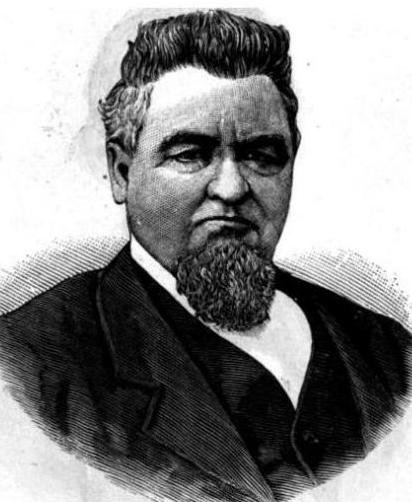
Historical · U.S. House · Michigan · District 8
Roswell Horr
Former U.S. Representative · Michigan District 8 · 1879–1885 · Republican
Roswell Horr represented Michigan's District 8 in the United States House of Representatives (1879–1885) for the Republican party. The page below collects sourced biographical facts, term history, committee roles, and provenance for Horr.
Bioguide ID: H000794
Key facts
- Full name
- Roswell Horr
- State
- Michigan
- District
- District 8
- Party
- Republican
- House service
- 1879–1885
- First House term
- 1879
- Status
- Left office
- Current term ends
- —
- Born
- 1830
- Bioguide ID
- H000794
- Committee assignments
- —
- Dataset version
- 1.20260606
Biographical narrative
908 words · sourced from the Wikipedia REST extract
Roswell Horr was a notable American politician who served as a U.S. Representative from Michigan's 8th congressional district during the late 19th century. A member of the Republican Party, he held office for three consecutive terms in the United States Congress from 1879 to 1885. His career in public service was marked by his involvement in various political and civic activities, both before and after his tenure in Congress. Following his political career, Horr transitioned into journalism, contributing to the New York Tribune until his death in 1896.
Early life and career
Roswell Gilbert Horr was born on November 26, 1830, in Waitsfield, Vermont. His early years were spent in a family that moved to Lorain County, Ohio, in 1834. This relocation provided him with the opportunity to attend public schools in Ohio, where he received a foundational education. Demonstrating a commitment to learning, Horr graduated from Antioch College in Yellow Springs, Ohio, in 1857. His academic achievements were complemented by his early professional endeavors; he served as the clerk of the court of common pleas in Lorain County from 1857 to 1862, a position he was reelected to in 1860.
Horr's legal career began after he studied law and was admitted to the bar in 1862. He commenced his practice in Elyria, Ohio, where he gained experience and established himself within the legal community. However, in 1866, he made a significant life change by moving to southeastern Missouri, where he engaged in mining activities for six years. This period in Missouri likely provided him with insights into the economic and labor issues of the time, which would later inform his political perspectives.
In 1872, Horr relocated to East Saginaw, Michigan, marking a pivotal shift in his career. His move to Michigan not only expanded his professional opportunities but also positioned him within a state that was rapidly developing during the post-Civil War era. The economic growth and political dynamics of Michigan during this time would play a crucial role in shaping his future political career.
House tenure
Roswell Horr's political career in the U.S. House of Representatives began when he was elected as a Republican to represent Michigan's 8th congressional district. He took office on March 4, 1879, and served three consecutive terms, concluding his service on March 3, 1885. His election to the 46th Congress marked the beginning of a significant chapter in his life, as he became actively involved in national legislative matters.
During his time in Congress, Horr participated in the legislative process during a period characterized by significant political and social changes in the United States. The late 19th century was marked by industrialization, the expansion of railroads, and various reforms aimed at addressing the challenges of a rapidly changing society. As a member of the Republican Party, Horr aligned himself with the party's platform, which often emphasized economic growth, infrastructure development, and support for business interests.
Horr's congressional career included serving in the 47th and 48th Congresses, where he continued to advocate for policies that aligned with his party's goals. However, his tenure in Congress came to an end after he was unsuccessful in his bid for reelection in 1884. Following his departure from the House, he remained active in political circles, serving as a delegate to the Republican National Convention in 1884. This involvement demonstrated his continued commitment to the Republican Party and its principles, even after leaving office.
In 1886, Horr attempted to return to Congress as a candidate for the 50th U.S. Congress but was unsuccessful in this endeavor. His political aspirations, while not fully realized in subsequent attempts, reflected his dedication to public service and his desire to influence the legislative process.
Legislative focus and committees
Throughout his congressional tenure, Roswell Horr's legislative focus was likely influenced by the pressing issues of his time, including economic development, labor rights, and the expansion of infrastructure. While specific details regarding the bills he sponsored or the committees he served on are not provided, it can be inferred that as a Republican representative during a period of significant industrial growth, he would have engaged with legislation that addressed the needs and concerns of his constituents in Michigan.
The late 19th century was a time of transformation in the United States, with the nation grappling with the implications of rapid industrialization and urbanization. Issues such as labor rights, economic policy, and the regulation of corporations were at the forefront of national discourse. As a member of Congress, Horr would have had the opportunity to contribute to discussions and decisions surrounding these critical topics, advocating for policies that reflected the interests of his district and the broader Republican agenda.
After leaving Congress, Horr transitioned to a career in journalism, which allowed him to continue engaging with political and social issues. In 1890, he moved to New York City, where he took on the role of associate editor for the New York Tribune. This position enabled him to influence public opinion and contribute to the national conversation on various matters, drawing on his experiences as a former legislator.
Horr's life came to an end on December 19, 1896, in Plainfield, New Jersey. His contributions to public service and journalism left a legacy that reflected the complexities of American politics during a transformative era. He was interred in Greenwood Cemetery in Wellington, Ohio, marking the final resting place of a figure who played a role in the political landscape of his time.
Notable legislation
Sponsored and co-sponsored legislation for Roswell Horr is pending operator curation. The biographical narrative above carries the same provenance trail until per-bill rows are written.
Sources
- [1]https://en.wikipedia.org/wiki/Roswell_G._HorrWikipedia · retrieved 2026-06-06
Notable quotes
Sourced quotes for Roswell Horr are pending operator curation. Narrative-scope provenance remains attached below.
Sources
- [1]https://en.wikipedia.org/wiki/Roswell_G._HorrWikipedia · retrieved 2026-06-06
Key positions
Curated policy positions for Roswell Horr are pending operator review. The biographical narrative above carries the same provenance trail until per-topic positions are written.
Sources
- [1]https://en.wikipedia.org/wiki/Roswell_G._HorrWikipedia · retrieved 2026-06-06
Terms served
- 1879–1881U.S. House · Term 1 · Republican
- 1881–1883U.S. House · Term 2 · Republican
- 1883–1885U.S. House · Term 3 · Republican
Sources & provenance
Every attributable claim above carries a per-section [N] marker that resolves to the corresponding URL below. Each entry records the upstream provider, the canonical URL, and the timestamp at which the source was retrieved by the ingest pipeline.
Key facts
- https://bioguide.congress.gov/search/bio/H000794bioguide · retrieved 2026-06-06
- https://www.govtrack.us/congress/members/405643govtrack · retrieved 2026-06-06
Biographical narrative
- https://en.wikipedia.org/wiki/Roswell_G._Horrwikipedia · retrieved 2026-06-06
Find your representative
Every U.S. state elects representatives by district. Browse Michigan’s delegation, the full former-representative roster, or explore the role and term length.
Related on The Candidate
- Preceded by Charles EllsworthEarlier holder of the Michigan District 8 House seat · Republican.Open
- Succeeded by Timothy TarsneyLater holder of the Michigan District 8 House seat · Democratic.Open
- Alexander BuelFormer U.S. Representative · Michigan District 1 · DemocraticOpen
- Alfred LuckingFormer U.S. Representative · Michigan District 1 · DemocraticOpen
- Alpheus WilliamsFormer U.S. Representative · Michigan District 1 · DemocraticOpen
- Bart StupakFormer U.S. Representative · Michigan District 1 · DemocraticOpen