
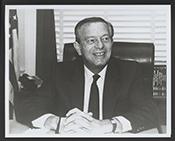
Historical · U.S. House · Michigan · District 9
Guy Vander Jagt
Former U.S. Representative · Michigan District 9 · 1965–1993 · Republican
Guy Vander Jagt represented Michigan's District 9 in the United States House of Representatives (1965–1993) for the Republican party. The page below collects sourced biographical facts, term history, committee roles, and provenance for Jagt.
Bioguide ID: V000027
Key facts
- Full name
- Guy Vander Jagt
- State
- Michigan
- District
- District 9
- Party
- Republican
- House service
- 1965–1993
- First House term
- 1965
- Status
- Left office
- Current term ends
- —
- Born
- 1931
- Bioguide ID
- V000027
- Committee assignments
- —
- Dataset version
- 1.20260605
Biographical narrative
1,056 words · sourced from the Wikipedia REST extract
Guy Vander Jagt was a prominent American lawyer and politician who served as a Republican member of the U.S. House of Representatives for Michigan's 9th congressional district from 1966 until 1993. Renowned for his exceptional public speaking skills, Vander Jagt held various leadership roles within the Republican Party, including serving as chairman of the National Republican Congressional Committee. His long tenure in Congress was marked by significant involvement in legislative matters, particularly in areas related to science, trade, and tax policy.
Early life and career
Guy Adrian Vander Jagt was born on August 26, 1931, in Cadillac, Michigan, to Harry and Marie Vander Jagt. His father, a Dutch immigrant, worked as a rancher, and the family operated a 120-acre farm in the vicinity of Cadillac. Vander Jagt's early experiences on the farm contributed to his work ethic and sense of community. He demonstrated an aptitude for public speaking during his high school years, notably while preaching at the Tustin Presbyterian Church. His talent in oratory was further recognized when he became the state debate champion in Michigan for three consecutive years while attending Hope College, where he graduated in 1953. During his senior year, he also won the National Oratorical Championship and served as the student body president, showcasing his leadership abilities.
Following his undergraduate studies, Vander Jagt attended Yale Divinity School, earning a Bachelor of Divinity degree in 1955. He further expanded his academic horizons through a Rotary Foundation Fellowship, which allowed him to study at the University of Bonn in Germany for a year. Upon returning to West Michigan, he briefly served as an interim pastor at the Cadillac Congregational Church before transitioning to a career in journalism. Vander Jagt worked as a newscaster and news director at WWTV, a local television station, where he was known for memorizing his broadcast scripts.
In pursuit of a legal career, Vander Jagt enrolled at Georgetown University Law School but later transferred to the University of Michigan Law School, where he received his Juris Doctor degree in 1960. After completing his education, he began practicing law in Grand Rapids, Michigan. His legal background would later inform his legislative work in Congress.
Vander Jagt's political career began in earnest when he was elected to the Michigan State Senate in 1964. His tenure in the state legislature set the stage for his subsequent entry into national politics. Following the death of U.S. Senator Patrick V. McNamara in April 1966, Vander Jagt was among the leading candidates considered for appointment to the vacant Senate seat. However, after determining that he would not receive the necessary support, he withdrew from consideration and instead chose to run for the U.S. House of Representatives in Michigan's 9th congressional district.
House tenure
Vander Jagt officially began his congressional career on November 8, 1966, when he won both a special election to complete the remainder of Griffin's term and a regular election for a full two-year term. He was re-elected 12 times during his tenure, establishing himself as a dominant figure in a district that was widely regarded as one of the most Republican in Michigan. His electoral success was characterized by a lack of serious opposition, allowing him to focus on his legislative priorities.
Throughout his time in the House, Vander Jagt was appointed to several important committees that shaped his legislative agenda. One of his earliest appointments was to the House Committee on Science and Astronautics, where he played a role during the early years of the U.S. space program, contributing to initiatives that eventually led to the Moon landing. He also served on the Conservation and National Resources Subcommittee, where he was instrumental in the establishment of Sleeping Bear Dunes National Lakeshore, a significant conservation effort in his home state. However, he later expressed concerns about the management of the park, highlighting issues related to land acquisition processes.
In addition to his work on environmental issues, Vander Jagt was a member of the Committee on Foreign Affairs, where he participated in trade missions to various countries in Africa and Asia. His involvement in international relations was complemented by his later appointment to the Ways and Means Committee in 1974, where he served throughout his congressional career. This committee was pivotal in shaping U.S. tax policy and trade legislation, and Vander Jagt's contributions included work on the Trade and Select Revenue Measures Subcommittees.
Vander Jagt's leadership within the Republican Party was further solidified when he was elected chairman of the National Republican Congressional Committee in 1975. In this role, he played a significant part in strategizing and supporting Republican candidates across the country. His influence extended to mentoring younger party members, including Newt Gingrich, whom he appointed to lead a long-range planning committee even before Gingrich officially took office.
Legislative focus and committees
Throughout his congressional career, Vander Jagt was known for his focus on a variety of legislative issues, including tax reform and the repeal of the Twenty-Second Amendment to the United States Constitution. In the late 1980s, he became a prominent advocate for repealing this amendment, which limits U.S. Presidents to two terms in office. Vander Jagt's rationale for this initiative stemmed from his admiration for President Ronald Reagan, whom he regarded as one of the greatest American Presidents. He sponsored amendments aimed at repealing the term limits multiple times during his tenure.
In 1992, Vander Jagt faced a significant challenge when his district was renumbered as the 2nd district due to reapportionment. For the first time since his initial election, he encountered serious competition in the primary election from Pete Hoekstra, a local businessman and fellow Dutch-American. Despite his long-standing incumbency, Vander Jagt's campaign was impacted by the changing political landscape and the emergence of a formidable opponent.
Vander Jagt's congressional career concluded on January 3, 1993, after a lengthy and impactful tenure that spanned nearly three decades. His legacy in the House of Representatives is characterized by his commitment to public service, his leadership within the Republican Party, and his contributions to various legislative initiatives that shaped the political landscape of his time. Following his departure from Congress, Vander Jagt remained active in various capacities until his passing on June 22, 2007. His life and career reflect a significant chapter in Michigan's political history and the broader narrative of American governance during the late 20th century.
Notable legislation
Sponsored and co-sponsored legislation for Guy Vander Jagt is pending operator curation. The biographical narrative above carries the same provenance trail until per-bill rows are written.
Sources
- [1]https://en.wikipedia.org/wiki/Guy_Vander_JagtWikipedia · retrieved 2026-06-05
Notable quotes
Sourced quotes for Guy Vander Jagt are pending operator curation. Narrative-scope provenance remains attached below.
Sources
- [1]https://en.wikipedia.org/wiki/Guy_Vander_JagtWikipedia · retrieved 2026-06-05
Key positions
Curated policy positions for Guy Vander Jagt are pending operator review. The biographical narrative above carries the same provenance trail until per-topic positions are written.
Sources
- [1]https://en.wikipedia.org/wiki/Guy_Vander_JagtWikipedia · retrieved 2026-06-05
Terms served
- 1965–1967U.S. House · Term 1 · Republican
- 1967–1969U.S. House · Term 2 · Republican
- 1969–1971U.S. House · Term 3 · Republican
- 1971–1973U.S. House · Term 4 · Republican
- 1973–1975U.S. House · Term 5 · Republican
- 1975–1977U.S. House · Term 6 · Republican
- 1977–1979U.S. House · Term 7 · Republican
- 1979–1981U.S. House · Term 8 · Republican
- 1981–1983U.S. House · Term 9 · Republican
- 1983–1985U.S. House · Term 10 · Republican
- 1985–1987U.S. House · Term 11 · Republican
- 1987–1989U.S. House · Term 12 · Republican
- 1989–1991U.S. House · Term 13 · Republican
- 1991–1993U.S. House · Term 14 · Republican
Sources & provenance
Every attributable claim above carries a per-section [N] marker that resolves to the corresponding URL below. Each entry records the upstream provider, the canonical URL, and the timestamp at which the source was retrieved by the ingest pipeline.
Key facts
- https://bioguide.congress.gov/search/bio/V000027bioguide · retrieved 2026-06-05
- https://www.govtrack.us/congress/members/411119govtrack · retrieved 2026-06-05
Biographical narrative
- https://en.wikipedia.org/wiki/Guy_Vander_Jagtwikipedia · retrieved 2026-06-05
Find your representative
Every U.S. state elects representatives by district. Browse Michigan’s delegation, the full former-representative roster, or explore the role and term length.
Related on The Candidate
- Preceded by Ruth ThompsonEarlier holder of the Michigan District 9 House seat · Republican.Open
- Succeeded by Joe KnollenbergLater holder of the Michigan District 9 House seat · Republican.Open
- Alexander BuelFormer U.S. Representative · Michigan District 1 · DemocraticOpen
- Alfred LuckingFormer U.S. Representative · Michigan District 1 · DemocraticOpen
- Alpheus WilliamsFormer U.S. Representative · Michigan District 1 · DemocraticOpen
- Bart StupakFormer U.S. Representative · Michigan District 1 · DemocraticOpen