
Historical · U.S. House · Minnesota · District 1
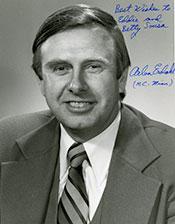
Arlen Erdahl
Former U.S. Representative · Minnesota District 1 · 1979–1983 · Republican
Arlen Erdahl represented Minnesota's District 1 in the United States House of Representatives (1979–1983) for the Republican party. The page below collects sourced biographical facts, term history, committee roles, and provenance for Erdahl.
Bioguide ID: E000198
Key facts
- Full name
- Arlen Erdahl
- State
- Minnesota
- District
- District 1
- Party
- Republican
- House service
- 1979–1983
- First House term
- 1979
- Status
- Left office
- Current term ends
- —
- Born
- 1931
- Bioguide ID
- E000198
- Committee assignments
- —
- Dataset version
- 1.20260605
Biographical narrative
971 words · sourced from the Wikipedia REST extract
Arlen Ingolf Erdahl was an American politician and farmer who served as a U.S. Representative for Minnesota's 1st congressional district from 1979 to 1983. A member of the Republican Party, Erdahl had a notable political career that included serving in the Minnesota House of Representatives and as the Minnesota Secretary of State. His contributions to public service extended beyond his congressional tenure, as he held various positions in federal agencies, including the Peace Corps and the U.S. Department of Energy. Erdahl's life was marked by a commitment to public service and community engagement, reflecting his deep roots in Minnesota.
Early life and career
Arlen Erdahl was born on February 27, 1931, in Blue Earth, Minnesota. He was one of two children, having a twin brother named Lowell. Erdahl's family background was steeped in Norwegian heritage, with his mother being born in Norway and his father of Norwegian descent. He received his early education in public schools located in Faribault County, Minnesota. Following high school, Erdahl pursued higher education at St. Olaf College, where he earned a bachelor's degree in 1953. His academic journey continued at Harvard University, where he obtained a Master of Public Administration (MPA) in 1966.
In addition to his academic pursuits, Erdahl served in the United States Army from 1954 to 1956, which contributed to his understanding of public service and governance. After his military service, he returned to Minnesota and worked as a grain and livestock farmer in Blue Earth. This experience in agriculture provided him with a practical understanding of the challenges faced by rural communities, which would later inform his political career.
Erdahl's entry into politics began in 1963 when he was elected to the Minnesota House of Representatives, where he served until 1970. During his tenure in the state legislature, he aligned himself with conservative factions within the officially nonpartisan body. His legislative work during this period laid the groundwork for his future political endeavors. In 1970, Erdahl was elected as Minnesota's Secretary of State, a position he held from 1971 to 1975. His tenure in this office was marked by a commitment to electoral integrity and public service.
Despite a successful term as Secretary of State, Erdahl faced challenges in his political career. He sought reelection in 1974 but was defeated by Joan Growe, a State Representative who would go on to serve in the role for 24 years. Following his time as Secretary of State, Erdahl served on the Minnesota Public Service Commission from 1975 to 1978, where he continued to engage in public service and policy-making.
House tenure
In 1978, Erdahl ran for the U.S. House of Representatives, seeking to represent Minnesota's 1st congressional district. The seat became available when the incumbent, Al Quie, retired after two decades in Congress to pursue the governorship of Minnesota. Erdahl won the Republican nomination and faced Democratic nominee Gerry Sikorski in the general election. He secured his seat in Congress with a decisive victory, receiving approximately 56% of the vote compared to Sikorski's 43%.
Erdahl began his first term in the House of Representatives in January 1979. During his time in Congress, he focused on issues relevant to his constituents, drawing on his experiences as a farmer and public servant. His legislative priorities were influenced by his background in agriculture and his understanding of rural issues, which were significant in Minnesota's 1st congressional district.
Erdahl was reelected in 1980, continuing to serve in the House until January 3, 1983. However, his political fortunes changed in 1982 due to congressional reapportionment, which altered the boundaries of his district. He chose to run in Minnesota's 6th congressional district, where he faced a rematch against Gerry Sikorski. This time, Erdahl was narrowly defeated, receiving approximately 49% of the vote compared to Sikorski's 51%. This loss marked the end of his congressional career, concluding his two terms in the U.S. House of Representatives.
Legislative focus and committees
During his tenure in the House, Erdahl was involved in various legislative initiatives and served on several committees. His background in agriculture and public service informed his legislative focus, allowing him to advocate for policies that benefitted rural communities and addressed the needs of his constituents. Erdahl's work in Congress reflected his commitment to public service and his understanding of the challenges faced by those in his district.
Following his time in Congress, Erdahl continued to serve in public roles. He was appointed to significant positions in federal agencies, including the Peace Corps, where he served as Country Director and later as Associate Director from 1983 to 1989. His work in the Peace Corps emphasized international service and development, aligning with his commitment to civic engagement and global citizenship. Erdahl also held a position at the U.S. Department of Energy, serving as Principal Deputy/Acting Assistant Secretary for International Affairs from 1989 to 1993.
Erdahl's contributions to public life extended beyond his official roles. He was active in various organizations, including the United Nations Association of Minnesota and the Nobel Peace Prize Forum. His involvement in these organizations demonstrated his dedication to promoting peace and international cooperation. Additionally, he served on the boards of several civic organizations, including the Minnesota chapter of People to People and the Minneapolis Lodge of the Sons of Norway.
In recognition of his public service, Erdahl received several awards, including the Twin Cities International Citizen Award in 1999 and the Hubert H. Humphrey Public Leadership Award in 2011 from the Humphrey School of Public Affairs at the University of Minnesota. These honors reflected his long-standing commitment to public leadership and community engagement.
Arlen Erdahl passed away on September 21, 2023, in Minneapolis at the age of 92, after battling Alzheimer's disease in his later years. His legacy as a public servant and advocate for rural communities remains a significant part of Minnesota's political history.
Notable legislation
Sponsored and co-sponsored legislation for Arlen Erdahl is pending operator curation. The biographical narrative above carries the same provenance trail until per-bill rows are written.
Sources
- [1]https://en.wikipedia.org/wiki/Arlen_ErdahlWikipedia · retrieved 2026-06-05
Notable quotes
Sourced quotes for Arlen Erdahl are pending operator curation. Narrative-scope provenance remains attached below.
Sources
- [1]https://en.wikipedia.org/wiki/Arlen_ErdahlWikipedia · retrieved 2026-06-05
Key positions
Curated policy positions for Arlen Erdahl are pending operator review. The biographical narrative above carries the same provenance trail until per-topic positions are written.
Sources
- [1]https://en.wikipedia.org/wiki/Arlen_ErdahlWikipedia · retrieved 2026-06-05
Terms served
- 1979–1981U.S. House · Term 1 · Republican
- 1981–1983U.S. House · Term 2 · Republican
Sources & provenance
Every attributable claim above carries a per-section [N] marker that resolves to the corresponding URL below. Each entry records the upstream provider, the canonical URL, and the timestamp at which the source was retrieved by the ingest pipeline.
Key facts
- https://bioguide.congress.gov/search/bio/E000198bioguide · retrieved 2026-06-05
- https://www.govtrack.us/congress/members/403885govtrack · retrieved 2026-06-05
Biographical narrative
- https://en.wikipedia.org/wiki/Arlen_Erdahlwikipedia · retrieved 2026-06-05
Find your representative
Every U.S. state elects representatives by district. Browse Minnesota’s delegation, the full former-representative roster, or explore the role and term length.
Related on The Candidate
- Preceded by Albert QuieEarlier holder of the Minnesota District 1 House seat · Republican.Open
- Succeeded by Timothy PennyLater holder of the Minnesota District 1 House seat · Democratic.Open
- Allen FurlowFormer U.S. Representative · Minnesota District 1 · RepublicanOpen
- August AndresenFormer U.S. Representative · Minnesota District 1 · RepublicanOpen
- Gil GutknechtFormer U.S. Representative · Minnesota District 1 · RepublicanOpen
- Republican PartyFederal candidates and office holders on the Republican line.Open