
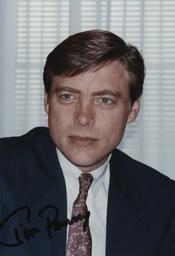
Historical · U.S. House · Minnesota · District 1
Timothy Penny
Former U.S. Representative · Minnesota District 1 · 1983–1995 · Democratic
Timothy Penny represented Minnesota's District 1 in the United States House of Representatives (1983–1995) for the Democratic party. The page below collects sourced biographical facts, term history, committee roles, and provenance for Penny.
Bioguide ID: P000215
Key facts
- Full name
- Timothy Penny
- State
- Minnesota
- District
- District 1
- Party
- Democratic
- House service
- 1983–1995
- First House term
- 1983
- Status
- Left office
- Current term ends
- —
- Born
- 1951
- Bioguide ID
- P000215
- Committee assignments
- —
- Dataset version
- 1.20260605
Biographical narrative
864 words · sourced from the Wikipedia REST extract
Timothy J. Penny is a former U.S. Representative who served Minnesota's 1st congressional district from 1983 to 1995 as a member of the Democratic-Farmer-Labor Party. Born on November 19, 1951, in Albert Lea, Minnesota, Penny has had a diverse career that includes roles as a politician, author, and musician. After leaving Congress, he continued to engage in public service and political discourse, notably as a gubernatorial candidate in 2002 and as a leader in various nonprofit and educational organizations.
Early life and career
Timothy Joseph Penny was born in Albert Lea, Minnesota, where he spent his formative years. He pursued higher education at Winona State College, earning a bachelor's degree in political science in 1974. His early career included service in the United States Naval Reserve, where he achieved the rank of lieutenant commander. This military background contributed to his leadership skills and understanding of public service.
Penny's political career began in earnest when he was elected to the Minnesota Senate, where he served from 1976 to 1982. His tenure in the state legislature provided him with valuable experience in governance and policy-making, laying the groundwork for his future congressional career. During this period, he developed a reputation for addressing issues relevant to his constituents and engaging in bipartisan efforts.
In 1982, Penny sought the Democratic-Farmer-Labor Party nomination for Minnesota's 1st congressional district. His campaign was marked by a significant upset against four-term Republican incumbent Tom Hagedorn. This victory was notable as it made Penny only the third Democrat to represent the district since its establishment. His success was aided by a divided Republican Party and a national trend favoring Democratic candidates during that election cycle.
House tenure
Penny's first term in the U.S. House of Representatives began in 1983, and he was re-elected multiple times, serving a total of six terms until his departure from Congress in 1995. His initial victory was followed by a strong showing in the 1984 election, where he became the first non-Republican to win re-election in the district since its statehood. Over the course of his congressional career, Penny consistently garnered substantial support from voters, often winning by significant margins.
As a member of the House, Penny was recognized as a somewhat conservative Democrat, reflecting the values of his predominantly rural constituency in southern Minnesota. His political positions included opposition to gun control and abortion, although he later shifted to a pro-choice stance. Penny's legislative focus was primarily on fiscal policy, where he sought to address budgetary concerns and promote economic stability.
Throughout his time in Congress, Penny built a strong reputation and a nearly unbreakable hold on his district. However, in 1994, he announced that he would not seek a seventh term, marking the end of his congressional career. Following his departure, he played an informal advisory role to Minnesota Governor Jesse Ventura, assisting with the transition team after Ventura's election in 1998.
Legislative focus and committees
During his tenure in the House of Representatives, Timothy Penny was involved in various legislative initiatives and served on several committees that aligned with his interests and the needs of his constituents. His work on fiscal policy was particularly notable, as he aimed to address the economic challenges facing his district and the nation. Penny's approach to governance was characterized by a focus on pragmatic solutions and a willingness to engage in bipartisan discussions.
Penny's legislative priorities often reflected the concerns of his rural constituents, including agricultural issues, economic development, and fiscal responsibility. His background in the Minnesota Senate provided him with insights into state-level governance, which he applied to his work in Congress. He was known for his ability to navigate complex political landscapes and advocate for policies that benefited his district.
After leaving Congress, Penny continued to engage in public service and political discourse. In 2002, he ran for governor of Minnesota as the Independence Party's nominee, positioning himself as a candidate representing the "sensible center." Although he did not win the election, his campaign reflected his ongoing commitment to public service and engagement in political issues.
In addition to his political activities, Penny has contributed to public discourse through his writings. He is the co-author of several books that explore the workings of Congress and political reform. His works include "Common Cents: A Retiring Six-Term Congressman Reveals How Congress Really Works — And What We Must Do to Fix It," which provides insights into the legislative process and the challenges faced by lawmakers.
Penny's post-congressional career has included leadership roles in various organizations. He serves as the president of the Southern Minnesota Initiative Foundation and has held positions at the University of Minnesota's Humphrey Institute, where he has contributed to discussions on public policy and governance. His involvement in nonprofit organizations and advisory boards reflects his ongoing commitment to civic engagement and community development.
In his personal life, Penny resides in Owatonna, Minnesota, and is a father to four adult children. He is also known for his musical talents, serving as the lead singer and guitarist in a band called Led Penny. Through his diverse career and continued involvement in public service, Timothy Penny has maintained a presence in Minnesota's political and civic landscape.
Notable legislation
Sponsored and co-sponsored legislation for Timothy Penny is pending operator curation. The biographical narrative above carries the same provenance trail until per-bill rows are written.
Sources
- [1]https://en.wikipedia.org/wiki/Tim_PennyWikipedia · retrieved 2026-06-05
Notable quotes
Sourced quotes for Timothy Penny are pending operator curation. Narrative-scope provenance remains attached below.
Sources
- [1]https://en.wikipedia.org/wiki/Tim_PennyWikipedia · retrieved 2026-06-05
Key positions
Curated policy positions for Timothy Penny are pending operator review. The biographical narrative above carries the same provenance trail until per-topic positions are written.
Sources
- [1]https://en.wikipedia.org/wiki/Tim_PennyWikipedia · retrieved 2026-06-05
Terms served
- 1983–1985U.S. House · Term 1 · Democratic
- 1985–1987U.S. House · Term 2 · Democratic
- 1987–1989U.S. House · Term 3 · Democratic
- 1989–1991U.S. House · Term 4 · Democratic
- 1991–1993U.S. House · Term 5 · Democratic
- 1993–1995U.S. House · Term 6 · Democratic
Sources & provenance
Every attributable claim above carries a per-section [N] marker that resolves to the corresponding URL below. Each entry records the upstream provider, the canonical URL, and the timestamp at which the source was retrieved by the ingest pipeline.
Key facts
- https://bioguide.congress.gov/search/bio/P000215bioguide · retrieved 2026-06-05
- https://www.govtrack.us/congress/members/408618govtrack · retrieved 2026-06-05
Biographical narrative
- https://en.wikipedia.org/wiki/Tim_Pennywikipedia · retrieved 2026-06-05
Find your representative
Every U.S. state elects representatives by district. Browse Minnesota’s delegation, the full former-representative roster, or explore the role and term length.
Related on The Candidate
- Preceded by Arlen ErdahlEarlier holder of the Minnesota District 1 House seat · Republican.Open
- Succeeded by Gil GutknechtLater holder of the Minnesota District 1 House seat · Republican.Open
- Albert QuieFormer U.S. Representative · Minnesota District 1 · RepublicanOpen
- Allen FurlowFormer U.S. Representative · Minnesota District 1 · RepublicanOpen
- August AndresenFormer U.S. Representative · Minnesota District 1 · RepublicanOpen
- Democratic PartyFederal candidates and office holders on the Democratic line.Open