
Historical · U.S. House · Minnesota · District 1
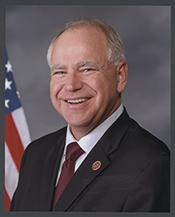
Timothy Walz
Former U.S. Representative · Minnesota District 1 · 2007–2019 · Democratic
Timothy Walz represented Minnesota's District 1 in the United States House of Representatives (2007–2019) for the Democratic party. The page below collects sourced biographical facts, term history, committee roles, and provenance for Walz.
Bioguide ID: W000799
Key facts
- Full name
- Timothy Walz
- State
- Minnesota
- District
- District 1
- Party
- Democratic
- House service
- 2007–2019
- First House term
- 2007
- Status
- Left office
- Current term ends
- —
- Born
- 1964
- Bioguide ID
- W000799
- Committee assignments
- —
- Dataset version
- 1.20260605
Biographical narrative
953 words · sourced from the Wikipedia REST extract
Timothy J. Walz is a former U.S. Representative who served Minnesota's 1st congressional district from 2007 until 2019. A member of the Democratic Party, Walz has a background as an educator and an Army National Guard veteran. Following his tenure in Congress, he was elected as the 41st governor of Minnesota in 2018, a position he continues to hold as of 2023. His political career has been marked by a focus on education, veterans' affairs, and progressive legislation.
Early life and career
Timothy James Walz was born on April 6, 1964, in West Point, Nebraska. He was raised in a family with a strong educational background; his father, James Frederick Walz, was a teacher and school superintendent who served in the U.S. Army during the Korean War. His mother, Darlene Rose Reiman, was a homemaker with roots in farming. Walz's heritage includes German, Swedish, Luxembourgish, and Irish ancestry, with his great-great-grandfather having emigrated from Germany in 1867. He was raised in the Catholic faith alongside his three siblings in Valentine, Nebraska, a small rural community characterized by its agricultural landscape.
During his school years, Walz was active in sports, participating in football, basketball, and track. His formative years were marked by personal challenges, particularly when his father was diagnosed with lung cancer, prompting the family to relocate to Butte, Nebraska, to be closer to relatives. After graduating from Butte High School in 1982, Walz joined the Army National Guard and worked in various jobs, including a factory position in Texas.
Walz pursued higher education at Chadron State College in Nebraska, where he earned a Bachelor of Science degree in social science education in 1989. He later obtained a master's degree from Minnesota State University, Mankato, where he focused on Holocaust and genocide education in his thesis. Although he began a Doctor of Education program at Saint Mary's University of Minnesota, he did not complete it.
Walz's early career was rooted in education. He initially taught at Foshan No.1 High School in China through the WorldTeach program shortly after the Tiananmen Square protests. Upon returning to the United States, he taught in Alliance, Nebraska, where he was recognized as an Outstanding Young Nebraskan in 1993. In 1996, he moved to Mankato, Minnesota, where he continued teaching and coaching at Mankato West High School. His coaching tenure was notable for transforming a struggling football team into state champions within a few years. Additionally, he was an advocate for inclusivity, serving as the faculty advisor for the school's first gay-straight alliance.
House tenure
Tim Walz entered politics by running for the U.S. House of Representatives in 2006, successfully defeating six-term Republican incumbent Gil Gutknecht. He officially began his congressional career in January 2007. Over the course of his six terms in office, Walz focused on various issues, particularly those affecting veterans, education, and rural communities. His background as a teacher and a veteran informed his legislative priorities and approach to governance.
During his time in the House, Walz served on several committees, including the House Committee on Veterans' Affairs, where he became the ranking member from 2017 to 2019. His work in this role involved advocating for veterans' benefits and addressing issues related to military service members and their families. He was known for his bipartisan approach, often seeking to collaborate across party lines to achieve legislative goals.
Walz's legislative record includes a range of initiatives aimed at improving healthcare access for veterans, enhancing educational opportunities, and supporting economic development in rural areas. His experience as an educator influenced his commitment to education reform and funding for schools, particularly in underserved communities. He was also involved in discussions surrounding healthcare policy, including efforts to expand access and affordability.
In 2018, Walz decided to run for governor of Minnesota, concluding his congressional tenure on January 3 of that year. His campaign focused on progressive values, emphasizing healthcare, education, and economic equity. He was elected governor later that year and subsequently reelected in 2022.
Legislative focus and committees
Throughout his congressional career, Tim Walz demonstrated a commitment to a variety of legislative issues, with a particular emphasis on veterans' affairs, education, and rural development. His background as a veteran and educator shaped his priorities, allowing him to advocate effectively for policies that addressed the needs of these communities.
As a member of the House Committee on Veterans' Affairs, Walz worked on initiatives aimed at improving the quality of care and services provided to veterans. He was involved in efforts to reform the Department of Veterans Affairs, focusing on reducing wait times for healthcare services and enhancing support for mental health programs. His leadership as the ranking member of the committee allowed him to influence key legislation that impacted veterans' benefits and services.
In addition to veterans' issues, Walz was a strong advocate for education. His experience as a teacher informed his legislative efforts to secure funding for public schools and improve educational outcomes for students. He supported initiatives aimed at increasing access to higher education, particularly for low-income families, and championed policies that promoted educational equity.
Walz also focused on rural development, recognizing the unique challenges faced by rural communities in Minnesota and across the nation. He advocated for policies that supported economic growth, infrastructure development, and access to healthcare in these areas. His efforts included promoting agricultural initiatives and supporting small businesses to enhance economic opportunities in rural regions.
Overall, Tim Walz's legislative focus was characterized by a commitment to serving the needs of his constituents, particularly veterans, students, and rural communities. His tenure in the U.S. House of Representatives laid the groundwork for his subsequent role as governor, where he continued to pursue a progressive agenda aimed at addressing the challenges facing Minnesota.
Notable legislation
Sponsored and co-sponsored legislation for Timothy Walz is pending operator curation. The biographical narrative above carries the same provenance trail until per-bill rows are written.
Sources
- [1]https://en.wikipedia.org/wiki/Tim_WalzWikipedia · retrieved 2026-06-05
Notable quotes
Sourced quotes for Timothy Walz are pending operator curation. Narrative-scope provenance remains attached below.
Sources
- [1]https://en.wikipedia.org/wiki/Tim_WalzWikipedia · retrieved 2026-06-05
Key positions
Curated policy positions for Timothy Walz are pending operator review. The biographical narrative above carries the same provenance trail until per-topic positions are written.
Sources
- [1]https://en.wikipedia.org/wiki/Tim_WalzWikipedia · retrieved 2026-06-05
Terms served
- 2007–2009U.S. House · Term 1 · Democratic
- 2009–2011U.S. House · Term 2 · Democratic
- 2011–2013U.S. House · Term 3 · Democratic
- 2013–2015U.S. House · Term 4 · Democratic
- 2015–2017U.S. House · Term 5 · Democratic
- 2017–2019U.S. House · Term 6 · Democratic
Sources & provenance
Every attributable claim above carries a per-section [N] marker that resolves to the corresponding URL below. Each entry records the upstream provider, the canonical URL, and the timestamp at which the source was retrieved by the ingest pipeline.
Key facts
- https://bioguide.congress.gov/search/bio/W000799bioguide · retrieved 2026-06-05
- https://walz.house.govhouse.gov · retrieved 2026-06-05
Biographical narrative
- https://en.wikipedia.org/wiki/Tim_Walzwikipedia · retrieved 2026-06-05
Find your representative
Every U.S. state elects representatives by district. Browse Minnesota’s delegation, the full former-representative roster, or explore the role and term length.
Related on The Candidate
- Preceded by Gil GutknechtEarlier holder of the Minnesota District 1 House seat · Republican.Open
- Succeeded by Jim HagedornLater holder of the Minnesota District 1 House seat · Republican.Open
- Albert QuieFormer U.S. Representative · Minnesota District 1 · RepublicanOpen
- Allen FurlowFormer U.S. Representative · Minnesota District 1 · RepublicanOpen
- Arlen ErdahlFormer U.S. Representative · Minnesota District 1 · RepublicanOpen
- August AndresenFormer U.S. Representative · Minnesota District 1 · RepublicanOpen