
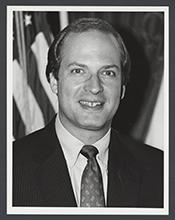
Historical · U.S. House · Minnesota · District 2
John Weber
Former U.S. Representative · Minnesota District 2 · 1981–1993 · Republican
John Weber represented Minnesota's District 2 in the United States House of Representatives (1981–1993) for the Republican party. The page below collects sourced biographical facts, term history, committee roles, and provenance for Weber.
Bioguide ID: W000237
Key facts
- Full name
- John Weber
- State
- Minnesota
- District
- District 2
- Party
- Republican
- House service
- 1981–1993
- First House term
- 1981
- Status
- Left office
- Current term ends
- —
- Born
- 1952
- Bioguide ID
- W000237
- Committee assignments
- —
- Dataset version
- 1.20260605
Biographical narrative
822 words · sourced from the Wikipedia REST extract
John Vincent Weber is a former American politician and lobbyist who served as a U.S. Representative for Minnesota's 2nd congressional district from 1981 until 1993. A member of the Republican Party, Weber's political career spanned over a decade in Congress, during which he held various leadership roles and was involved in significant legislative efforts. After leaving Congress, he transitioned into a lobbying career and has remained active in political strategy and advisory roles.
Early life and career
Vin Weber was born on July 24, 1952, in Slayton, Minnesota. He pursued higher education at the University of Minnesota, Twin Cities, where he studied from 1970 to 1974. Following his academic endeavors, Weber began his political career as a press secretary for Representative Tom Hagedorn from 1974 to 1975. He later served as a senior aide to Senator Rudy Boschwitz from 1977 to 1980. In addition to his political roles, Weber was involved in the media industry; he co-published a local newspaper in Murray County, Minnesota, from 1976 to 1978 and held the position of president at Weber Publishing Company.
Weber's political engagement extended to the Republican Party at the state level, where he was a delegate to the Minnesota State Republican conventions in both 1972 and 1978. His entry into national politics came in 1980 when he successfully ran for a seat in the U.S. House of Representatives at the age of 28. In a competitive election, he defeated his opponent, Archie Baumann, securing a significant portion of the vote.
House tenure
Weber's tenure in the U.S. House of Representatives began in 1981 and lasted until he chose not to seek reelection in 1992. During his six terms in office, he was involved in various legislative initiatives and held leadership roles within the Republican Party. One notable position he held was as the secretary of the House Republican Conference, where he played a crucial role in shaping party strategy and messaging.
Weber's congressional career was marked by his involvement in the Republican resurgence of the early 1990s, particularly as a key adviser to incoming Speaker Newt Gingrich. He was recognized as one of the architects of the Republican Party's success in the 1994 elections, which resulted in a significant shift in congressional power. Following the Republican victory, Weber provided commentary on developments in Congress, particularly regarding the implications of the party's control over the House.
However, Weber's congressional career was not without controversy. He was implicated in the House banking scandal, which involved the writing of bad checks. This scandal contributed to his decision not to run for reelection in 1992, marking the end of his time in Congress.
Legislative focus and committees
Throughout his time in the House, Weber focused on various legislative issues, although specific details regarding his committee assignments and legislative achievements are not extensively documented. His role as a senior member of the Republican Party allowed him to influence key policy discussions and decisions during a pivotal time in American politics.
After leaving Congress, Weber transitioned into a lobbying career, where he continued to exert influence in political circles. He became involved with the lobbying firm Clark & Weinstock, where he opened and managed the Washington, D.C. branch. In this capacity, he represented various clients, including major corporations and foreign entities. His lobbying efforts included work for Freddie Mac, where he was compensated to advocate against regulatory measures in the lead-up to the subprime mortgage crisis.
Weber's lobbying activities extended to international issues as well. He was associated with the European Centre for a Modern Ukraine, where he lobbied on behalf of pro-Russian interests during a politically tumultuous period in Ukraine. His involvement in this area raised questions about compliance with the Foreign Agents Registration Act (FARA), leading to scrutiny from federal investigators.
In addition to his lobbying work, Weber has remained active in political strategy and advisory roles within the Republican Party. He has served as a strategist for various presidential campaigns, including those of Bob Dole in 1996, George W. Bush in 2004, and Mitt Romney in 2008. His expertise has also led him to hold positions with several nonprofit organizations, including the National Endowment for Democracy, where he serves as chairman.
Weber's contributions to political discourse extend to academia, where he is a senior fellow at the Humphrey Institute at the University of Minnesota. He is involved in various advisory boards and organizations, including the Council on Foreign Relations and the Institute for Law and Politics at the University of Minnesota Law School. His work continues to influence discussions on democratic governance and international relations.
In summary, Vin Weber's career reflects a significant trajectory through American politics, from his early days as a congressional staffer to his eventual role as a U.S. Representative and later as a lobbyist and political strategist. His involvement in key political movements and legislative efforts has left a lasting impact on the Republican Party and American political discourse.
Notable legislation
Sponsored and co-sponsored legislation for John Weber is pending operator curation. The biographical narrative above carries the same provenance trail until per-bill rows are written.
Sources
- [1]https://en.wikipedia.org/wiki/Vin_WeberWikipedia · retrieved 2026-06-05
Notable quotes
Sourced quotes for John Weber are pending operator curation. Narrative-scope provenance remains attached below.
Sources
- [1]https://en.wikipedia.org/wiki/Vin_WeberWikipedia · retrieved 2026-06-05
Key positions
Curated policy positions for John Weber are pending operator review. The biographical narrative above carries the same provenance trail until per-topic positions are written.
Sources
- [1]https://en.wikipedia.org/wiki/Vin_WeberWikipedia · retrieved 2026-06-05
Terms served
- 1981–1983U.S. House · Term 1 · Republican
- 1983–1985U.S. House · Term 2 · Republican
- 1985–1987U.S. House · Term 3 · Republican
- 1987–1989U.S. House · Term 4 · Republican
- 1989–1991U.S. House · Term 5 · Republican
- 1991–1993U.S. House · Term 6 · Republican
Sources & provenance
Every attributable claim above carries a per-section [N] marker that resolves to the corresponding URL below. Each entry records the upstream provider, the canonical URL, and the timestamp at which the source was retrieved by the ingest pipeline.
Key facts
- https://bioguide.congress.gov/search/bio/W000237bioguide · retrieved 2026-06-05
- https://www.govtrack.us/congress/members/411405govtrack · retrieved 2026-06-05
Biographical narrative
- https://en.wikipedia.org/wiki/Vin_Weberwikipedia · retrieved 2026-06-05
Find your representative
Every U.S. state elects representatives by district. Browse Minnesota’s delegation, the full former-representative roster, or explore the role and term length.
Related on The Candidate
- Preceded by Ancher NelsenEarlier holder of the Minnesota District 2 House seat · Republican.Open
- Succeeded by David MingeLater holder of the Minnesota District 2 House seat · Democratic.Open
- Albert QuieFormer U.S. Representative · Minnesota District 1 · RepublicanOpen
- Allen FurlowFormer U.S. Representative · Minnesota District 1 · RepublicanOpen
- Arlen ErdahlFormer U.S. Representative · Minnesota District 1 · RepublicanOpen
- August AndresenFormer U.S. Representative · Minnesota District 1 · RepublicanOpen