
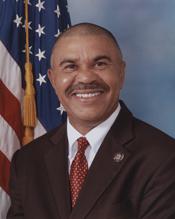
Historical · U.S. House · Missouri · District 1
Wm. Clay Jr.
Former U.S. Representative · Missouri District 1 · 2001–2021 · Democratic
Wm. Clay Jr. represented Missouri's District 1 in the United States House of Representatives (2001–2021) for the Democratic party. The page below collects sourced biographical facts, term history, committee roles, and provenance for Jr..
Bioguide ID: C001049
Key facts
- Full name
- Wm. Clay Jr.
- State
- Missouri
- District
- District 1
- Party
- Democratic
- House service
- 2001–2021
- First House term
- 2001
- Status
- Left office
- Current term ends
- —
- Born
- 1956
- Bioguide ID
- C001049
- Committee assignments
- —
- Dataset version
- 1.20260604
Biographical narrative
954 words · sourced from the Wikipedia REST extract
William Lacy Clay Jr. is a former American politician who served as the U.S. Representative for Missouri's 1st congressional district from 2001 until 2021. A member of the Democratic Party, Clay's tenure in Congress was marked by his advocacy on various issues, including gun control, environmental protection, and civil rights. He succeeded his father, Bill Clay, who held the congressional seat for over three decades. Throughout his political career, Clay was known for his commitment to his constituents in St. Louis and surrounding areas, navigating the complexities of local and national politics.
Early life and career
William Lacy Clay Jr. was born on July 27, 1956, in St. Louis, Missouri. He spent part of his childhood in Washington, D.C., where his father was elected to Congress. This early exposure to the political landscape significantly influenced his career path. Clay attended public schools in Silver Spring, Maryland, and graduated from Springbrook High School in 1974. He furthered his education at the University of Maryland, College Park, where he earned a degree in political science along with a paralegal certificate.
Clay's involvement in politics began at a young age, as he worked on his father's congressional campaigns and served as an Assistant Doorkeeper of the United States House of Representatives. He also became a member of Kappa Alpha Psi, a historically African American fraternity. After completing his undergraduate studies, he attended Howard University School of Law, where he continued to develop his understanding of legal and political systems.
Clay's political career began in earnest when he entered the Missouri House of Representatives in 1983, winning a special election to fill the vacancy left by Nathaniel J. "Nat" Rivers. His tenure in the state legislature lasted nearly a decade, during which he gained valuable experience and established a reputation as a dedicated public servant. In 1991, he was elected to the Missouri Senate, further solidifying his role in state politics and preparing him for a future in national governance.
House tenure
In 2000, after 32 years of service, Bill Clay announced his retirement from Congress, creating an opportunity for his son to succeed him. William Lacy Clay Jr. entered a competitive three-way Democratic primary to represent Missouri's 1st congressional district, where he emerged victorious with a significant majority of the votes. He subsequently won the general election, marking the beginning of his congressional career in January 2001.
Throughout his time in the House of Representatives, Clay was reelected nine times, consistently winning Democratic primaries by substantial margins. His electoral success can be attributed to his strong connection with the constituents of his district, which encompasses the city of St. Louis and parts of northern St. Louis County, including communities such as Ferguson and Florissant. For the first six terms, Clay represented the northern two-thirds of St. Louis, while the southern third was represented by another congressman. Following a redistricting process after the 2010 census, Clay's district absorbed all of St. Louis, a change that was met with various political reactions.
In the 2018 Democratic primary, Clay faced a challenge from Cori Bush, a progressive candidate. He won that primary but was ultimately defeated by Bush in the 2020 primary, marking the end of his congressional career. Over his two decades in office, Clay participated in numerous legislative initiatives and was involved in key political discussions affecting his constituents and the nation.
Legislative focus and committees
During his time in Congress, Clay served on several important committees, including the Committee on Financial Services, where he chaired the Subcommittee on Housing, Community Development, and Insurance. He was also a member of the House Committee on Oversight and Reform and the House Natural Resources Committee. His committee assignments allowed him to influence legislation on a range of issues, particularly those related to housing, environmental protection, and community development.
Clay's legislative focus included a strong commitment to addressing gun violence. In the 116th Congress, he introduced the Local Public Health and Safety Protection Act, which aimed to empower local communities to enact their own regulations to combat gun violence. This legislation sought to provide local control by linking it to federal public safety grant funding, garnering support from various gun control advocacy groups.
Environmental issues were another significant aspect of Clay's legislative work. As a member of the House Natural Resources Committee, he advocated for renewable energy and took action on climate change. He was a cosponsor of the Green New Deal and worked to protect national parks, wildlife refuges, and other natural resources. Clay also focused on environmental justice, leading efforts to clean up hazardous waste sites in minority communities within his district. Notable projects included securing funding for the cleanup of the former St. Louis Army Ammunition Plant, the Carter Carburetor plant site, and the West Lake Landfill Superfund site.
In addition to his legislative initiatives, Clay was an active member of several caucuses, including the Congressional Black Caucus, the Congressional Progressive Caucus, and the United States Congressional International Conservation Caucus. His participation in these groups reflected his commitment to addressing issues of racial equity, social justice, and environmental sustainability.
Throughout his congressional career, Clay was involved in various high-profile incidents, including a notable dispute over a controversial painting displayed in the Capitol that depicted police officers in a negative light. This incident highlighted the tensions surrounding police-community relations and the broader discussions about freedom of expression in political spaces.
William Lacy Clay Jr.'s two decades in the U.S. House of Representatives were characterized by his dedication to his constituents and his efforts to address pressing social, environmental, and economic issues. His legislative legacy continues to influence discussions in Missouri and beyond, as new leaders build upon the groundwork he laid during his time in office.
Notable legislation
Sponsored and co-sponsored legislation for Wm. Clay Jr. is pending operator curation. The biographical narrative above carries the same provenance trail until per-bill rows are written.
Sources
- [1]https://en.wikipedia.org/wiki/Lacy_ClayWikipedia · retrieved 2026-06-04
Notable quotes
Sourced quotes for Wm. Clay Jr. are pending operator curation. Narrative-scope provenance remains attached below.
Sources
- [1]https://en.wikipedia.org/wiki/Lacy_ClayWikipedia · retrieved 2026-06-04
Key positions
Curated policy positions for Wm. Clay Jr. are pending operator review. The biographical narrative above carries the same provenance trail until per-topic positions are written.
Sources
- [1]https://en.wikipedia.org/wiki/Lacy_ClayWikipedia · retrieved 2026-06-04
Terms served
- 2001–2003U.S. House · Term 1 · Democratic
- 2003–2005U.S. House · Term 2 · Democratic
- 2005–2007U.S. House · Term 3 · Democratic
- 2007–2009U.S. House · Term 4 · Democratic
- 2009–2011U.S. House · Term 5 · Democratic
- 2011–2013U.S. House · Term 6 · Democratic
- 2013–2015U.S. House · Term 7 · Democratic
- 2015–2017U.S. House · Term 8 · Democratic
- 2017–2019U.S. House · Term 9 · Democratic
- 2019–2021U.S. House · Term 10 · Democratic
Sources & provenance
Every attributable claim above carries a per-section [N] marker that resolves to the corresponding URL below. Each entry records the upstream provider, the canonical URL, and the timestamp at which the source was retrieved by the ingest pipeline.
Key facts
- https://bioguide.congress.gov/search/bio/C001049bioguide · retrieved 2026-06-04
- https://lacyclay.house.govhouse.gov · retrieved 2026-06-04
Biographical narrative
- https://en.wikipedia.org/wiki/Lacy_Claywikipedia · retrieved 2026-06-04
Find your representative
Every U.S. state elects representatives by district. Browse Missouri’s delegation, the full former-representative roster, or explore the role and term length.
Related on The Candidate
- Preceded by Bill Clay Sr.Earlier holder of the Missouri District 1 House seat · Democratic.Open
- Succeeded by Cori BushLater holder of the Missouri District 1 House seat · Democratic.Open
- Anthony IttnerFormer U.S. Representative · Missouri District 1 · RepublicanOpen
- Charles ClarkFormer U.S. Representative · Missouri District 1 · RepublicanOpen
- Clare MageeFormer U.S. Representative · Missouri District 1 · DemocraticOpen
- Democratic PartyFederal candidates and office holders on the Democratic line.Open