
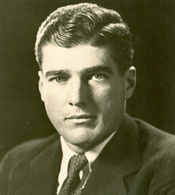
Historical · U.S. House · Missouri · District 11
Claude Bakewell
Former U.S. Representative · Missouri District 11 · 1947–1953 · Republican
Claude Bakewell represented Missouri's District 11 in the United States House of Representatives (1947–1953) for the Republican party. The page below collects sourced biographical facts, term history, committee roles, and provenance for Bakewell.
Bioguide ID: B000080
Key facts
- Full name
- Claude Bakewell
- State
- Missouri
- District
- District 11
- Party
- Republican
- House service
- 1947–1953
- First House term
- 1947
- Status
- Left office
- Current term ends
- —
- Born
- 1912
- Bioguide ID
- B000080
- Committee assignments
- —
- Dataset version
- 1.20260605
Biographical narrative
811 words · sourced from the Wikipedia REST extract
Claude Bakewell was an American lawyer and politician who served as a U.S. Representative for Missouri's 11th congressional district from 1947 to 1953. A member of the Republican Party, Bakewell is noted for his involvement in local governance prior to his congressional career and for his subsequent role as the postmaster of St. Louis. His political career was marked by a mix of liberal and conservative positions, reflecting the complexities of mid-20th century American politics.
Early life and career
Claude Ignatius Bakewell was born on August 9, 1912, in St. Louis, Missouri, into a prominent family with deep roots in the region. He was the son of Paul Bakewell, Jr. and Mary Morgan Bakewell (née Fullerton). His mother, Mary, was known for her wealth, being the daughter of Joseph Scott Fullerton and a grand-niece of the influential financier J. P. Morgan. The Bakewell family had a notable legal background; Claude's grandfather, Paul Bakewell, was a patent and trademark lawyer, and his great-grandfather, Robert Armytage Bakewell, served as a judge in Missouri.
Claude Bakewell completed his early education at St. Louis University High School before pursuing higher education at Georgetown University, where he graduated in 1932. He continued his studies at St. Louis University School of Law, earning his law degree in 1935. Following his graduation, he entered private practice as a lawyer.
In addition to his legal career, Bakewell was active in local politics. He served as a member of the board of aldermen for the 25th Ward in St. Louis from 1941 to 1945, where he held the position of chairman of the legislation committee. His involvement in local governance provided him with valuable experience in public service. During World War II, from 1944 to 1946, Bakewell served in the United States Navy, contributing to the war effort.
House tenure
Bakewell's congressional career began when he was elected as a Republican to the 80th United States Congress in 1946. His campaign was managed by Phyllis Schlafly, a prominent conservative activist. Bakewell's initial term in Congress was characterized by a liberal platform that included proposals for increasing the minimum wage, implementing rent control, expanding Social Security, and abolishing the poll tax. However, his liberal stance did not secure him a second term in the 1948 election, where he was defeated by Democrat John B. Sullivan.
Following Sullivan's death, Bakewell successfully ran in a special election in March 1951 to reclaim his seat in the House. During this campaign, he faced Democratic opponent Harry Schendel, whom he accused of being linked to a powerful political machine in St. Louis. The election occurred during the Second Red Scare, and Bakewell's rhetoric included labeling Schendel as a "stooge" for a political action committee he deemed influenced by Moscow. Bakewell's victory in this election was significant, as it was perceived as a defeat of the entrenched political establishment in the area.
Throughout his time in Congress, Bakewell served on the House Judiciary Committee. He was involved in various legislative discussions, including opposing a bill that sought to impose royalty fees on jukeboxes. He was also the sole Republican to sign a minority report on a quitclaim bill regarding tidelands, expressing concerns about Congress's authority over public lands. Bakewell's tenure in the House concluded when he lost the regular election in 1952 to Leonor K. Sullivan, the widow of his former opponent. This defeat marked the end of his congressional career, and he remains notable as the last Republican to represent a significant portion of St. Louis in the House.
Legislative focus and committees
During his time in Congress, Bakewell's legislative focus encompassed a range of issues reflective of the political climate of the era. He was particularly engaged in matters concerning civil rights and economic policy. Bakewell's response to an anti-segregation initiative in St. Louis demonstrated his awareness of the social issues of the time. He criticized local department stores for their discriminatory practices in dining facilities, highlighting the inconsistency of welcoming diverse customers while excluding them from certain services.
As a member of the House Judiciary Committee, Bakewell participated in discussions on various legal and legislative matters, including those related to civil rights and economic regulation. His opposition to certain bills, such as the one regarding jukebox royalties, indicated his willingness to challenge proposals he believed could have negative implications for constituents or the broader public interest.
After leaving Congress, Bakewell transitioned to a significant role in the postal service, serving as the postmaster for St. Louis from 1958 until 1982. His long tenure in this position allowed him to continue his public service beyond his congressional career. Claude Bakewell passed away on March 18, 1987, in University City, Missouri, at the age of 74. He was interred at Calvary Cemetery in St. Louis, leaving behind a legacy as a public servant who navigated the complexities of mid-20th century American politics.
Notable legislation
Sponsored and co-sponsored legislation for Claude Bakewell is pending operator curation. The biographical narrative above carries the same provenance trail until per-bill rows are written.
Sources
- [1]https://en.wikipedia.org/wiki/Claude_I._BakewellWikipedia · retrieved 2026-06-05
Notable quotes
Sourced quotes for Claude Bakewell are pending operator curation. Narrative-scope provenance remains attached below.
Sources
- [1]https://en.wikipedia.org/wiki/Claude_I._BakewellWikipedia · retrieved 2026-06-05
Key positions
Curated policy positions for Claude Bakewell are pending operator review. The biographical narrative above carries the same provenance trail until per-topic positions are written.
Sources
- [1]https://en.wikipedia.org/wiki/Claude_I._BakewellWikipedia · retrieved 2026-06-05
Terms served
- 1947–1949U.S. House · Term 1 · Republican
- 1951–1953U.S. House · Term 2 · Republican
Sources & provenance
Every attributable claim above carries a per-section [N] marker that resolves to the corresponding URL below. Each entry records the upstream provider, the canonical URL, and the timestamp at which the source was retrieved by the ingest pipeline.
Key facts
- https://bioguide.congress.gov/search/bio/B000080bioguide · retrieved 2026-06-05
- https://www.govtrack.us/congress/members/401083govtrack · retrieved 2026-06-05
Biographical narrative
- https://en.wikipedia.org/wiki/Claude_I._Bakewellwikipedia · retrieved 2026-06-05
Find your representative
Every U.S. state elects representatives by district. Browse Missouri’s delegation, the full former-representative roster, or explore the role and term length.
Related on The Candidate
- Preceded by Louis MillerEarlier holder of the Missouri District 11 House seat · Republican.Open
- Anthony IttnerFormer U.S. Representative · Missouri District 1 · RepublicanOpen
- Bill Clay Sr.Former U.S. Representative · Missouri District 1 · DemocraticOpen
- Charles ClarkFormer U.S. Representative · Missouri District 1 · RepublicanOpen
- Clare MageeFormer U.S. Representative · Missouri District 1 · DemocraticOpen
- Republican PartyFederal candidates and office holders on the Republican line.Open