
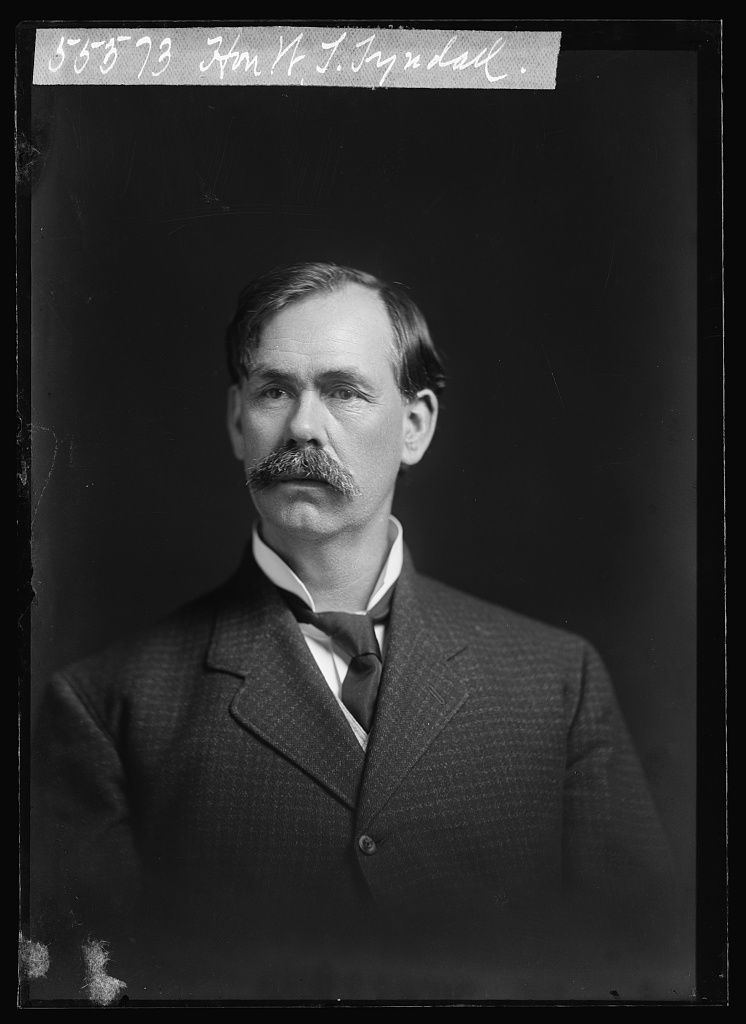
Historical · U.S. House · Missouri · District 14
William Tyndall
Former U.S. Representative · Missouri District 14 · 1905–1907 · Republican
William Tyndall represented Missouri's District 14 in the United States House of Representatives (1905–1907) for the Republican party. The page below collects sourced biographical facts, term history, committee roles, and provenance for Tyndall.
Bioguide ID: T000451
Key facts
- Full name
- William Tyndall
- State
- Missouri
- District
- District 14
- Party
- Republican
- House service
- 1905–1907
- First House term
- 1905
- Status
- Left office
- Current term ends
- —
- Born
- 1862
- Bioguide ID
- T000451
- Committee assignments
- —
- Dataset version
- 1.20260606
Biographical narrative
875 words · sourced from the Wikipedia REST extract
William Tyndall was a U.S. Representative from Missouri, serving in the 14th congressional district as a member of the Republican Party. His congressional career was marked by a single term in the House of Representatives from 1905 to 1907. Born in 1862 in Sparta, Missouri, Tyndall's early life and career were characterized by his involvement in education and law, culminating in his election to Congress. After his tenure in the House, he returned to his legal practice and later moved to Oklahoma, where he continued his professional work until his death in 1928.
Early life and career
William Tyndall was born on January 16, 1862, in Sparta, Missouri. Growing up in a small town, he received his education through local public schools, which laid the foundation for his future endeavors. Tyndall furthered his education at Henderson Academy and Sparta Academy, institutions that provided him with a more advanced understanding of various subjects, likely including the principles of governance and law.
After completing his education, Tyndall took on the role of a teacher in Sparta, where he worked from 1884 until 1895. His experience in education not only contributed to his personal development but also allowed him to engage with the community and understand the needs and concerns of his fellow citizens. This period of teaching would have given him insights into the educational system and the importance of public service, both of which would later influence his political career.
In addition to his teaching career, Tyndall pursued a legal education, studying law and preparing for a career in the legal field. He was admitted to the bar in 1893, marking the beginning of his legal practice in Sparta. His legal career would play a significant role in shaping his understanding of legislative processes and the intricacies of law, which would be beneficial during his time in Congress.
Tyndall's public service began in earnest when he was appointed as the postmaster of Sparta, Missouri, by President Benjamin Harrison. He served in this role from March 23, 1891, until November 14, 1893. This position allowed him to gain experience in federal government operations and community service. After a brief hiatus, he was again appointed postmaster, this time by President William McKinley, serving from December 8, 1897, until January 7, 1905. His repeated appointments to the postmaster position reflect his standing in the community and the trust placed in him by national leaders.
House tenure
William Tyndall's political career took a significant turn when he was elected to the United States House of Representatives as a Republican. His term began on March 4, 1905, as he assumed office in the Fifty-ninth Congress. During this time, Tyndall represented Missouri's 14th congressional district, a role that placed him at the heart of national legislative discussions and decisions.
As a member of the House, Tyndall participated in the legislative process, contributing to various discussions and votes that shaped the policies of the time. His tenure in Congress lasted until March 3, 1907, when he completed his term. Despite his efforts, Tyndall was not successful in securing reelection for the Sixtieth Congress in 1906. The reasons for his defeat are not detailed in the available records, but it is common for incumbents to face challenges in maintaining their positions due to changing political climates and voter sentiments.
After leaving Congress, Tyndall returned to his legal practice in Sparta, Missouri. His experience in the House likely enriched his understanding of law and governance, allowing him to serve his clients with a more informed perspective. The transition back to law after a congressional term is not uncommon, as many former legislators continue to engage in public service through their professional careers.
Legislative focus and committees
While specific details regarding Tyndall's legislative focus or committee assignments during his time in the House are not provided in the available records, it can be inferred that his background in law and education would have influenced his interests and priorities as a legislator. Representatives often draw upon their professional experiences to guide their legislative agendas, and Tyndall's legal expertise may have led him to engage in issues related to law, education, and public service.
The early 20th century was a period of significant change in the United States, with various social, economic, and political issues emerging. Tyndall's role as a congressman would have placed him in the midst of these developments, requiring him to navigate complex legislative challenges and advocate for the needs of his constituents in Missouri.
After his congressional career, Tyndall moved to Bartlesville, Oklahoma, in 1912, where he continued to practice law until his death on November 26, 1928. His relocation to Oklahoma marked a new chapter in his life, allowing him to engage with a different community while applying his legal skills. Tyndall's contributions to his profession and community continued until his passing, and he was interred in a mausoleum at White Rose Cemetery.
William Tyndall's life reflects a commitment to public service, education, and the law. His journey from a teacher to a U.S. Representative illustrates the diverse paths individuals can take in their pursuit of civic engagement and leadership. Through his various roles, Tyndall contributed to the fabric of his community and the broader political landscape of his time.
Notable legislation
Sponsored and co-sponsored legislation for William Tyndall is pending operator curation. The biographical narrative above carries the same provenance trail until per-bill rows are written.
Sources
- [1]https://en.wikipedia.org/wiki/William_T._TyndallWikipedia · retrieved 2026-06-06
Notable quotes
Sourced quotes for William Tyndall are pending operator curation. Narrative-scope provenance remains attached below.
Sources
- [1]https://en.wikipedia.org/wiki/William_T._TyndallWikipedia · retrieved 2026-06-06
Key positions
Curated policy positions for William Tyndall are pending operator review. The biographical narrative above carries the same provenance trail until per-topic positions are written.
Sources
- [1]https://en.wikipedia.org/wiki/William_T._TyndallWikipedia · retrieved 2026-06-06
Terms served
- 1905–1907U.S. House · Term 1 · Republican
Sources & provenance
Every attributable claim above carries a per-section [N] marker that resolves to the corresponding URL below. Each entry records the upstream provider, the canonical URL, and the timestamp at which the source was retrieved by the ingest pipeline.
Key facts
- https://bioguide.congress.gov/search/bio/T000451bioguide · retrieved 2026-06-06
- https://www.govtrack.us/congress/members/411019govtrack · retrieved 2026-06-06
Biographical narrative
- https://en.wikipedia.org/wiki/William_T._Tyndallwikipedia · retrieved 2026-06-06
Find your representative
Every U.S. state elects representatives by district. Browse Missouri’s delegation, the full former-representative roster, or explore the role and term length.
Related on The Candidate
- Preceded by Willard VandiverEarlier holder of the Missouri District 14 House seat · Democratic.Open
- Succeeded by Joseph RussellLater holder of the Missouri District 14 House seat · Democratic.Open
- Anthony IttnerFormer U.S. Representative · Missouri District 1 · RepublicanOpen
- Bill Clay Sr.Former U.S. Representative · Missouri District 1 · DemocraticOpen
- Charles ClarkFormer U.S. Representative · Missouri District 1 · RepublicanOpen
- Clare MageeFormer U.S. Representative · Missouri District 1 · DemocraticOpen