
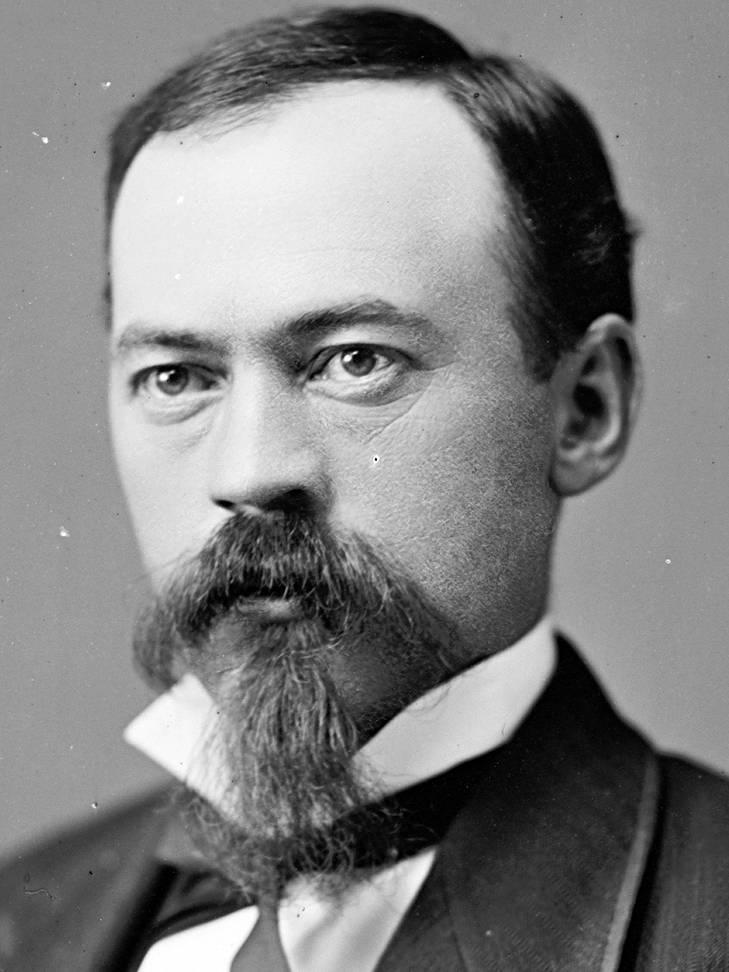
Historical · U.S. House · Missouri · District 15
Charles Morgan
Former U.S. Representative · Missouri District 15 · 1875–1911 · Republican
Charles Morgan represented Missouri's District 15 in the United States House of Representatives (1875–1911) for the Republican party. The page below collects sourced biographical facts, term history, committee roles, and provenance for Morgan.
Bioguide ID: M000944
Key facts
- Full name
- Charles Morgan
- State
- Missouri
- District
- District 15
- Party
- Republican
- House service
- 1875–1911
- First House term
- 1875
- Status
- Left office
- Current term ends
- —
- Born
- 1842
- Bioguide ID
- M000944
- Committee assignments
- —
- Dataset version
- 1.20260606
Biographical narrative
858 words · sourced from the Wikipedia REST extract
Charles Morgan was an American lawyer and politician who served as a U.S. Representative for Missouri's 15th congressional district. A member of the Republican Party, he held office for five terms over a span of four decades, reflecting a long and varied political career. In addition to his legislative work, Morgan was also a military officer, having served in both the American Civil War and the Spanish–American War. His life was marked by a commitment to public service, both in the military and in government.
Early life and career
Charles Henry Morgan was born on July 5, 1842, in Cuba, New York. His family relocated to Pewaukee, Wisconsin, in 1845, where he spent his formative years. Morgan attended Fond du Lac High School in Wisconsin, graduating in 1861. Following the conclusion of the Civil War, he pursued a legal education, attending Albany Law School in New York, where he graduated in 1865.
Morgan's early career was significantly influenced by his military service. At the onset of the American Civil War, he was among the first volunteers from Wisconsin to enlist in the Union Army. He initially joined Company I of the 1st Wisconsin Infantry Regiment, which was formed for a three-month term. The regiment participated in the Battle of Hoke's Run before its initial term expired in August 1861. Morgan chose to re-enlist for a longer duration, and upon the reorganization of the regiment, he was assigned to Company K and received a promotion to sergeant.
Throughout 1862, Morgan's military career progressed as he was promoted to sergeant major of the 1st Wisconsin Infantry. The regiment primarily engaged in provost duty in Kentucky and Tennessee during this period. Later that year, he was commissioned as a second lieutenant in Company F of the 21st Wisconsin Infantry Regiment, which saw significant combat in the Tennessee and Kentucky theaters. Morgan faced considerable challenges during the war, including being captured twice. After the Battle of Perryville, he was paroled, but after the Battle of Chickamauga, he was imprisoned at Libby Prison. Notably, he escaped from Libby Prison in February 1864, returning to his regiment and eventually being promoted to captain of Company H in April 1865. He participated in the Grand Review of the Armies at the war's conclusion.
In addition to his military service, Morgan began his legal career in Lamar, Missouri, after the war. He served as the prosecuting attorney for Barton County in 1868 and was a member of the Missouri House of Representatives from 1872 to 1874. He practiced law until 1884, after which he transitioned into coal and zinc mining.
House tenure
Morgan's political career in the U.S. House of Representatives began in 1875 when he was elected as a Democrat. He served in this capacity until 1879, marking his first congressional term. Following a brief hiatus from Congress, he returned to serve additional terms from 1883 to 1885 and again from 1893 to 1895. During his time in the House, he held the position of chairman of the Committee on Expenditures in the Post Office Department, which allowed him to influence matters related to postal expenditures and oversight.
In 1907, Morgan relocated to Joplin, Missouri, where he continued his political career. He switched party affiliation to the Republican Party and was elected to the House again in 1908, serving from 1909 until the end of his last term in 1911. Throughout his five terms in Congress, Morgan was involved in various legislative efforts and contributed to the political landscape of his time.
Legislative focus and committees
During his tenure in the House of Representatives, Morgan's legislative focus encompassed a range of issues relevant to his constituents and the broader national agenda. His role as chairman of the Committee on Expenditures in the Post Office Department during his second term highlighted his involvement in fiscal oversight and government efficiency, particularly concerning postal services.
Morgan's long service in Congress, spanning multiple decades, allowed him to witness and participate in significant legislative developments. His experience as a lawyer and military officer informed his approach to governance, as he navigated the complexities of post-war America and the evolving political landscape. His commitment to public service was evident not only in his legislative work but also in his military service, which provided him with a unique perspective on the needs of his constituents.
Morgan's political career was characterized by a dedication to his community and a willingness to adapt to the changing political environment. His transition from a Democratic to a Republican congressman reflects the shifting dynamics of American politics during the late 19th and early 20th centuries. His contributions to the House of Representatives and his involvement in various committees underscored his commitment to addressing the needs of his constituents and the nation as a whole.
Charles Morgan passed away on January 4, 1912, in Joplin, Missouri, due to pneumonia. He was interred in Mount Hope Cemetery, leaving behind a legacy of public service that spanned both military and political arenas. His life and career exemplify the dedication of individuals who have served in the U.S. Congress, contributing to the governance and development of the nation.
Notable legislation
Sponsored and co-sponsored legislation for Charles Morgan is pending operator curation. The biographical narrative above carries the same provenance trail until per-bill rows are written.
Sources
- [1]https://en.wikipedia.org/wiki/Charles_H._Morgan_(politician)Wikipedia · retrieved 2026-06-06
Notable quotes
Sourced quotes for Charles Morgan are pending operator curation. Narrative-scope provenance remains attached below.
Sources
- [1]https://en.wikipedia.org/wiki/Charles_H._Morgan_(politician)Wikipedia · retrieved 2026-06-06
Key positions
Curated policy positions for Charles Morgan are pending operator review. The biographical narrative above carries the same provenance trail until per-topic positions are written.
Sources
- [1]https://en.wikipedia.org/wiki/Charles_H._Morgan_(politician)Wikipedia · retrieved 2026-06-06
Terms served
- 1875–1877U.S. House · Term 1 · Democratic
- 1877–1879U.S. House · Term 2 · Democratic
- 1883–1885U.S. House · Term 3 · Democratic
- 1893–1895U.S. House · Term 4 · Democratic
- 1909–1911U.S. House · Term 5 · Republican
Sources & provenance
Every attributable claim above carries a per-section [N] marker that resolves to the corresponding URL below. Each entry records the upstream provider, the canonical URL, and the timestamp at which the source was retrieved by the ingest pipeline.
Key facts
- https://bioguide.congress.gov/search/bio/M000944bioguide · retrieved 2026-06-06
- https://www.govtrack.us/congress/members/407912govtrack · retrieved 2026-06-06
Biographical narrative
- https://en.wikipedia.org/wiki/Charles_H._Morgan_(politician)wikipedia · retrieved 2026-06-06
Find your representative
Every U.S. state elects representatives by district. Browse Missouri’s delegation, the full former-representative roster, or explore the role and term length.
Related on The Candidate
- Succeeded by James DaughertyLater holder of the Missouri District 15 House seat · Democratic.Open
- Anthony IttnerFormer U.S. Representative · Missouri District 1 · RepublicanOpen
- Bill Clay Sr.Former U.S. Representative · Missouri District 1 · DemocraticOpen
- Charles ClarkFormer U.S. Representative · Missouri District 1 · RepublicanOpen
- Clare MageeFormer U.S. Representative · Missouri District 1 · DemocraticOpen
- Republican PartyFederal candidates and office holders on the Republican line.Open