
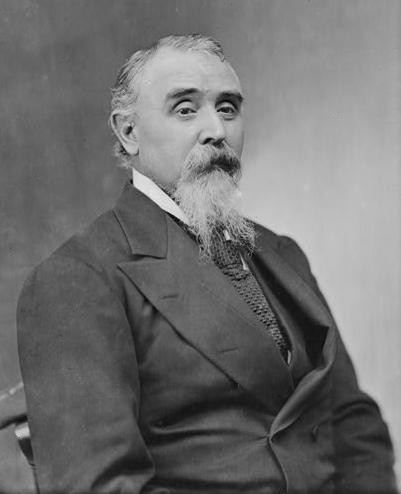
Historical · U.S. House · Missouri · District 2
Nathan Cole
Former U.S. Representative · Missouri District 2 · 1877–1879 · Republican
Nathan Cole represented Missouri's District 2 in the United States House of Representatives (1877–1879) for the Republican party. The page below collects sourced biographical facts, term history, committee roles, and provenance for Cole.
Bioguide ID: C000610
Key facts
- Full name
- Nathan Cole
- State
- Missouri
- District
- District 2
- Party
- Republican
- House service
- 1877–1879
- First House term
- 1877
- Status
- Left office
- Current term ends
- —
- Born
- 1825
- Bioguide ID
- C000610
- Committee assignments
- —
- Dataset version
- 1.20260606
Biographical narrative
1,019 words · sourced from the Wikipedia REST extract
Nathan Cole was an American politician and businessman who served as a U.S. Representative for Missouri's 2nd congressional district from 1877 to 1879. A member of the Republican Party, Cole had a diverse career that included significant roles in local government and the banking sector. He was also notable for his contributions to the business community in St. Louis, where he spent much of his life. His tenure in Congress was preceded by a period of public service as the Mayor of St. Louis, and he continued to be active in business after leaving office. Cole's life spanned a time of considerable change in American society, and he was involved in various capacities throughout his career.
Early life and career
Nathan Cole was born on July 26, 1825, in St. Louis, Missouri. He was the son of Nathan Cole Sr., who was among the early settlers of Plymouth Colony. Cole's family background is significant, as his father made a considerable journey to St. Louis, walking approximately 100 miles from Cairo, Illinois, to reach the city. This journey reflects the challenges of transportation during that era and highlights the determination of early settlers. Nathan Cole is believed to have been one of the first individuals born in St. Louis following its incorporation as a city, marking him as a figure of local historical importance.
Cole received his education through common schools before attending Shurtleff College, where he spent two years working after his studies. This educational background laid a foundation for his future endeavors in both business and public service. In 1843, he began his career as a merchant in St. Louis, which marked the beginning of a long and varied professional life. Over the next 43 years, he became a prominent figure in the financial sector, serving as a director of the St. Louis Bank of Commerce for a significant portion of that time, including a lengthy period as its vice-president. His leadership in the banking industry contributed to the economic development of St. Louis and established him as a respected figure in the community.
In addition to his banking career, Cole was involved in various corporate roles, including leadership positions in insurance companies. His business acumen was recognized when he served as the president of the Merchants Exchange in 1876, a role that further solidified his standing in the local business community. Cole's professional life was marked by a commitment to the economic growth of St. Louis, and his various roles allowed him to influence the city's development during a period of significant change in the United States.
House tenure
Nathan Cole's political career began to take shape when he was elected as the Mayor of St. Louis, serving from 1869 to 1871. During his time as mayor, he was known for his efforts to protect former Confederate States Army soldiers, reflecting the complex social and political landscape of the post-Civil War era. His tenure as mayor provided him with valuable experience in governance and public service, which would later inform his work as a U.S. Representative.
Cole's congressional career began when he was elected to represent Missouri's 2nd congressional district in the United States House of Representatives. He took office on March 4, 1877, and served until March 3, 1879. His time in Congress was characterized by the challenges and responsibilities of representing his constituents during a period marked by economic and social transformation in the United States. Although specific details of his legislative activities are not provided, his role as a Republican representative during this time would have involved navigating the complexities of national issues, including reconstruction, economic policy, and the evolving political landscape.
After serving one term in the House, Cole did not seek re-election, losing his bid for a subsequent term. This transition marked the end of his formal political career, but he continued to be involved in business and community affairs. His experience in Congress and local government contributed to his understanding of the intersection between politics and business, which he would carry into his post-congressional life.
Legislative focus and committees
While specific details regarding Nathan Cole's legislative focus and committee assignments during his time in Congress are not available, it is important to contextualize his role within the broader political environment of the late 19th century. As a member of the Republican Party, Cole would have been part of a political movement that was focused on issues such as economic development, civil rights for formerly enslaved individuals, and the expansion of infrastructure across the nation. The Republican Party during this period was also concerned with issues related to industrialization and the economic challenges facing the country.
Cole's background as a businessman likely influenced his perspective on economic policies and legislation. His extensive experience in banking and commerce would have provided him with insights into the needs of his constituents, particularly in terms of economic growth and development. It is reasonable to assume that his legislative priorities may have included support for measures that would foster business development, improve financial regulations, and enhance the economic well-being of his district.
After leaving Congress, Cole returned to his business pursuits and continued to be active in the St. Louis community. His involvement in various corporate roles and leadership positions in local organizations demonstrated his commitment to the economic and social development of the region. He retired from active business around 1889, concluding a long and successful career that spanned several decades.
In addition to his professional achievements, Nathan Cole was a family man. He married Rebecca Lane Fagin on January 30, 1851, and together they had eleven children, one of whom, Nathan Cole Jr., became a founder of the Los Angeles Times. Cole's personal life was intertwined with his professional endeavors, and his family played a significant role in his legacy.
Nathan Cole passed away on March 4, 1904, in St. Louis, at the age of 78. His death marked the end of a life dedicated to public service and business. He was buried at Bellefontaine Cemetery, leaving behind a legacy that reflects the complexities of American life during the 19th century.
Notable legislation
Sponsored and co-sponsored legislation for Nathan Cole is pending operator curation. The biographical narrative above carries the same provenance trail until per-bill rows are written.
Sources
- [1]https://en.wikipedia.org/wiki/Nathan_ColeWikipedia · retrieved 2026-06-06
Notable quotes
Sourced quotes for Nathan Cole are pending operator curation. Narrative-scope provenance remains attached below.
Sources
- [1]https://en.wikipedia.org/wiki/Nathan_ColeWikipedia · retrieved 2026-06-06
Key positions
Curated policy positions for Nathan Cole are pending operator review. The biographical narrative above carries the same provenance trail until per-topic positions are written.
Sources
- [1]https://en.wikipedia.org/wiki/Nathan_ColeWikipedia · retrieved 2026-06-06
Terms served
- 1877–1879U.S. House · Term 1 · Republican
Sources & provenance
Every attributable claim above carries a per-section [N] marker that resolves to the corresponding URL below. Each entry records the upstream provider, the canonical URL, and the timestamp at which the source was retrieved by the ingest pipeline.
Key facts
- https://bioguide.congress.gov/search/bio/C000610bioguide · retrieved 2026-06-06
- https://www.govtrack.us/congress/members/402739govtrack · retrieved 2026-06-06
Biographical narrative
- https://en.wikipedia.org/wiki/Nathan_Colewikipedia · retrieved 2026-06-06
Find your representative
Every U.S. state elects representatives by district. Browse Missouri’s delegation, the full former-representative roster, or explore the role and term length.
Related on The Candidate
- Preceded by Gustavus FinkelnburgEarlier holder of the Missouri District 2 House seat · Liberal Republican.Open
- Succeeded by James McLeanLater holder of the Missouri District 2 House seat · Republican.Open
- Anthony IttnerFormer U.S. Representative · Missouri District 1 · RepublicanOpen
- Bill Clay Sr.Former U.S. Representative · Missouri District 1 · DemocraticOpen
- Charles ClarkFormer U.S. Representative · Missouri District 1 · RepublicanOpen
- Clare MageeFormer U.S. Representative · Missouri District 1 · DemocraticOpen