
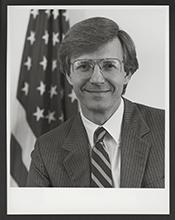
Historical · U.S. House · Missouri · District 6
Earl Coleman
Former U.S. Representative · Missouri District 6 · 1975–1993 · Republican
Earl Coleman represented Missouri's District 6 in the United States House of Representatives (1975–1993) for the Republican party. The page below collects sourced biographical facts, term history, committee roles, and provenance for Coleman.
Bioguide ID: C000618
Key facts
- Full name
- Earl Coleman
- State
- Missouri
- District
- District 6
- Party
- Republican
- House service
- 1975–1993
- First House term
- 1975
- Status
- Left office
- Current term ends
- —
- Born
- 1943
- Bioguide ID
- C000618
- Committee assignments
- —
- Dataset version
- 1.20260605
Biographical narrative
890 words · sourced from the Wikipedia REST extract
E. Thomas Coleman is a former American politician who served as a U.S. Representative for Missouri's 6th congressional district from 1976 to 1993. A member of the Republican Party, Coleman was elected to Congress following the death of his predecessor and went on to serve nine consecutive terms. His tenure in the House was marked by his representation of a district that included parts of northwestern Missouri, including a portion of Kansas City and the city of Saint Joseph. After leaving Congress, Coleman transitioned into lobbying and has remained active in political discourse.
Early life and career
E. Thomas Coleman was born on May 29, 1943. He received his early education in public schools, which laid the foundation for his later academic pursuits. Coleman attended William Jewell College, where he earned a Bachelor of Arts degree in 1965. He continued his education at Wagner Graduate School of Public Service, obtaining a Master of Public Administration in 1969. That same year, he graduated with a Juris Doctor degree from Washington University School of Law. Following his admission to the Missouri Bar in 1969, Coleman began practicing law in Kansas City.
Coleman's early career included a significant role as Missouri's State Assistant Attorney General from 1969 to 1972. This position allowed him to gain valuable experience in legal and governmental affairs. In 1972, he was elected to the Missouri House of Representatives, where he served until 1976. His legislative experience at the state level provided him with insights into the workings of government and prepared him for his future role in Congress.
In 1976, following the unexpected death of U.S. Representative Jerry Litton, Coleman was elected to represent Missouri's 6th congressional district. This district encompassed a diverse area in northwestern Missouri, including parts of Kansas City north of the Missouri River and the city of Saint Joseph. Coleman's election to the House marked the beginning of a long and influential career in federal politics.
House tenure
E. Thomas Coleman began his first term in the U.S. House of Representatives in 1976, representing a district that had a mix of urban and rural constituents. Over the course of his nine terms, he was re-elected every two years, demonstrating a consistent level of support from his constituents. His tenure in the House lasted until January 3, 1993, when he was defeated in his bid for re-election by Democrat Pat Danner, who had previously served as the district administrator for Litton.
During his time in Congress, Coleman was involved in various legislative initiatives and participated in numerous debates on issues pertinent to his district and the nation. His long service in the House allowed him to build a network of relationships with fellow lawmakers and gain experience in navigating the complexities of federal legislation.
Coleman's electoral success can be attributed to his ability to connect with voters and address the concerns of his constituents. His focus on local issues, combined with his legal background, positioned him as a knowledgeable representative in discussions about law and policy. Throughout his congressional career, he maintained a commitment to serving the interests of the people in his district.
Legislative focus and committees
During his time in the U.S. House of Representatives, E. Thomas Coleman served on various committees, which allowed him to influence legislation on a range of issues. His committee assignments provided him with opportunities to engage in discussions and decision-making processes that shaped national policy. While specific details about his committee memberships and legislative accomplishments are not provided, it is common for members of Congress to focus on issues relevant to their constituents, such as economic development, education, healthcare, and infrastructure.
Coleman's legislative focus likely reflected the needs and priorities of the 6th congressional district, which included both urban and rural areas. Representatives often advocate for policies that support local industries, improve public services, and enhance the quality of life for their constituents. Given his legal background, Coleman may have also been involved in discussions related to legal reform and public safety.
After leaving Congress, Coleman continued to engage in political and civic activities. He became associated with The Livingston Group, a lobbying organization founded by former Congressman Bob Livingston. This role allowed him to leverage his experience and connections in Washington, D.C., to influence policy and advocate for various interests.
In addition to his lobbying work, Coleman has remained active in political discourse. In May 2019, he expressed his views on the Trump presidency, calling for impeachment. His political stance evolved further in August 2020 when he was one of 24 former Republican lawmakers who endorsed Democratic presidential nominee Joe Biden during the Republican National Convention. This endorsement reflected a significant shift in his political alignment and highlighted his willingness to speak out on issues of national importance.
Coleman is also involved with the bipartisan advisory board of the States United Democracy Center, an organization focused on promoting democracy and civic engagement. His participation in such initiatives underscores his ongoing commitment to public service and the democratic process.
In summary, E. Thomas Coleman’s career in public service spans several decades, beginning with his work as a state attorney general and culminating in his long tenure as a U.S. Representative. His legislative contributions, combined with his continued engagement in political discourse and advocacy, reflect a dedication to the principles of governance and civic responsibility.
Notable legislation
Sponsored and co-sponsored legislation for Earl Coleman is pending operator curation. The biographical narrative above carries the same provenance trail until per-bill rows are written.
Sources
- [1]https://en.wikipedia.org/wiki/Tom_Coleman_(Missouri_politician)Wikipedia · retrieved 2026-06-05
Notable quotes
Sourced quotes for Earl Coleman are pending operator curation. Narrative-scope provenance remains attached below.
Sources
- [1]https://en.wikipedia.org/wiki/Tom_Coleman_(Missouri_politician)Wikipedia · retrieved 2026-06-05
Key positions
Curated policy positions for Earl Coleman are pending operator review. The biographical narrative above carries the same provenance trail until per-topic positions are written.
Sources
- [1]https://en.wikipedia.org/wiki/Tom_Coleman_(Missouri_politician)Wikipedia · retrieved 2026-06-05
Terms served
- 1975–1977U.S. House · Term 1 · Republican
- 1977–1979U.S. House · Term 2 · Republican
- 1979–1981U.S. House · Term 3 · Republican
- 1981–1983U.S. House · Term 4 · Republican
- 1983–1985U.S. House · Term 5 · Republican
- 1985–1987U.S. House · Term 6 · Republican
- 1987–1989U.S. House · Term 7 · Republican
- 1989–1991U.S. House · Term 8 · Republican
- 1991–1993U.S. House · Term 9 · Republican
Sources & provenance
Every attributable claim above carries a per-section [N] marker that resolves to the corresponding URL below. Each entry records the upstream provider, the canonical URL, and the timestamp at which the source was retrieved by the ingest pipeline.
Key facts
- https://bioguide.congress.gov/search/bio/C000618bioguide · retrieved 2026-06-05
- https://www.govtrack.us/congress/members/402747govtrack · retrieved 2026-06-05
Biographical narrative
- https://en.wikipedia.org/wiki/Tom_Coleman_(Missouri_politician)wikipedia · retrieved 2026-06-05
Find your representative
Every U.S. state elects representatives by district. Browse Missouri’s delegation, the full former-representative roster, or explore the role and term length.
Related on The Candidate
- Preceded by William Hull Jr.Earlier holder of the Missouri District 6 House seat · Democratic.Open
- Succeeded by Pat DannerLater holder of the Missouri District 6 House seat · Democratic.Open
- Anthony IttnerFormer U.S. Representative · Missouri District 1 · RepublicanOpen
- Bill Clay Sr.Former U.S. Representative · Missouri District 1 · DemocraticOpen
- Charles ClarkFormer U.S. Representative · Missouri District 1 · RepublicanOpen
- Clare MageeFormer U.S. Representative · Missouri District 1 · DemocraticOpen