
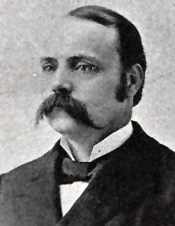
Historical · U.S. House · Missouri · District 9
William Treloar
Former U.S. Representative · Missouri District 9 · 1895–1897 · Republican
William Treloar represented Missouri's District 9 in the United States House of Representatives (1895–1897) for the Republican party. The page below collects sourced biographical facts, term history, committee roles, and provenance for Treloar.
Bioguide ID: T000363
Key facts
- Full name
- William Treloar
- State
- Missouri
- District
- District 9
- Party
- Republican
- House service
- 1895–1897
- First House term
- 1895
- Status
- Left office
- Current term ends
- —
- Born
- 1850
- Bioguide ID
- T000363
- Committee assignments
- —
- Dataset version
- 1.20260606
Biographical narrative
878 words · sourced from the Wikipedia REST extract
William Treloar was an American music professor, composer, music publisher, and politician who served as a U.S. Representative for Missouri's 9th congressional district. A member of the Republican Party, Treloar held office during the 54th Congress from 1895 to 1897. His career spanned various fields, including education and politics, and he was known for his contributions to music and copyright legislation. After his congressional term, he continued to engage in music publishing and education, leaving a lasting impact on his community.
Early life and career
William Treloar was born on September 21, 1850, near Linden, Wisconsin. He received his early education in local common schools before his family relocated to Mount Pleasant, Iowa, in 1864. There, he attended high school and later enrolled at Iowa Wesleyan College, where he likely developed his interests in music and education. In 1872, Treloar moved to Missouri, marking the beginning of his professional journey in the field of music.
From 1872 to 1875, Treloar taught music at Mount Pleasant College in Huntsville, Missouri. His role as an educator was significant, as he contributed to the musical education of many students during this period. In 1875, he transitioned to a position as a professor of music at Hardin College in Mexico, Missouri. In addition to his work at Hardin College, he also taught at the Synodical Female College in nearby Fulton and in local public schools, further expanding his influence in the educational landscape of the region.
Treloar's early career was characterized by a commitment to music education and composition, which laid the groundwork for his later endeavors in both music publishing and politics. His background in music not only shaped his professional life but also informed his legislative interests, particularly in areas related to copyright and intellectual property.
House tenure
Treloar's entry into politics began in 1894 when he served as a delegate to the Republican state convention. He ran for the U.S. House of Representatives in the same year, challenging the incumbent Democratic Congressman Champ Clark. Treloar's victory in this election was notable, as it occurred during a Republican landslide, which contributed to his success. Despite being regarded as the fifth choice of the Republican Party for the nomination, Treloar managed to secure the seat, although he faced ridicule from some quarters, with newspapers referring to him in derogatory terms related to his musical background.
During his term in the 54th Congress, which lasted from 1895 to 1897, Treloar sponsored the Treloar Copyright Bill. This proposed legislation aimed to establish a copyright registry and extend copyright terms, reflecting his interests in protecting the rights of creators in the music industry. The bill generated considerable controversy and was the subject of extensive lobbying efforts from both supporters and opponents. Ultimately, the legislation did not advance out of committee; however, some of its provisions were later incorporated into other laws, indicating that Treloar's efforts had a lasting impact on copyright policy.
After serving one term in Congress, Treloar sought reelection in 1896 but was defeated by Champ Clark in a rematch. This election took place during a year marked by Democratic gains, which contributed to Treloar's loss. His congressional career, while brief, was marked by his engagement in significant legislative issues related to copyright and his efforts to represent the interests of his constituents.
Legislative focus and committees
During his time in the House of Representatives, Treloar's legislative focus was primarily centered on issues related to copyright and intellectual property rights. The Treloar Copyright Bill, which he sponsored, aimed to create a copyright registry and extend the duration of copyright protections. This initiative highlighted his commitment to supporting the rights of artists and composers, particularly in the music industry, where he had extensive experience.
Although the bill did not progress beyond committee, the discussions surrounding it reflected the growing importance of copyright issues during that era. The lobbying efforts that accompanied the bill underscored the contentious nature of copyright legislation and the varying interests of different stakeholders in the music and publishing industries. Treloar's involvement in this legislative effort demonstrated his dedication to advocating for the rights of creators, a theme that would continue to resonate throughout his career.
Following his departure from Congress, Treloar continued to be active in his community and in the field of music. He served as the postmaster of Mexico, Missouri, from 1898 to 1904, a position that allowed him to remain engaged in public service. In 1905, he moved to Kansas City, Missouri, where he founded a music publishing business, further solidifying his connection to the music industry. Treloar operated this business until 1915, after which he relocated it to St. Louis. In addition to his work in publishing, he continued to teach music and compose, contributing to the cultural landscape of the region.
Treloar's legacy extends beyond his political career; he is remembered for his contributions to music education and publishing. He served as an election judge from 1920 to 1924, reflecting his ongoing commitment to civic engagement. Treloar passed away on July 3, 1935, in St. Louis and was buried in Bellefontaine Cemetery. His influence is commemorated in part by the town of Treloar, Missouri, which is named in his honor, recognizing his contributions to the state and the field of music.
Notable legislation
Sponsored and co-sponsored legislation for William Treloar is pending operator curation. The biographical narrative above carries the same provenance trail until per-bill rows are written.
Sources
- [1]https://en.wikipedia.org/wiki/William_M._TreloarWikipedia · retrieved 2026-06-06
Notable quotes
Sourced quotes for William Treloar are pending operator curation. Narrative-scope provenance remains attached below.
Sources
- [1]https://en.wikipedia.org/wiki/William_M._TreloarWikipedia · retrieved 2026-06-06
Key positions
Curated policy positions for William Treloar are pending operator review. The biographical narrative above carries the same provenance trail until per-topic positions are written.
Sources
- [1]https://en.wikipedia.org/wiki/William_M._TreloarWikipedia · retrieved 2026-06-06
Terms served
- 1895–1897U.S. House · Term 1 · Republican
Sources & provenance
Every attributable claim above carries a per-section [N] marker that resolves to the corresponding URL below. Each entry records the upstream provider, the canonical URL, and the timestamp at which the source was retrieved by the ingest pipeline.
Key facts
- https://bioguide.congress.gov/search/bio/T000363bioguide · retrieved 2026-06-06
- https://www.govtrack.us/congress/members/410933govtrack · retrieved 2026-06-06
Biographical narrative
- https://en.wikipedia.org/wiki/William_M._Treloarwikipedia · retrieved 2026-06-06
Find your representative
Every U.S. state elects representatives by district. Browse Missouri’s delegation, the full former-representative roster, or explore the role and term length.
Related on The Candidate
- Preceded by Nathan FrankEarlier holder of the Missouri District 9 House seat · Republican.Open
- Succeeded by Theodore HukriedeLater holder of the Missouri District 9 House seat · Republican.Open
- Anthony IttnerFormer U.S. Representative · Missouri District 1 · RepublicanOpen
- Bill Clay Sr.Former U.S. Representative · Missouri District 1 · DemocraticOpen
- Charles ClarkFormer U.S. Representative · Missouri District 1 · RepublicanOpen
- Clare MageeFormer U.S. Representative · Missouri District 1 · DemocraticOpen