
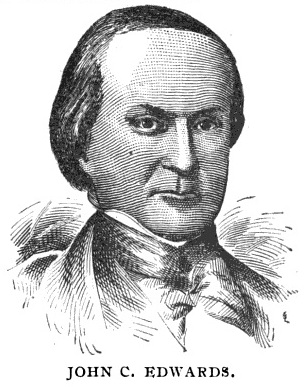
Historical · U.S. House · Missouri · At-Large
John Edwards
Former U.S. Representative · Missouri At-Large · 1841–1843 · Democratic
John Edwards represented Missouri's At-Large in the United States House of Representatives (1841–1843) for the Democratic party. The page below collects sourced biographical facts, term history, committee roles, and provenance for Edwards.
Bioguide ID: E000076
Key facts
- Full name
- John Edwards
- State
- Missouri
- District
- At-Large
- Party
- Democratic
- House service
- 1841–1843
- First House term
- 1841
- Status
- Left office
- Current term ends
- —
- Born
- 1804
- Bioguide ID
- E000076
- Committee assignments
- —
- Dataset version
- 1.20260606
Biographical narrative
1,010 words · sourced from the Wikipedia REST extract
John Cummins Edwards was a Democratic politician from Missouri who served as a U.S. Representative in the 27th Congress and later became the 9th Governor of Missouri. His political career was marked by significant involvement in both state and national issues, particularly during a transformative period in American history. Edwards' tenure in public office was characterized by his commitment to the principles of Jacksonian democracy and his efforts to address key legislative matters affecting his constituents.
Early life and career
John Cummins Edwards was born on June 24, 1804, in Frankfort, Kentucky, to John and Sarah (Cummins) Edwards. His early years were spent in the Murfreesboro area of Tennessee, where he completed his preparatory education at Black's College in Kentucky. Following this, he pursued legal studies at Dr. Henderson's Classic School in Rutherford County, Tennessee. Edwards further honed his legal acumen by studying under the local states attorney, which ultimately led to his admission to the Tennessee Bar in 1825.
Edwards began his professional career as an attorney in Murfreesboro, where he practiced law for three years. In 1828, he relocated to Missouri, setting up a law practice in Jefferson City. His move to Missouri marked the beginning of a lengthy and influential political career. In 1830, he was appointed Secretary of State by Governor John G. Miller, a role he held until 1835, with a brief return to the position in 1837. During his time as Secretary of State, Edwards was responsible for overseeing various administrative functions and played a role in the legal education of his younger brother, Edward Livingston Edwards.
In addition to his duties as Secretary of State, Edwards served as a district judge for Cole County from 1832 to 1837, a dual role that was not uncommon in that era but would be viewed as unusual today. His political alignment as a Jacksonian Democrat positioned him as a supporter of the policies championed by President Andrew Jackson, and he was a close ally of Missouri Senator Thomas Hart Benton. In 1836, Edwards was elected to the Missouri House of Representatives; however, his time in this role was short-lived, as he was appointed to the Missouri Supreme Court in 1837, serving until 1839.
House tenure
Edwards transitioned to national politics in 1841 when he was elected to the United States House of Representatives, representing Missouri's at-large congressional district during the 27th Congress. His term in the House lasted until March 3, 1843, and during this period, he engaged in several significant legislative matters that were pertinent to Missouri and the nation at large. One of the key issues he opposed was the Tariff of 1842, which he believed would adversely affect his constituents. Additionally, he was involved in efforts to address the Missouri-Iowa border dispute, known as the Honey War, where he played a role in blocking federal settlement of the issue.
Despite his active participation in Congress, Edwards chose not to seek a second term in the House. Instead, he set his sights on the governorship of Missouri. His decision to return to state politics was likely influenced by his desire to have a more direct impact on the governance of Missouri, as well as the opportunities presented by the evolving political landscape of the state.
Legislative focus and committees
Following his congressional tenure, Edwards successfully ran for the office of Governor of Missouri in the election of 1844. He narrowly defeated his opponent, a former Democrat who had switched to the Whig Party. As Governor, Edwards presided over a period of considerable change and development in Missouri. His administration saw the establishment of nineteen new counties, reflecting the state's growth and the increasing demands of its population.
During his governorship, Edwards was also at the forefront of technological advancements. He oversaw the introduction of the telegraph system in St. Louis, which significantly improved communication across the state. Additionally, his administration was responsible for the chartering of the state's first railroad, the Hannibal and St. Joseph Railroad, which facilitated transportation and commerce.
Edwards served as a wartime governor during the Mexican-American War, overseeing the formation of the Missouri Mounted Volunteers, a military unit that participated in the conflict. His leadership during this tumultuous period was marked by efforts to ensure that Missouri contributed effectively to the war effort. Furthermore, he played a crucial role in resolving the Honey War, as his administration agreed to arbitration regarding the border dispute with Iowa, which had been a contentious issue for several years.
Among his notable accomplishments as governor was the establishment of the Missouri state hospital for the mentally ill in Fulton, which represented a significant step forward in the state's approach to mental health care. Edwards also implemented a new tax system that transformed Missouri's financial situation from a deficit to a surplus, demonstrating his fiscal responsibility. Additionally, he approved a tax to fund a free normal school at the University of Missouri, contributing to the advancement of education in the state.
However, Edwards' time in office was not without challenges. He faced criticism from the Missouri legislature, which deemed his expenses excessive and refused to reimburse him for renovations and maintenance of the Governor's mansion. His decision to travel to New Orleans to sell state bonds also drew scrutiny, and he faced public disapproval from a grand jury in St. Louis for his administration's use of the pardoning power, particularly regarding the release of individuals involved in abolitionist activities.
After leaving the governorship, Edwards did not remain in Missouri for long. He organized a stock train to California, where he became a successful rancher and merchant in the Stockton area. In 1851, he briefly returned to public service as the mayor of Stockton. Edwards married in 1854 and had eleven children with his wife, Emma Jeanne Catherine Richard. He passed away on either September 17 or October 14, 1888, in Stockton, California, and was laid to rest in the Rural Cemetery there. His life and career reflect the complexities of American politics during a pivotal era, marked by both progress and conflict.
Notable legislation
Sponsored and co-sponsored legislation for John Edwards is pending operator curation. The biographical narrative above carries the same provenance trail until per-bill rows are written.
Sources
- [1]https://en.wikipedia.org/wiki/John_C._EdwardsWikipedia · retrieved 2026-06-06
Notable quotes
Sourced quotes for John Edwards are pending operator curation. Narrative-scope provenance remains attached below.
Sources
- [1]https://en.wikipedia.org/wiki/John_C._EdwardsWikipedia · retrieved 2026-06-06
Key positions
Curated policy positions for John Edwards are pending operator review. The biographical narrative above carries the same provenance trail until per-topic positions are written.
Sources
- [1]https://en.wikipedia.org/wiki/John_C._EdwardsWikipedia · retrieved 2026-06-06
Terms served
- 1841–1843U.S. House · Term 1 · Democratic
Sources & provenance
Every attributable claim above carries a per-section [N] marker that resolves to the corresponding URL below. Each entry records the upstream provider, the canonical URL, and the timestamp at which the source was retrieved by the ingest pipeline.
Key facts
- https://bioguide.congress.gov/search/bio/E000076bioguide · retrieved 2026-06-06
- https://www.govtrack.us/congress/members/403768govtrack · retrieved 2026-06-06
Biographical narrative
- https://en.wikipedia.org/wiki/John_C._Edwardswikipedia · retrieved 2026-06-06
Find your representative
Every U.S. state elects representatives by district. Browse Missouri’s delegation, the full former-representative roster, or explore the role and term length.
Related on The Candidate
- Preceded by Albert HarrisonEarlier holder of the Missouri At-Large House seat · Democratic.Open
- Succeeded by Gustavus BowerLater holder of the Missouri At-Large House seat · Democratic.Open
- Anthony IttnerFormer U.S. Representative · Missouri District 1 · RepublicanOpen
- Bill Clay Sr.Former U.S. Representative · Missouri District 1 · DemocraticOpen
- Charles ClarkFormer U.S. Representative · Missouri District 1 · RepublicanOpen
- Clare MageeFormer U.S. Representative · Missouri District 1 · DemocraticOpen