
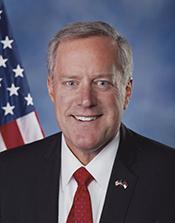
Historical · U.S. House · North Carolina · District 11
Mark Meadows
Former U.S. Representative · North Carolina District 11 · 2013–2020 · Republican
Mark Meadows represented North Carolina's District 11 in the United States House of Representatives (2013–2020) for the Republican party. The page below collects sourced biographical facts, term history, committee roles, and provenance for Meadows.
Bioguide ID: M001187
Key facts
- Full name
- Mark Meadows
- State
- North Carolina
- District
- District 11
- Party
- Republican
- House service
- 2013–2020
- First House term
- 2013
- Status
- Left office
- Current term ends
- —
- Born
- 1959
- Bioguide ID
- M001187
- Committee assignments
- —
- Dataset version
- 1.20260605
Biographical narrative
856 words · sourced from the Wikipedia REST extract
Mark Meadows is a former American politician who served as a U.S. Representative for North Carolina's 11th congressional district from 2013 until 2020. A member of the Republican Party, Meadows is recognized for his role as a founding member of the Freedom Caucus and for his close alignment with the Trump administration, culminating in his appointment as White House Chief of Staff from 2020 to 2021. His legislative career was marked by a strong conservative stance and significant involvement in key political events, including the federal government shutdown of 2013 and efforts to challenge the leadership within the House of Representatives.
Early life and career
Mark Meadows was born on July 28, 1959, in Verdun, France, where his father was stationed in the U.S. Army, and his mother worked as a civilian nurse. He spent his formative years in Brandon, Florida, where he has described himself as a "fat nerd" during his childhood, a self-assessment that he attributed to a personal experience that motivated him to adopt a healthier lifestyle. Meadows attended Florida State University for a year before transferring to the University of South Florida, where he earned an Associate of Arts degree.
In 1987, Meadows ventured into entrepreneurship by opening a small restaurant named "Aunt D's" in Highlands, North Carolina. This establishment was supported by members of the Community Bible Church, which provided the necessary building space. After selling the restaurant, Meadows transitioned into real estate development in the Tampa area, where he remained until his congressional victory in 2013. His early career also included working at a local hardware store and receiving assistance from Ginger Burnett Glasson, who provided him with land for housing and helped him establish a joint business.
Meadows became actively involved in local politics, serving as the chairman of the Republican Party in Macon County and participating as a delegate in several state and national Republican conventions. His commitment to economic development in Western North Carolina was reflected in his role on North Carolina's Board for Economic Development. In 2011, he relocated to Glenville, North Carolina, and later moved to an apartment in Biltmore Park, Asheville, in 2016 while contemplating future real estate investments.
House tenure
Mark Meadows was elected to the U.S. House of Representatives in 2012, representing North Carolina's 11th congressional district. His first term began in January 2013, and he was subsequently re-elected for three additional terms, concluding his service in March 2020. During his time in Congress, Meadows was known for his ultraconservative voting record and was a prominent figure within the Republican Party's right wing.
As a founding member of the Freedom Caucus, Meadows played a pivotal role in shaping the group's agenda, which was aligned with the Tea Party movement's principles. His legislative actions included signing the "Contract from America," a manifesto of ten policies that encapsulated the movement's goals. Meadows was involved in significant political events, including the federal government shutdown in 2013, which was partly driven by disputes over funding for the Affordable Care Act.
Meadows's tenure was characterized by his opposition to various spending measures, including disaster relief funding for Hurricane Sandy, which struck the Northeastern United States in 2012. His stance on fiscal conservatism often placed him at odds with more moderate Republicans and Democrats. Additionally, Meadows was noted for his efforts to challenge the leadership of then-Speaker John Boehner, reflecting his commitment to a more conservative direction for the party.
In March 2020, Meadows resigned from Congress to accept the position of White House Chief of Staff under President Donald Trump. His departure marked the end of a notable congressional career that was defined by a strong alignment with conservative values and active participation in key legislative battles.
Legislative focus and committees
Throughout his congressional career, Mark Meadows focused on a range of issues that aligned with his conservative ideology. He was particularly vocal on matters related to fiscal responsibility, government spending, and limited government intervention. His membership in the Freedom Caucus underscored his commitment to these principles, as the group sought to exert influence over the Republican agenda in Congress.
Meadows's voting record reflected his ultraconservative stance, as he consistently supported measures aimed at reducing government spending and opposing what he viewed as excessive regulation. His involvement in the 2013 government shutdown was a significant event that highlighted his willingness to leverage political tactics to achieve policy goals, particularly in relation to the Affordable Care Act.
In addition to his fiscal conservatism, Meadows was active in various committees during his time in the House. His committee assignments allowed him to engage with a wide range of issues, from economic development to healthcare. His leadership within the Freedom Caucus also positioned him as a key player in shaping the Republican Party's response to major legislative initiatives.
Meadows's tenure in Congress concluded with his resignation in March 2020, after which he transitioned to the role of White House Chief of Staff. His time in the House was marked by a commitment to conservative principles and a willingness to engage in contentious political battles, leaving a lasting impact on the legislative landscape during his years of service.
Notable legislation
Sponsored and co-sponsored legislation for Mark Meadows is pending operator curation. The biographical narrative above carries the same provenance trail until per-bill rows are written.
Sources
- [1]https://en.wikipedia.org/wiki/Mark_MeadowsWikipedia · retrieved 2026-06-05
Notable quotes
Sourced quotes for Mark Meadows are pending operator curation. Narrative-scope provenance remains attached below.
Sources
- [1]https://en.wikipedia.org/wiki/Mark_MeadowsWikipedia · retrieved 2026-06-05
Key positions
Curated policy positions for Mark Meadows are pending operator review. The biographical narrative above carries the same provenance trail until per-topic positions are written.
Sources
- [1]https://en.wikipedia.org/wiki/Mark_MeadowsWikipedia · retrieved 2026-06-05
Terms served
- 2013–2015U.S. House · Term 1 · Republican
- 2015–2017U.S. House · Term 2 · Republican
- 2017–2019U.S. House · Term 3 · Republican
- 2019–2020U.S. House · Term 4 · Republican
Sources & provenance
Every attributable claim above carries a per-section [N] marker that resolves to the corresponding URL below. Each entry records the upstream provider, the canonical URL, and the timestamp at which the source was retrieved by the ingest pipeline.
Key facts
- https://bioguide.congress.gov/search/bio/M001187bioguide · retrieved 2026-06-05
- https://meadows.house.govhouse.gov · retrieved 2026-06-05
Biographical narrative
- https://en.wikipedia.org/wiki/Mark_Meadowswikipedia · retrieved 2026-06-05
Find your representative
Every U.S. state elects representatives by district. Browse North Carolina’s delegation, the full former-representative roster, or explore the role and term length.
Related on The Candidate
- Preceded by Heath ShulerEarlier holder of the North Carolina District 11 House seat · Democratic.Open
- Succeeded by Madison CawthornLater holder of the North Carolina District 11 House seat · Republican.Open
- Alfred GatlinFormer U.S. Representative · North Carolina District 1 · Crawford RepublicanOpen
- Clinton CobbFormer U.S. Representative · North Carolina District 1 · RepublicanOpen
- Eva ClaytonFormer U.S. Representative · North Carolina District 1 · DemocraticOpen
- Frank Ballance Jr.Former U.S. Representative · North Carolina District 1 · DemocraticOpen