
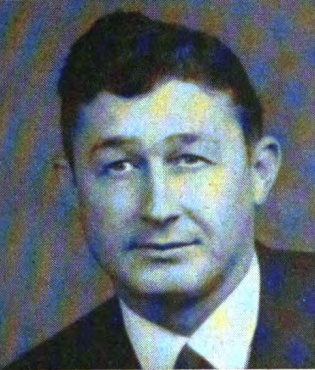
Historical · U.S. House · North Carolina · District 11
Woodrow Jones
Former U.S. Representative · North Carolina District 11 · 1949–1957 · Democratic
Woodrow Jones represented North Carolina's District 11 in the United States House of Representatives (1949–1957) for the Democratic party. The page below collects sourced biographical facts, term history, committee roles, and provenance for Jones.
Bioguide ID: J000263
Key facts
- Full name
- Woodrow Jones
- State
- North Carolina
- District
- District 11
- Party
- Democratic
- House service
- 1949–1957
- First House term
- 1949
- Status
- Left office
- Current term ends
- —
- Born
- 1914
- Bioguide ID
- J000263
- Committee assignments
- —
- Dataset version
- 1.20260605
Biographical narrative
998 words · sourced from the Wikipedia REST extract
Woodrow Jones was a prominent figure in American politics, serving as a U.S. Representative from North Carolina's 11th congressional district from 1950 to 1957. A member of the Democratic Party, Jones's political career was marked by his involvement in both state and federal government, culminating in his later appointment as a federal judge. His contributions to the legal and political landscape of North Carolina are notable, particularly during a time of significant change in the United States.
Early life and career
Woodrow Wilson Jones was born on January 26, 1914, in Rutherfordton, North Carolina, a town located in Rutherford County. Growing up in this small community, he attended the local public schools, which laid the foundation for his educational pursuits. In 1934, he earned an Associate of Arts degree from Mars Hill College, a private liberal arts college in North Carolina. Following this, he continued his education at Wake Forest University School of Law, where he received his Bachelor of Laws degree in 1937. This legal education prepared him for a career in law, which he began shortly after graduation.
Jones entered private legal practice in Rutherfordton in 1937, where he worked until 1944. During this period, he also held several positions that contributed to his professional development and community involvement. He served as the City Attorney of Rutherfordton from 1940 to 1943, which provided him with valuable experience in municipal law. Additionally, he was the prosecuting attorney for the Rutherford County Recorder's Court from 1941 to 1943, further establishing his reputation as a legal professional in the region.
His career was interrupted by World War II, during which he served as a Lieutenant (junior grade) in the United States Naval Reserve from 1944 to 1946. This military service not only reflected his commitment to his country but also likely influenced his later political career. After the war, Jones returned to private practice in Rutherfordton from 1946 until 1950. His legal background and community engagement paved the way for his entry into politics.
In 1947, Jones began his political career by being elected to the North Carolina House of Representatives, where he served until 1949. This experience in state government allowed him to gain insights into legislative processes and the needs of his constituents, which would prove beneficial in his subsequent congressional career.
House tenure
Jones's tenure in the U.S. House of Representatives began when he was elected to the 81st Congress to fill a vacancy caused by the death of Representative Alfred L. Bulwinkle. He officially took office on November 7, 1950, representing North Carolina's 11th congressional district. His election marked the beginning of a significant period in his political career, during which he was reelected to three additional Congresses, serving until January 3, 1957.
Throughout his time in Congress, Jones was actively involved in various legislative matters and represented the interests of his constituents. His service coincided with a transformative era in American history, characterized by post-war recovery, civil rights movements, and significant social change. While specific details of his legislative actions are not provided, it can be inferred that his role as a congressman would have involved addressing the pressing issues of the time, including economic development, education, and civil rights.
In addition to his legislative responsibilities, Jones was deeply engaged in party politics. He was a delegate to all Democratic State Conventions from 1940 to 1960, which allowed him to play a role in shaping the party's platform and direction at the state level. His involvement extended to the national stage as well, where he served as a delegate to the Democratic National Convention in 1960. This participation in party activities reflects his commitment to the Democratic Party and his influence within it.
Jones also held leadership positions within the party, including serving as the Chairman of the North Carolina Democratic Party Executive Committee from 1958 to 1960. His leadership in this capacity would have involved strategizing for elections, mobilizing party members, and addressing key issues facing the state and the nation.
Despite his active political career, Jones chose not to seek renomination for the 85th Congress in 1956. This decision marked the end of his congressional tenure, but it did not conclude his public service, as he continued to be involved in various political and legal capacities.
Legislative focus and committees
During his time in the House of Representatives, Jones's legislative focus and committee assignments are not detailed in the available records. However, it is known that he was a signatory to the 1956 Southern Manifesto, which opposed the desegregation of public schools mandated by the Supreme Court's decision in Brown v. Board of Education. This position reflects the complex and often contentious issues surrounding civil rights during that era, particularly in the Southern states.
Following his congressional service, Jones returned to private legal practice in Rutherfordton from 1956 until 1967. His legal expertise and experience in public service positioned him well for his next significant role in the federal judiciary. In 1967, he was nominated by President Lyndon B. Johnson to serve as a judge on the United States District Court for the Western District of North Carolina. His confirmation by the Senate occurred shortly thereafter, and he received his commission on the same day.
Jones's judicial career included serving as Chief Judge from 1968 to 1984, during which he oversaw numerous cases and contributed to the development of federal law in his district. He later assumed senior status in 1985, allowing him to continue serving in a reduced capacity. His judicial service was marked by involvement in significant cases, including presiding over criminal proceedings related to a major federal investigation into vote-buying in western North Carolina.
Woodrow Jones passed away on November 25, 2002, in Rutherfordton, North Carolina, where he was interred in the Rutherfordton City Cemetery. His contributions to both the legislative and judicial branches of government reflect a career dedicated to public service and the legal profession, leaving a lasting impact on the communities he served.
Notable legislation
Sponsored and co-sponsored legislation for Woodrow Jones is pending operator curation. The biographical narrative above carries the same provenance trail until per-bill rows are written.
Sources
- [1]https://en.wikipedia.org/wiki/Woodrow_W._JonesWikipedia · retrieved 2026-06-05
Notable quotes
Sourced quotes for Woodrow Jones are pending operator curation. Narrative-scope provenance remains attached below.
Sources
- [1]https://en.wikipedia.org/wiki/Woodrow_W._JonesWikipedia · retrieved 2026-06-05
Key positions
Curated policy positions for Woodrow Jones are pending operator review. The biographical narrative above carries the same provenance trail until per-topic positions are written.
Sources
- [1]https://en.wikipedia.org/wiki/Woodrow_W._JonesWikipedia · retrieved 2026-06-05
Terms served
- 1949–1951U.S. House · Term 1 · Democratic
- 1951–1953U.S. House · Term 2 · Democratic
- 1953–1955U.S. House · Term 3 · Democratic
- 1955–1957U.S. House · Term 4 · Democratic
Sources & provenance
Every attributable claim above carries a per-section [N] marker that resolves to the corresponding URL below. Each entry records the upstream provider, the canonical URL, and the timestamp at which the source was retrieved by the ingest pipeline.
Key facts
- https://bioguide.congress.gov/search/bio/J000263bioguide · retrieved 2026-06-05
- https://www.govtrack.us/congress/members/406155govtrack · retrieved 2026-06-05
Biographical narrative
- https://en.wikipedia.org/wiki/Woodrow_W._Joneswikipedia · retrieved 2026-06-05
Find your representative
Every U.S. state elects representatives by district. Browse North Carolina’s delegation, the full former-representative roster, or explore the role and term length.
Related on The Candidate
- Preceded by Greene CaldwellEarlier holder of the North Carolina District 11 House seat · Democratic.Open
- Succeeded by Roy TaylorLater holder of the North Carolina District 11 House seat · Democratic.Open
- Alfred GatlinFormer U.S. Representative · North Carolina District 1 · Crawford RepublicanOpen
- Clinton CobbFormer U.S. Representative · North Carolina District 1 · RepublicanOpen
- Eva ClaytonFormer U.S. Representative · North Carolina District 1 · DemocraticOpen
- Frank Ballance Jr.Former U.S. Representative · North Carolina District 1 · DemocraticOpen