
Historical · U.S. House · North Carolina · District 3
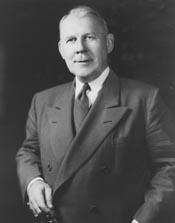
Graham Barden
Former U.S. Representative · North Carolina District 3 · 1935–1961 · Democratic
Graham Barden represented North Carolina's District 3 in the United States House of Representatives (1935–1961) for the Democratic party. The page below collects sourced biographical facts, term history, committee roles, and provenance for Barden.
Bioguide ID: B000139
Key facts
- Full name
- Graham Barden
- State
- North Carolina
- District
- District 3
- Party
- Democratic
- House service
- 1935–1961
- First House term
- 1935
- Status
- Left office
- Current term ends
- —
- Born
- 1896
- Bioguide ID
- B000139
- Committee assignments
- —
- Dataset version
- 1.20260605
Biographical narrative
936 words · sourced from the Wikipedia REST extract
Graham Barden was a prominent American lawyer and politician who served as a U.S. Representative for North Carolina's 3rd congressional district from 1935 until 1961. A member of the Democratic Party, Barden's lengthy tenure in Congress spanned 13 terms, during which he held significant leadership roles, particularly in education-related committees. His career was marked by his involvement in legislative matters during a transformative period in American history, including World War II and the civil rights movement.
Early life and career
Graham Arthur Barden was born on September 25, 1896, in Sampson County, North Carolina. At the age of 12, he relocated to Burgaw, North Carolina, where he completed his education in the local public schools. His early life was characterized by a commitment to service, as he enlisted in the United States Navy during World War I, serving as a seaman until his discharge in 1919.
Following his military service, Barden pursued higher education at the University of North Carolina at Chapel Hill, where he studied law. He successfully gained admission to the bar in 1920, marking the beginning of his professional career. Initially, he practiced law while also taking on the role of a high school teacher. His legal career progressed when he was appointed as a judge in the Craven County courts, a position he held until 1924. This early experience in the judiciary provided him with a foundation in legal matters that would later inform his legislative work.
Barden's political career began in earnest in 1932 when he was elected to the North Carolina House of Representatives. His time in the state legislature allowed him to gain valuable experience in governance and public policy, setting the stage for his subsequent election to the U.S. Congress.
House tenure
In 1935, Graham Barden was elected to the United States House of Representatives, marking the start of a lengthy and impactful congressional career. Over the course of 13 consecutive terms, he became a significant figure in the House, representing North Carolina's 3rd congressional district. His tenure in Congress was notable for his leadership roles, particularly in the realm of education.
During the 78th and 79th Congresses, Barden served as the chairman of the House Education Committee. His leadership in this capacity allowed him to influence a variety of educational policies and initiatives. Following a merger of the Education Committee with the Labor Committee, Barden continued to serve as chairman when the newly formed Education and Labor Committee convened during the 81st, 82nd, 84th, 85th, and 86th Congresses. His extended chairmanship underscored his commitment to educational issues and his ability to navigate the complexities of legislative processes.
Barden's congressional career unfolded during a time of significant national change, including the Great Depression and World War II. His legislative actions reflected the priorities of the Democratic Party during this era, as well as the evolving needs of his constituents. He was involved in various initiatives aimed at improving education and labor conditions, which were critical issues during the mid-20th century.
In addition to his work on education, Barden's political stance included a notable opposition to the Supreme Court's decision in Brown v. Board of Education, which mandated the desegregation of public schools. He was a signatory to the 1956 Southern Manifesto, a document that expressed resistance to the ruling and reflected the sentiments of many Southern politicians at the time.
Barden's decision not to seek re-election in 1960 marked the end of his long and distinguished career in public service. He concluded his final term in the House on January 3, 1961, leaving behind a legacy shaped by his extensive involvement in education and labor issues.
Legislative focus and committees
Throughout his time in Congress, Graham Barden's legislative focus was primarily centered on education and labor, reflecting his background and expertise in these areas. As chairman of the House Education Committee and later the Education and Labor Committee, he played a pivotal role in shaping policies that impacted schools, teachers, and students across the nation.
Barden's leadership in these committees allowed him to advocate for various educational reforms and initiatives aimed at improving the quality of education in the United States. His tenure coincided with significant changes in educational policy, including discussions around federal funding for education and the establishment of programs designed to support both students and educators.
In addition to his work on educational issues, Barden's involvement in labor-related matters was also significant. He engaged with legislation that addressed the rights and conditions of workers, contributing to the broader discourse on labor rights during a time when such issues were increasingly coming to the forefront of national politics.
Barden's legislative actions were influenced by the political climate of his time, particularly the challenges posed by the civil rights movement. His opposition to desegregation efforts, as evidenced by his support for the Southern Manifesto, positioned him within a contentious debate that would shape American society for decades to come.
Following his retirement from Congress, Barden's contributions to public service continued to be recognized. He passed away on January 29, 1967, in New Bern, North Carolina. His legacy is commemorated in part by the naming of Graham A. Barden Elementary School in Havelock, North Carolina, which serves as a testament to his impact on education in the region.
In summary, Graham Barden's career as a U.S. Representative was marked by a commitment to education and labor issues, as well as a significant role in legislative leadership. His lengthy tenure in Congress reflects a period of profound change in American society, and his contributions continue to be acknowledged in the context of North Carolina's political history.
Notable legislation
Sponsored and co-sponsored legislation for Graham Barden is pending operator curation. The biographical narrative above carries the same provenance trail until per-bill rows are written.
Sources
- [1]https://en.wikipedia.org/wiki/Graham_A._BardenWikipedia · retrieved 2026-06-05
Notable quotes
Sourced quotes for Graham Barden are pending operator curation. Narrative-scope provenance remains attached below.
Sources
- [1]https://en.wikipedia.org/wiki/Graham_A._BardenWikipedia · retrieved 2026-06-05
Key positions
Curated policy positions for Graham Barden are pending operator review. The biographical narrative above carries the same provenance trail until per-topic positions are written.
Sources
- [1]https://en.wikipedia.org/wiki/Graham_A._BardenWikipedia · retrieved 2026-06-05
Terms served
- 1935–1937U.S. House · Term 1 · Democratic
- 1937–1939U.S. House · Term 2 · Democratic
- 1939–1941U.S. House · Term 3 · Democratic
- 1941–1943U.S. House · Term 4 · Democratic
- 1943–1945U.S. House · Term 5 · Democratic
- 1945–1947U.S. House · Term 6 · Democratic
- 1947–1949U.S. House · Term 7 · Democratic
- 1949–1951U.S. House · Term 8 · Democratic
- 1951–1953U.S. House · Term 9 · Democratic
- 1953–1955U.S. House · Term 10 · Democratic
- 1955–1957U.S. House · Term 11 · Democratic
- 1957–1959U.S. House · Term 12 · Democratic
- 1959–1961U.S. House · Term 13 · Democratic
Sources & provenance
Every attributable claim above carries a per-section [N] marker that resolves to the corresponding URL below. Each entry records the upstream provider, the canonical URL, and the timestamp at which the source was retrieved by the ingest pipeline.
Key facts
- https://bioguide.congress.gov/search/bio/B000139bioguide · retrieved 2026-06-05
- https://www.govtrack.us/congress/members/401140govtrack · retrieved 2026-06-05
Biographical narrative
- https://en.wikipedia.org/wiki/Graham_A._Bardenwikipedia · retrieved 2026-06-05
Find your representative
Every U.S. state elects representatives by district. Browse North Carolina’s delegation, the full former-representative roster, or explore the role and term length.
Related on The Candidate
- Preceded by Charles AbernethyEarlier holder of the North Carolina District 3 House seat · Democratic.Open
- Succeeded by David HendersonLater holder of the North Carolina District 3 House seat · Democratic.Open
- Alfred GatlinFormer U.S. Representative · North Carolina District 1 · Crawford RepublicanOpen
- Clinton CobbFormer U.S. Representative · North Carolina District 1 · RepublicanOpen
- Eva ClaytonFormer U.S. Representative · North Carolina District 1 · DemocraticOpen
- Frank Ballance Jr.Former U.S. Representative · North Carolina District 1 · DemocraticOpen