
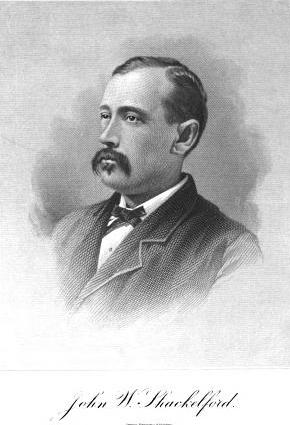
Historical · U.S. House · North Carolina · District 3
John Shackelford
Former U.S. Representative · North Carolina District 3 · 1881–1883 · Democratic
John Shackelford represented North Carolina's District 3 in the United States House of Representatives (1881–1883) for the Democratic party. The page below collects sourced biographical facts, term history, committee roles, and provenance for Shackelford.
Bioguide ID: S000273
Key facts
- Full name
- John Shackelford
- State
- North Carolina
- District
- District 3
- Party
- Democratic
- House service
- 1881–1883
- First House term
- 1881
- Status
- Left office
- Current term ends
- —
- Born
- 1844
- Bioguide ID
- S000273
- Committee assignments
- —
- Dataset version
- 1.20260606
Biographical narrative
908 words · sourced from the Wikipedia REST extract
John Shackelford was a U.S. Representative from North Carolina who served in the House of Representatives during the early 1880s. A member of the Democratic Party, he represented the state's third congressional district. Shackelford's political career was preceded by his service as a soldier in the Confederate Army during the Civil War, as well as his involvement in North Carolina's state legislature. His time in Congress was cut short by his untimely death in 1883, marking the end of his single term in office.
Early life and career
John Williams Shackelford was born on November 16, 1844, in Richlands, North Carolina. He hailed from a family with historical roots in Virginia, specifically from a locality known as Shacklefords. This background may have influenced his early life and values, as he grew up in a region that was deeply affected by the cultural and political dynamics of the time.
At the age of 17, Shackelford enlisted in the Confederate Army, a decision that would shape much of his early adulthood. His military service during the Civil War was significant; he rose to the rank of lieutenant, indicating a level of leadership and commitment during a tumultuous period in American history. The experiences he gained during the war likely informed his perspectives and actions in later political roles.
Following the conclusion of the Civil War, Shackelford transitioned into public service. In 1872, he began his political career by winning a seat in the North Carolina House of Representatives. His tenure in the state legislature lasted for six years, during which he engaged in various legislative activities and contributed to the governance of North Carolina in the post-war era. His experiences in the House of Representatives provided him with valuable insights into the workings of government and the needs of his constituents.
In 1878, Shackelford was elected to the North Carolina Senate, where he served a single two-year term. His time in the Senate further solidified his political experience and reputation within the Democratic Party. These roles in the state legislature not only established him as a prominent figure in North Carolina politics but also laid the groundwork for his future aspirations on a national level.
House tenure
Shackelford's congressional career began when he was elected to the 47th United States Congress in 1880. This election marked a significant milestone in his political journey, as he transitioned from state-level politics to the national stage. During his time in the House, he represented North Carolina's third congressional district, a role that came with the responsibility of addressing both local and national issues.
Shackelford's term in Congress was relatively short-lived, as he served from 1881 until his death in January 1883. His tenure was characterized by the challenges and complexities of the post-Civil War era, a time when the nation was grappling with issues of reconstruction, economic recovery, and social change. Although specific details regarding his legislative activities during this period are not extensively documented, it is evident that his background as a veteran and state legislator influenced his approach to governance.
Tragically, Shackelford's time in Congress came to an abrupt end when he passed away in Washington, D.C., on January 18, 1883. His death occurred while he was still in office, highlighting the often unpredictable nature of political life. Following his passing, he was laid to rest in his hometown of Richlands, North Carolina, where he is remembered for his contributions to both state and national politics.
Legislative focus and committees
While specific details about Shackelford's legislative focus and committee assignments during his time in Congress are not extensively recorded, his background as a Confederate veteran and state legislator likely influenced his priorities and areas of interest. During the late 19th century, issues such as veterans' affairs, economic development, and the integration of Southern states into the broader national framework were prominent topics of discussion.
Given Shackelford's military service, it is reasonable to infer that he may have had an interest in legislation related to veterans' benefits and support for those who served in the armed forces. The post-Civil War period saw a growing recognition of the need to address the challenges faced by veterans returning to civilian life, and Shackelford's experiences would have provided him with a unique perspective on these issues.
Additionally, as a member of the Democratic Party during a time of significant political realignment in the United States, Shackelford would have been involved in discussions surrounding economic policies and the rebuilding of the Southern economy. The late 19th century was a time of industrialization and change, and representatives from Southern states were often focused on how to navigate these developments while advocating for their constituents' needs.
Although specific legislative achievements or committee roles are not detailed in the available records, Shackelford's involvement in the House of Representatives during this transformative period in American history would have placed him at the center of important debates and decisions that shaped the future of the nation.
In conclusion, John Shackelford's life and career reflect the complexities of American politics in the late 19th century. From his early years as a Confederate soldier to his service in the North Carolina legislature and ultimately in the U.S. Congress, Shackelford's journey illustrates the interconnectedness of local and national governance. His contributions, though limited by the brevity of his congressional tenure, are part of the broader narrative of a nation in transition, navigating the challenges of reconstruction and the evolving political landscape.
Notable legislation
Sponsored and co-sponsored legislation for John Shackelford is pending operator curation. The biographical narrative above carries the same provenance trail until per-bill rows are written.
Sources
- [1]https://en.wikipedia.org/wiki/John_W._ShackelfordWikipedia · retrieved 2026-06-06
Notable quotes
Sourced quotes for John Shackelford are pending operator curation. Narrative-scope provenance remains attached below.
Sources
- [1]https://en.wikipedia.org/wiki/John_W._ShackelfordWikipedia · retrieved 2026-06-06
Key positions
Curated policy positions for John Shackelford are pending operator review. The biographical narrative above carries the same provenance trail until per-topic positions are written.
Sources
- [1]https://en.wikipedia.org/wiki/John_W._ShackelfordWikipedia · retrieved 2026-06-06
Terms served
- 1881–1883U.S. House · Term 1 · Democratic
Sources & provenance
Every attributable claim above carries a per-section [N] marker that resolves to the corresponding URL below. Each entry records the upstream provider, the canonical URL, and the timestamp at which the source was retrieved by the ingest pipeline.
Key facts
- https://bioguide.congress.gov/search/bio/S000273bioguide · retrieved 2026-06-06
- https://www.govtrack.us/congress/members/409773govtrack · retrieved 2026-06-06
Biographical narrative
- https://en.wikipedia.org/wiki/John_W._Shackelfordwikipedia · retrieved 2026-06-06
Find your representative
Every U.S. state elects representatives by district. Browse North Carolina’s delegation, the full former-representative roster, or explore the role and term length.
Related on The Candidate
- Preceded by Daniel RussellEarlier holder of the North Carolina District 3 House seat · National Greenbacker.Open
- Succeeded by Wharton GreenLater holder of the North Carolina District 3 House seat · Democratic.Open
- Alfred GatlinFormer U.S. Representative · North Carolina District 1 · Crawford RepublicanOpen
- Clinton CobbFormer U.S. Representative · North Carolina District 1 · RepublicanOpen
- Eva ClaytonFormer U.S. Representative · North Carolina District 1 · DemocraticOpen
- Frank Ballance Jr.Former U.S. Representative · North Carolina District 1 · DemocraticOpen