
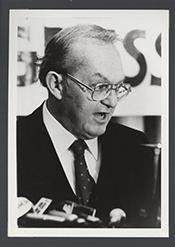
Historical · U.S. House · North Carolina · District 6
Howard Coble
Former U.S. Representative · North Carolina District 6 · 1985–2015 · Republican
Howard Coble represented North Carolina's District 6 in the United States House of Representatives (1985–2015) for the Republican party. The page below collects sourced biographical facts, term history, committee roles, and provenance for Coble.
Bioguide ID: C000556
Key facts
- Full name
- Howard Coble
- State
- North Carolina
- District
- District 6
- Party
- Republican
- House service
- 1985–2015
- First House term
- 1985
- Status
- Left office
- Current term ends
- —
- Born
- 1931
- Bioguide ID
- C000556
- Committee assignments
- —
- Dataset version
- 1.20260605
Biographical narrative
1,113 words · sourced from the Wikipedia REST extract
John Howard Coble was an American politician who served as a U.S. Representative for North Carolina's 6th congressional district from 1985 until 2015. A member of the Republican Party, Coble's political career spanned three decades, during which he became known for his support of agricultural interests, his stance on drug policy, and his involvement in various legislative initiatives. His tenure in Congress was marked by a commitment to his constituents and a focus on issues pertinent to North Carolina, particularly in the areas of agriculture and copyright law.
Early life and career
Howard Coble was born on March 18, 1931, in Greensboro, North Carolina, to Johnnie E. Holt and Joseph Howard Coble. Growing up in a region that would later become central to his political career, Coble's early life was shaped by the values and culture of the American South. After completing high school, he began his higher education at Appalachian State University. However, his academic pursuits were interrupted when he enlisted in the United States Coast Guard, where he served for over five years. Following his active duty, Coble continued his military commitment as a reservist for an additional 18 years, reflecting a dedication to public service that would characterize his later political career.
After his military service, Coble returned to academia, enrolling at Guilford College, where he earned a degree in history. His involvement in campus life included membership in the Epsilon Iota chapter of the Pi Kappa Phi fraternity at the University of North Carolina at Greensboro. He later attended the University of North Carolina at Chapel Hill, where he obtained a law degree. This educational background laid the foundation for his future career in law and politics.
Coble's professional journey began in the insurance industry, where he worked as an insurance agent. He subsequently transitioned into law, practicing as an attorney for nearly two decades. His legal career was complemented by a significant role in state government, where he served as Secretary of Revenue under North Carolina Governor James Holshouser. This position provided him with valuable experience in public administration and fiscal policy. In 1979, Coble entered the political arena by winning a seat in the North Carolina House of Representatives, where he served until his election to Congress in 1984.
House tenure
Coble's congressional career began when he was elected to the U.S. House of Representatives in 1984. His initial victory came after a competitive primary in which he narrowly defeated Walter Cockerham. In the general election, Coble faced one-term Democratic incumbent Robin Britt, winning by a slim margin. His election was likely aided by the popularity of President Ronald Reagan, who had a significant influence on the political landscape at the time.
Coble's subsequent re-elections demonstrated his growing popularity and solidified his position within the Republican Party. He faced Britt again in 1986, winning that rematch by an even narrower margin. Following these early contests, Coble consistently secured re-election, often with substantial majorities, reflecting his strong support among constituents in North Carolina's 6th district. By 2008, he had become the longest-serving Republican congressman from North Carolina, surpassing the previous record held by Jim Broyhill.
Throughout his tenure in Congress, Coble was involved in various legislative initiatives. He was known for his support of agricultural policies, particularly those that benefited North Carolina's tobacco farmers. Coble opposed additional regulations on tobacco, arguing that such measures would negatively impact local growers. His commitment to agriculture was a defining aspect of his legislative focus, as he sought to protect the interests of farmers in his district.
Coble's approach to drug policy was characterized by a hard-line stance against illegal drugs. He co-sponsored a resolution opposing the legalization of medical marijuana and supported measures that authorized drug testing for federal employees. His legislative record included a resolution celebrating the repeal of Prohibition, highlighting his nuanced views on alcohol regulation.
In 2013, Coble announced plans to introduce legislation aimed at reforming the congressional pension program. He argued that such reforms were overdue and proposed extending the service requirement for eligibility in the pension program. Notably, Coble pledged not to accept a pension from the government, stating that he believed his salary was sufficient for his needs. This decision underscored his commitment to fiscal responsibility and accountability to his constituents.
Coble's tenure was not without controversy. During the government shutdown in October 2013, he stated that he would continue to receive his salary despite the furlough of 800,000 federal workers, citing legal requirements. This decision drew attention and sparked discussions about the responsibilities of elected officials during times of fiscal crisis.
Legislative focus and committees
Throughout his time in the House, Coble served on several important committees that shaped his legislative priorities. He was a member of the Committee on the Judiciary, where he held the position of Chair of the Subcommittee on Courts, Commercial and Administrative Law. His work on this committee allowed him to influence legislation related to the judicial system and intellectual property rights. Coble was also involved in the Subcommittee on Intellectual Property, Competition, and the Internet, where he played a role in shaping policies that addressed copyright issues and the evolving landscape of digital media.
In addition to his work on the Judiciary Committee, Coble served on the Committee on Transportation and Infrastructure. His involvement in this committee included participation in the Subcommittee on Aviation, the Subcommittee on Coast Guard and Maritime Transportation, and the Subcommittee on Highways and Transit. These roles enabled him to advocate for infrastructure improvements and transportation policies that would benefit his constituents and the broader North Carolina community.
Coble's legislative initiatives included sponsorship of significant bills, such as the Digital Millennium Copyright Act (DMCA) in 1997, which laid the groundwork for internet law as it is understood today. He also introduced a bill to extend the Undetectable Firearms Act of 1988, which aimed to address concerns related to gun safety and regulation.
In addition to his committee assignments, Coble was a member of several caucuses, including the Congressional Fire Services Caucus, the Congressional Caucus on Turkey and Turkish Americans, and the International Conservation Caucus. His participation in these groups reflected his diverse interests and commitment to various issues, ranging from public safety to international relations.
Coble's legislative career concluded when he announced in 2013 that he would not seek re-election in 2014, marking the end of a long and impactful tenure in Congress. He officially left office on January 3, 2015, after serving a total of 15 terms in the House of Representatives. His legacy includes a focus on agricultural interests, a commitment to public service, and a significant influence on copyright law and drug policy during his time in office.
Notable legislation
Sponsored and co-sponsored legislation for Howard Coble is pending operator curation. The biographical narrative above carries the same provenance trail until per-bill rows are written.
Sources
- [1]https://en.wikipedia.org/wiki/Howard_CobleWikipedia · retrieved 2026-06-05
Notable quotes
Sourced quotes for Howard Coble are pending operator curation. Narrative-scope provenance remains attached below.
Sources
- [1]https://en.wikipedia.org/wiki/Howard_CobleWikipedia · retrieved 2026-06-05
Key positions
Curated policy positions for Howard Coble are pending operator review. The biographical narrative above carries the same provenance trail until per-topic positions are written.
Sources
- [1]https://en.wikipedia.org/wiki/Howard_CobleWikipedia · retrieved 2026-06-05
Terms served
- 1985–1987U.S. House · Term 1 · Republican
- 1987–1989U.S. House · Term 2 · Republican
- 1989–1991U.S. House · Term 3 · Republican
- 1991–1993U.S. House · Term 4 · Republican
- 1993–1995U.S. House · Term 5 · Republican
- 1995–1997U.S. House · Term 6 · Republican
- 1997–1999U.S. House · Term 7 · Republican
- 1999–2001U.S. House · Term 8 · Republican
- 2001–2003U.S. House · Term 9 · Republican
- 2003–2005U.S. House · Term 10 · Republican
- 2005–2007U.S. House · Term 11 · Republican
- 2007–2009U.S. House · Term 12 · Republican
- 2009–2011U.S. House · Term 13 · Republican
- 2011–2013U.S. House · Term 14 · Republican
- 2013–2015U.S. House · Term 15 · Republican
Sources & provenance
Every attributable claim above carries a per-section [N] marker that resolves to the corresponding URL below. Each entry records the upstream provider, the canonical URL, and the timestamp at which the source was retrieved by the ingest pipeline.
Key facts
- https://bioguide.congress.gov/search/bio/C000556bioguide · retrieved 2026-06-05
- http://coble.house.govhouse.gov · retrieved 2026-06-05
Biographical narrative
- https://en.wikipedia.org/wiki/Howard_Coblewikipedia · retrieved 2026-06-05
Find your representative
Every U.S. state elects representatives by district. Browse North Carolina’s delegation, the full former-representative roster, or explore the role and term length.
Related on The Candidate
- Preceded by Charles BrittEarlier holder of the North Carolina District 6 House seat · Democratic.Open
- Succeeded by Mark WalkerLater holder of the North Carolina District 6 House seat · Republican.Open
- Alfred GatlinFormer U.S. Representative · North Carolina District 1 · Crawford RepublicanOpen
- Clinton CobbFormer U.S. Representative · North Carolina District 1 · RepublicanOpen
- Eva ClaytonFormer U.S. Representative · North Carolina District 1 · DemocraticOpen
- Frank Ballance Jr.Former U.S. Representative · North Carolina District 1 · DemocraticOpen