
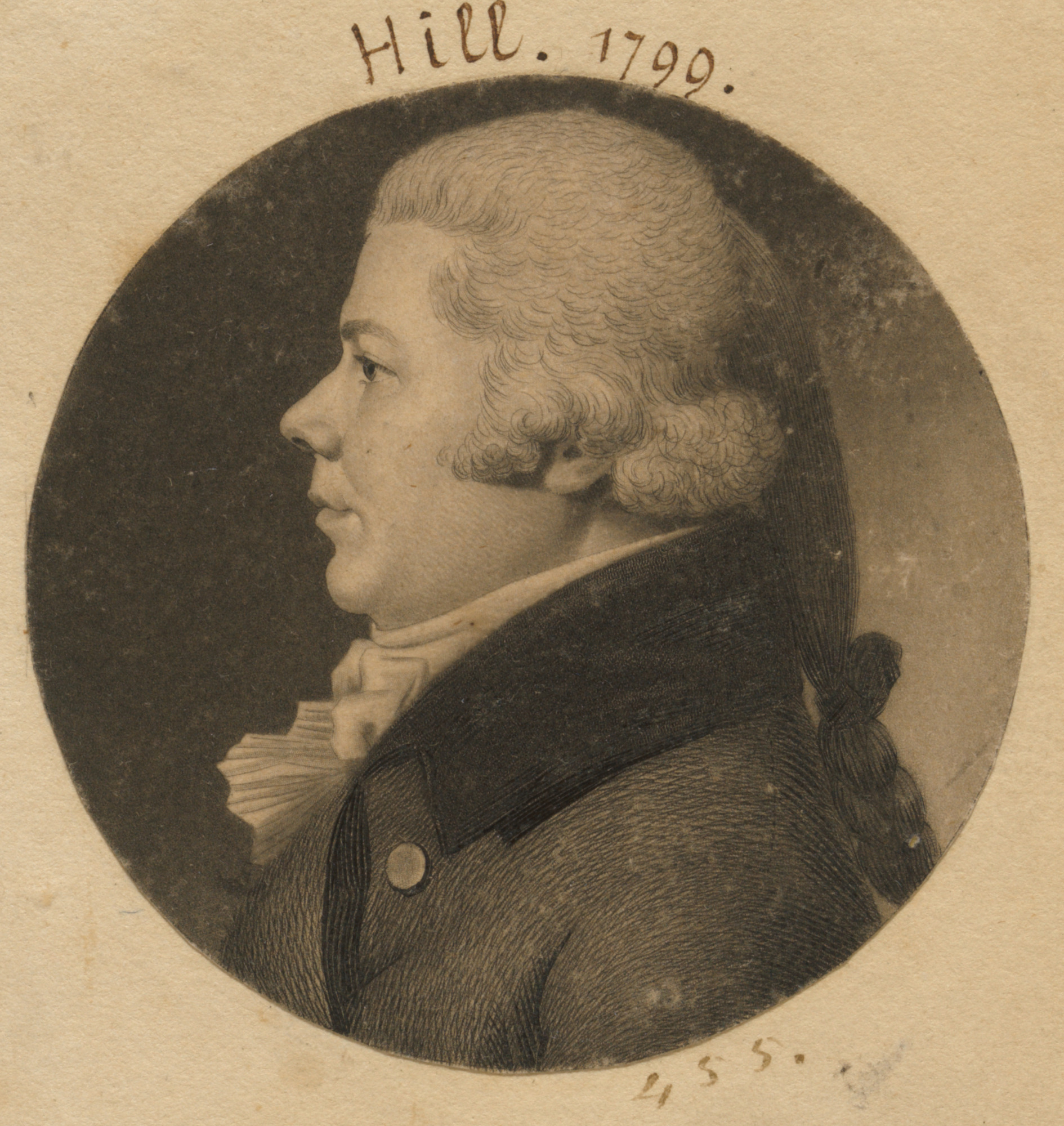
Historical · U.S. House · North Carolina · District 6
William Hill
Former U.S. Representative · North Carolina District 6 · 1799–1803 · Federalist
William Hill represented North Carolina's District 6 in the United States House of Representatives (1799–1803) for the Federalist party. The page below collects sourced biographical facts, term history, committee roles, and provenance for Hill.
Bioguide ID: H000611
Key facts
- Full name
- William Hill
- State
- North Carolina
- District
- District 6
- Party
- Federalist
- House service
- 1799–1803
- First House term
- 1799
- Status
- Left office
- Current term ends
- —
- Born
- 1767
- Bioguide ID
- H000611
- Committee assignments
- —
- Dataset version
- 1.20260606
Biographical narrative
1,010 words · sourced from the Wikipedia REST extract
William Hill was a prominent figure in early American politics, serving as a U.S. Representative from North Carolina during the late 18th and early 19th centuries. A member of the Federalist Party, Hill's political career spanned two terms in the House of Representatives, where he contributed to the legislative processes of the newly formed United States government. His life journey began in Brunswick Town, North Carolina, where he was born in 1767, and he later pursued a career that combined law, agriculture, and public service. Hill's legacy is marked by his involvement in the establishment of the federal government and his role in shaping the political landscape of North Carolina during a formative period in American history.
Early life and career
William Hill was born on May 1, 1767, in Brunswick Town, located in Brunswick County, North Carolina. His early education took place in Boston, Massachusetts, where he attended public schools. This educational foundation would serve him well as he embarked on a career that would eventually lead him into the realms of law and politics. After completing his studies, Hill engaged in agricultural pursuits, which were common in the region at the time and reflected the agrarian nature of the economy in North Carolina.
In addition to his agricultural activities, Hill pursued a legal education in Boston. He studied law diligently and was eventually admitted to the bar, allowing him to practice law professionally. This legal background provided him with the skills necessary for a career in public service and politics. His legal expertise would later be instrumental in his roles within the government.
Hill's political career began to take shape when he was appointed as the United States district attorney for North Carolina in 1790 by President George Washington. This appointment marked a significant step in Hill's public service career, as he was entrusted with the responsibility of representing the federal government in legal matters within the state. His role as district attorney allowed him to gain valuable experience in the workings of the federal legal system and further solidified his reputation in the political arena.
In 1794, Hill expanded his political involvement by becoming a member of the North Carolina State Senate. This position provided him with a platform to influence state legislation and engage with the political issues of the day. His work in the state senate helped to establish his credentials as a public servant and laid the groundwork for his future endeavors in the U.S. Congress.
House tenure
William Hill's tenure in the U.S. House of Representatives began on March 4, 1799, when he was elected to serve as a representative for North Carolina's 6th congressional district. He was affiliated with the Federalist Party, which was one of the first political parties in the United States and advocated for a strong national government. Hill's election to the Sixth Congress marked the beginning of his two terms in the House, during which he participated in the legislative processes that were critical to the development of the young nation.
During his time in Congress, Hill served in the Seventh Congress, which lasted from 1799 to 1803. His contributions during these terms were part of a broader effort by Federalists to shape national policy and governance. The Federalist Party, which was founded by figures such as Alexander Hamilton and John Adams, aimed to promote a strong central government and support for economic development, including the establishment of a national bank and a robust federal judiciary.
Hill's legislative work occurred during a period of significant change and development in the United States. The nation was still in its infancy, and the political landscape was evolving rapidly. As a member of Congress, Hill was involved in discussions and decisions that would have lasting implications for the country. His participation in the legislative process reflected the challenges and opportunities faced by the early American government as it sought to define its role and responsibilities.
After serving two terms, Hill's congressional career came to an end on March 3, 1803. His departure from the House marked a transition in his professional life, as he would later pursue other avenues of public service and personal endeavors.
Legislative focus and committees
While specific details regarding the legislation Hill supported or the committees on which he served are not extensively documented, his affiliation with the Federalist Party suggests that his legislative focus likely aligned with the party's priorities. Federalists were generally concerned with issues such as national security, economic development, and the establishment of a strong federal government. Hill's background in law and his experience as a district attorney would have informed his perspectives on legal and judicial matters, potentially influencing his contributions to discussions surrounding the judiciary and federal law.
In addition to his legislative responsibilities, Hill's career was marked by his involvement in various aspects of public service. After his time in Congress, he was appointed by President John Adams to serve as a judge of the United States District Court for the District of North Carolina. However, this appointment was later withdrawn by President Thomas Jefferson, reflecting the political shifts that occurred during that period. This experience underscored the complexities of political appointments and the impact of changing administrations on public service roles.
Following his congressional tenure, Hill returned to his estate near Wilmington, North Carolina, where he continued to engage in agricultural pursuits. His return to private life allowed him to focus on his personal interests and manage his estate, known as "Hilton." Hill's life in agriculture was emblematic of the lifestyle of many individuals in North Carolina during this era, as the state was primarily agrarian.
William Hill passed away on December 9, 1808, leaving behind a legacy as a public servant who contributed to the early governance of the United States. He was interred in the family burial ground on his estate, where he had spent his later years. His life and career reflect the complexities of early American politics and the role of individuals in shaping the nation's legislative framework during its formative years.
Notable legislation
Sponsored and co-sponsored legislation for William Hill is pending operator curation. The biographical narrative above carries the same provenance trail until per-bill rows are written.
Sources
- [1]https://en.wikipedia.org/wiki/William_Henry_Hill_(North_Carolina_politician)Wikipedia · retrieved 2026-06-06
Notable quotes
Sourced quotes for William Hill are pending operator curation. Narrative-scope provenance remains attached below.
Sources
- [1]https://en.wikipedia.org/wiki/William_Henry_Hill_(North_Carolina_politician)Wikipedia · retrieved 2026-06-06
Key positions
Curated policy positions for William Hill are pending operator review. The biographical narrative above carries the same provenance trail until per-topic positions are written.
Sources
- [1]https://en.wikipedia.org/wiki/William_Henry_Hill_(North_Carolina_politician)Wikipedia · retrieved 2026-06-06
Terms served
- 1799–1801U.S. House · Term 1 · Federalist
- 1801–1803U.S. House · Term 2 · Federalist
Sources & provenance
Every attributable claim above carries a per-section [N] marker that resolves to the corresponding URL below. Each entry records the upstream provider, the canonical URL, and the timestamp at which the source was retrieved by the ingest pipeline.
Key facts
- https://bioguide.congress.gov/search/bio/H000611bioguide · retrieved 2026-06-06
- https://www.govtrack.us/congress/members/405470govtrack · retrieved 2026-06-06
Biographical narrative
- https://en.wikipedia.org/wiki/William_Henry_Hill_(North_Carolina_politician)wikipedia · retrieved 2026-06-06
Find your representative
Every U.S. state elects representatives by district. Browse North Carolina’s delegation, the full former-representative roster, or explore the role and term length.
Related on The Candidate
- Succeeded by Weldon EdwardsLater holder of the North Carolina District 6 House seat · Jackson.Open
- Alfred GatlinFormer U.S. Representative · North Carolina District 1 · Crawford RepublicanOpen
- Clinton CobbFormer U.S. Representative · North Carolina District 1 · RepublicanOpen
- Eva ClaytonFormer U.S. Representative · North Carolina District 1 · DemocraticOpen
- Frank Ballance Jr.Former U.S. Representative · North Carolina District 1 · DemocraticOpen
- Representatives from North CarolinaEvery former U.S. Representative who has represented North Carolina.Open