
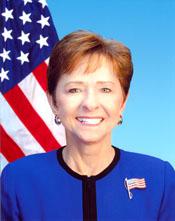
Historical · U.S. House · North Carolina · District 9
Sue Myrick
Former U.S. Representative · North Carolina District 9 · 1995–2013 · Republican
Sue Myrick represented North Carolina's District 9 in the United States House of Representatives (1995–2013) for the Republican party. The page below collects sourced biographical facts, term history, committee roles, and provenance for Myrick.
Bioguide ID: M001134
Key facts
- Full name
- Sue Myrick
- State
- North Carolina
- District
- District 9
- Party
- Republican
- House service
- 1995–2013
- First House term
- 1995
- Status
- Left office
- Current term ends
- —
- Born
- 1941
- Bioguide ID
- M001134
- Committee assignments
- —
- Dataset version
- 1.20260605
Biographical narrative
848 words · sourced from the Wikipedia REST extract
Sue Wilkins Myrick is a former U.S. Representative who served North Carolina's 9th congressional district from 1995 until 2013. A member of the Republican Party, she was notable for being the first Republican woman to represent North Carolina in Congress. Throughout her political career, Myrick was recognized for her conservative stance on various issues and her advocacy for breast cancer awareness and treatment. After announcing her retirement in early 2012, she concluded her congressional tenure in January 2013, leaving a legacy of service that included significant roles in various committees and caucuses.
Early life and career
Sue Wilkins Myrick was born on August 1, 1941, in Tiffin, Ohio. She completed her secondary education at Port Clinton High School in Port Clinton, Ohio. Following high school, Myrick attended Heidelberg University in Tiffin, Ohio, for a brief period from 1959 to 1960. Before entering the political arena, she worked as a Sunday school teacher and later transitioned into the fields of public relations and advertising. Myrick became the President and CEO of Myrick Advertising and Public Relations, as well as Myrick Enterprises, establishing herself as a businesswoman in her community.
Myrick's initial foray into politics began at the local level. In 1981, she ran for a seat on the Charlotte City Council but was unsuccessful. However, her political aspirations did not wane, and in 1983, she was elected to an At-Large District seat on the City Council, serving until 1985. Her political career took a significant turn in 1987 when she was elected as the first female Mayor of Charlotte, North Carolina. During her tenure as mayor, she was recognized for her leadership and commitment to the city. In 1989, while campaigning for re-election, Myrick publicly acknowledged a past relationship with her husband that had occurred while he was still married to his former wife. Despite this revelation, she won the election and continued her service as mayor.
In 1992, Myrick sought the Republican nomination for a U.S. Senate seat held by incumbent Democratic Senator Terry Sanford. However, she was defeated in the primary by Lauch Faircloth, who went on to win the general election.
House tenure
Myrick's congressional career began in 1995 when she was elected to the U.S. House of Representatives, succeeding five-term incumbent Alex McMillan. Over the course of her nine terms in office, she became a prominent figure in North Carolina politics. Myrick was re-elected multiple times, including a significant victory in the 2004 elections, where she received a substantial majority of the popular vote against her Democratic opponent. Her electoral success continued in 2006, when she again defeated her Democratic challenger with a considerable margin. In 2008, she faced challenges from two Charlotte-area Democrats but secured her seat with a strong showing at the polls.
On February 7, 2012, Myrick announced her decision to retire from Congress, concluding her tenure on January 3, 2013. During her time in office, she was known for her conservative positions and was regarded as one of the more conservative members of the House.
Legislative focus and committees
Throughout her congressional career, Myrick was actively involved in various legislative initiatives and committee assignments. She served as the Vice Chair of the Committee on Energy and Commerce, where she contributed to discussions and decisions on energy policy and public health. Additionally, she was involved in the Subcommittee on Health and the Subcommittee on Oversight and Investigations, where she served as Vice Chair of the full committee, focusing on issues related to health care and government oversight.
Myrick was also the Chair of the Subcommittee on Terrorism, Human Intelligence, Analysis, and Counterintelligence within the Permanent Select Committee on Intelligence. In this role, she was engaged in matters concerning national security and intelligence operations, reflecting her commitment to addressing terrorism and related threats.
In addition to her committee work, Myrick was a member of several caucuses, including the Congressional Anti-Terrorism Caucus, which she co-founded, and the House Cancer Caucus, where she served as Co-Chair. Her advocacy for cancer awareness was particularly personal, as she was a cancer survivor herself. Myrick introduced legislation aimed at providing treatment options for women diagnosed with breast cancer under Medicaid, which successfully passed and was signed into law, addressing a significant gap in health care for this demographic.
Myrick also held leadership positions within the Republican Party, including serving as the first woman chairman of the Republican Study Committee from 2003 to 2005. Her involvement in this group of House conservatives underscored her alignment with the party's more traditional values and priorities.
In her personal life, Myrick is a mother of two children and has three stepchildren. She and her husband, Ed Myrick, have a large extended family, including 12 grandchildren, 11 great-grandchildren, and two great-great-grandchildren. Her son, Dan Forest, was elected as the Lieutenant Governor of North Carolina in 2012, furthering the family's involvement in state politics.
Myrick's career reflects a blend of business acumen and public service, marked by her pioneering role as a Republican woman in North Carolina's political landscape and her commitment to various legislative causes during her time in Congress.
Notable legislation
Sponsored and co-sponsored legislation for Sue Myrick is pending operator curation. The biographical narrative above carries the same provenance trail until per-bill rows are written.
Sources
- [1]https://en.wikipedia.org/wiki/Sue_MyrickWikipedia · retrieved 2026-06-05
Notable quotes
Sourced quotes for Sue Myrick are pending operator curation. Narrative-scope provenance remains attached below.
Sources
- [1]https://en.wikipedia.org/wiki/Sue_MyrickWikipedia · retrieved 2026-06-05
Key positions
Curated policy positions for Sue Myrick are pending operator review. The biographical narrative above carries the same provenance trail until per-topic positions are written.
Sources
- [1]https://en.wikipedia.org/wiki/Sue_MyrickWikipedia · retrieved 2026-06-05
Terms served
- 1995–1997U.S. House · Term 1 · Republican
- 1997–1999U.S. House · Term 2 · Republican
- 1999–2001U.S. House · Term 3 · Republican
- 2001–2003U.S. House · Term 4 · Republican
- 2003–2005U.S. House · Term 5 · Republican
- 2005–2007U.S. House · Term 6 · Republican
- 2007–2009U.S. House · Term 7 · Republican
- 2009–2011U.S. House · Term 8 · Republican
- 2011–2013U.S. House · Term 9 · Republican
Sources & provenance
Every attributable claim above carries a per-section [N] marker that resolves to the corresponding URL below. Each entry records the upstream provider, the canonical URL, and the timestamp at which the source was retrieved by the ingest pipeline.
Key facts
- https://bioguide.congress.gov/search/bio/M001134bioguide · retrieved 2026-06-05
- http://www.house.gov/myrickhouse.gov · retrieved 2026-06-05
Biographical narrative
- https://en.wikipedia.org/wiki/Sue_Myrickwikipedia · retrieved 2026-06-05
Find your representative
Every U.S. state elects representatives by district. Browse North Carolina’s delegation, the full former-representative roster, or explore the role and term length.
Related on The Candidate
- Preceded by Alex McMillanEarlier holder of the North Carolina District 9 House seat · Republican.Open
- Succeeded by Robert PittengerLater holder of the North Carolina District 9 House seat · Republican.Open
- Alfred GatlinFormer U.S. Representative · North Carolina District 1 · Crawford RepublicanOpen
- Clinton CobbFormer U.S. Representative · North Carolina District 1 · RepublicanOpen
- Eva ClaytonFormer U.S. Representative · North Carolina District 1 · DemocraticOpen
- Frank Ballance Jr.Former U.S. Representative · North Carolina District 1 · DemocraticOpen