
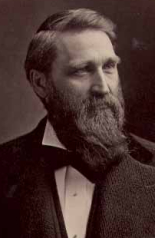
Historical · U.S. House · Nebraska · District 1
Lorenzo Crounse
Former U.S. Representative · Nebraska District 1 · 1873–1877 · Republican
Lorenzo Crounse represented Nebraska's District 1 in the United States House of Representatives (1873–1877) for the Republican party. The page below collects sourced biographical facts, term history, committee roles, and provenance for Crounse.
Bioguide ID: C000935
Key facts
- Full name
- Lorenzo Crounse
- State
- Nebraska
- District
- District 1
- Party
- Republican
- House service
- 1873–1877
- First House term
- 1873
- Status
- Left office
- Current term ends
- —
- Born
- 1834
- Bioguide ID
- C000935
- Committee assignments
- —
- Dataset version
- 1.20260606
Biographical narrative
857 words · sourced from the Wikipedia REST extract
Lorenzo Crounse was a prominent American politician and lawyer who served as a U.S. Representative from Nebraska and later became the eighth governor of the state. A member of the Republican Party, Crounse's political career spanned several decades, during which he held various significant positions, including serving in the U.S. House of Representatives and as a state supreme court justice. His contributions to Nebraska's early governance and his involvement in the Civil War reflect a life dedicated to public service and law.
Early life and career
Lorenzo Crounse was born on January 27, 1834, in Sharon, a town located in Schoharie County, New York. He pursued his education at the New York Conference Seminary in Charlotteville, New York, where he laid the groundwork for his future career. After completing his studies, Crounse began teaching school, which allowed him to support himself while simultaneously studying law. His dedication to the legal profession paid off when he was admitted to the bar in 1857.
In 1860, Crounse married Mary E. Griffiths, and together they had four children. He established a law practice in Fort Plain, New York, where he began to build his reputation as a capable attorney. His career took a significant turn during the Civil War when he organized Battery K of the New York Light Artillery, enlisting as a captain in 1861. Crounse served for a year but was wounded during a battle on the Rappahannock River in Virginia, which led to his discharge. Following his military service, he returned to his law practice.
In 1864, Crounse relocated to the Nebraska Territory, where he quickly became involved in local governance. He participated in the territorial legislature and later served as a delegate to Nebraska's constitutional convention, contributing to the establishment of the state's legal framework. His legal expertise and commitment to public service led to his appointment as a Justice of the Nebraska State Supreme Court, a position he held from 1867 until 1873. This role further solidified his standing in Nebraska's political landscape.
House tenure
Crounse's congressional career began when he was elected as a Republican to the Forty-third and Forty-fourth Congresses, serving from 1873 until 1877. His tenure in the U.S. House of Representatives marked a significant chapter in his political life, as he represented Nebraska's first congressional district during a formative period for the state. Crounse's decision to run for Congress came after his term on the state supreme court, indicating a continued commitment to public service and governance.
During his time in the House, Crounse participated in various legislative activities, contributing to discussions and decisions that shaped the direction of national policy. However, after completing two terms in Congress, he chose not to seek re-election in 1876, marking the end of his direct involvement in federal legislative affairs. His departure from Congress did not signify a retreat from public service, as he continued to engage in various roles within the government.
Legislative focus and committees
While specific details regarding Crounse's legislative focus and committee assignments during his time in the House of Representatives are not documented, it can be inferred that his background as a lawyer and a state supreme court justice would have influenced his approach to legislation. Given the era in which he served, Crounse likely engaged with issues pertinent to the post-Civil War United States, including matters related to reconstruction, statehood, and the integration of new territories into the Union.
After his congressional tenure, Crounse continued to serve the public in various capacities. In 1879, he was appointed as an internal revenue collector for the district of Nebraska, a position that underscored his ongoing involvement in federal governance. His career progressed further when he was appointed as the Assistant Secretary of the United States Treasury in 1891. This role allowed him to influence financial policy at a national level, although he resigned in 1892 to pursue the governorship of Nebraska.
Crounse's governorship, which began after his appointment in 1892, lasted until 1895. During his time as governor, he oversaw various state initiatives and worked to address the challenges facing Nebraska during a period of growth and development. His administration was marked by efforts to improve the state's infrastructure and governance. Notably, William E. Andrews, who would later become a Nebraska representative, served as Crounse's private secretary during this time.
After leaving the governorship, Crounse briefly returned to the Nebraska state senate in 1901, further demonstrating his commitment to public service and governance. His political career spanned several significant roles, reflecting a dedication to the legal and political frameworks of Nebraska and the United States.
Crounse's life came to an end on May 13, 1909, in Omaha, Nebraska. He spent his later years as a widower after the death of his wife, Mary E. Griffiths Crounse, in 1882. He lived with one of his children until his passing. His legacy is remembered in part through the now-extinct village of Crounse, Nebraska, located near Lincoln, which was named in his honor. Crounse's contributions to Nebraska's early governance and his service in various legal and political capacities underscore his role in shaping the state's history during a pivotal time.
Notable legislation
Sponsored and co-sponsored legislation for Lorenzo Crounse is pending operator curation. The biographical narrative above carries the same provenance trail until per-bill rows are written.
Sources
- [1]https://en.wikipedia.org/wiki/Lorenzo_CrounseWikipedia · retrieved 2026-06-06
Notable quotes
Sourced quotes for Lorenzo Crounse are pending operator curation. Narrative-scope provenance remains attached below.
Sources
- [1]https://en.wikipedia.org/wiki/Lorenzo_CrounseWikipedia · retrieved 2026-06-06
Key positions
Curated policy positions for Lorenzo Crounse are pending operator review. The biographical narrative above carries the same provenance trail until per-topic positions are written.
Sources
- [1]https://en.wikipedia.org/wiki/Lorenzo_CrounseWikipedia · retrieved 2026-06-06
Terms served
- 1873–1875U.S. House · Term 1 · Republican
- 1875–1877U.S. House · Term 2 · Republican
Sources & provenance
Every attributable claim above carries a per-section [N] marker that resolves to the corresponding URL below. Each entry records the upstream provider, the canonical URL, and the timestamp at which the source was retrieved by the ingest pipeline.
Key facts
- https://bioguide.congress.gov/search/bio/C000935bioguide · retrieved 2026-06-06
- https://www.govtrack.us/congress/members/403047govtrack · retrieved 2026-06-06
Biographical narrative
- https://en.wikipedia.org/wiki/Lorenzo_Crounsewikipedia · retrieved 2026-06-06
Find your representative
Every U.S. state elects representatives by district. Browse Nebraska’s delegation, the full former-representative roster, or explore the role and term length.
Related on The Candidate
- Preceded by John TaffeEarlier holder of the Nebraska District 1 House seat · Republican.Open
- Succeeded by Frank WelchLater holder of the Nebraska District 1 House seat · Republican.Open
- Archibald WeaverFormer U.S. Representative · Nebraska District 1 · RepublicanOpen
- Charles ReavisFormer U.S. Representative · Nebraska District 1 · RepublicanOpen
- Charles ThoneFormer U.S. Representative · Nebraska District 1 · RepublicanOpen
- Clair CallanFormer U.S. Representative · Nebraska District 1 · DemocraticOpen