
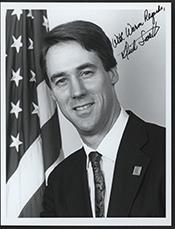
Historical · U.S. House · New Hampshire · District 2
Richard Swett
Former U.S. Representative · New Hampshire District 2 · 1991–1995 · Democratic
Richard Swett represented New Hampshire's District 2 in the United States House of Representatives (1991–1995) for the Democratic party. The page below collects sourced biographical facts, term history, committee roles, and provenance for Swett.
Bioguide ID: S001113
Key facts
- Full name
- Richard Swett
- State
- New Hampshire
- District
- District 2
- Party
- Democratic
- House service
- 1991–1995
- First House term
- 1991
- Status
- Left office
- Current term ends
- —
- Born
- 1957
- Bioguide ID
- S001113
- Committee assignments
- —
- Dataset version
- 1.20260605
Biographical narrative
840 words · sourced from the Wikipedia REST extract
Richard Nelson Swett is a former American politician and diplomat who served as the U.S. Representative for New Hampshire's 2nd congressional district from 1991 to 1995. A member of the Democratic Party, Swett's political career also included his appointment as the U.S. ambassador to Denmark from 1998 to 2001. His background in architecture and his involvement in various political and civic endeavors have shaped his professional trajectory.
Early life and career
Richard Nelson Swett was born on May 1, 1957, in Bryn Mawr, Pennsylvania. He spent his childhood in New Hampshire after his family relocated there. Swett pursued higher education at Yale University, where he developed a foundation in both the liberal arts and professional disciplines. Following his graduation, he embarked on a career in architecture, initially working in San Francisco. His architectural background would later influence his approach to public service and policy.
Swett's early career was marked by his engagement with the Democratic Party, where he began to establish himself as a political figure. His architectural expertise provided him with a unique perspective on urban development and community planning, which would later inform his legislative priorities. As he became more involved in politics, he transitioned from his professional career in architecture to public service, culminating in his election to the U.S. House of Representatives.
House tenure
Swett's political career in the U.S. House of Representatives began when he was elected in November 1990. His tenure lasted until January 3, 1995, during which he served two terms. In the lead-up to his election, Swett faced challenges related to his name recognition and ballot listing, which became a point of contention during his campaign. Despite these challenges, he successfully secured a seat in Congress.
During his time in the House, Swett was known for his active participation in legislative matters. One notable aspect of his tenure was his vote in favor of a bill aimed at banning assault weapons, which passed narrowly. This decision drew significant attention and resulted in threats against his life, highlighting the contentious nature of gun control debates during that period.
In 1994, Swett sought re-election but was ultimately defeated. His loss was attributed to various factors, including the political climate of the time and the challenges faced by Democratic candidates in the mid-1990s. Following his departure from Congress, Swett continued to engage in public service and political activities.
Legislative focus and committees
During his time in the House of Representatives, Swett was involved in various legislative initiatives and served on committees that aligned with his interests and expertise. His background in architecture influenced his focus on issues related to urban development, infrastructure, and community planning. Swett's approach to legislation often reflected a commitment to addressing the needs of his constituents in New Hampshire.
In addition to his legislative duties, Swett's political career extended beyond his time in Congress. After leaving the House, he ran for the U.S. Senate in 1996 as a Democratic candidate, challenging incumbent Republican Bob Smith. Although he was narrowly defeated in that race, Swett's continued involvement in politics demonstrated his dedication to public service.
In 1998, Swett was appointed by President Bill Clinton to serve as the U.S. ambassador to Denmark, a position he held until 2001. This role allowed him to further engage in international diplomacy and represent U.S. interests abroad. Following his ambassadorship, Swett returned to New Hampshire and resumed his career in architecture, eventually becoming the Managing Principal for the Washington office of Leo A. Daly. He later co-founded Climate Prosperity Enterprise Solutions, focusing on sustainable practices and energy policy.
Throughout his career, Swett has remained active in various civic and political organizations. He is a member of the ReFormers Caucus of Issue One, which advocates for political reform and campaign finance reform. His involvement in these initiatives reflects his ongoing commitment to improving the political landscape and fostering civic engagement.
In addition to his political and professional endeavors, Swett has authored a publication titled "Leadership by Design: Creating an Architecture of Trust," which explores themes of leadership and trust in organizational contexts. This work illustrates his belief in the importance of integrity and collaboration in both public service and private enterprise.
Swett's personal life is marked by his membership in the Church of Jesus Christ of Latter-day Saints (LDS Church). He married Katrina Lantos, who is the daughter of Congressman Tom Lantos and a former congressional candidate herself. Together, they have seven children, reflecting their commitment to family and community.
In recent years, Swett has remained engaged in political discourse, endorsing candidates and participating in discussions about national issues. His endorsement of Joe Biden for President in 2019 highlights his continued involvement in the Democratic Party and his interest in shaping the future of American politics.
Overall, Richard Nelson Swett's career has been characterized by a blend of architecture, public service, and diplomacy. His experiences in the U.S. House of Representatives and as an ambassador have contributed to his understanding of both domestic and international issues, shaping his approach to leadership and civic engagement.
Notable legislation
Sponsored and co-sponsored legislation for Richard Swett is pending operator curation. The biographical narrative above carries the same provenance trail until per-bill rows are written.
Sources
- [1]https://en.wikipedia.org/wiki/Richard_N._SwettWikipedia · retrieved 2026-06-05
Notable quotes
Sourced quotes for Richard Swett are pending operator curation. Narrative-scope provenance remains attached below.
Sources
- [1]https://en.wikipedia.org/wiki/Richard_N._SwettWikipedia · retrieved 2026-06-05
Key positions
Curated policy positions for Richard Swett are pending operator review. The biographical narrative above carries the same provenance trail until per-topic positions are written.
Sources
- [1]https://en.wikipedia.org/wiki/Richard_N._SwettWikipedia · retrieved 2026-06-05
Terms served
- 1991–1993U.S. House · Term 1 · Democratic
- 1993–1995U.S. House · Term 2 · Democratic
Sources & provenance
Every attributable claim above carries a per-section [N] marker that resolves to the corresponding URL below. Each entry records the upstream provider, the canonical URL, and the timestamp at which the source was retrieved by the ingest pipeline.
Key facts
- https://bioguide.congress.gov/search/bio/S001113bioguide · retrieved 2026-06-05
- https://www.govtrack.us/congress/members/410565govtrack · retrieved 2026-06-05
Biographical narrative
- https://en.wikipedia.org/wiki/Richard_N._Swettwikipedia · retrieved 2026-06-05
Find your representative
Every U.S. state elects representatives by district. Browse New Hampshire’s delegation, the full former-representative roster, or explore the role and term length.
Related on The Candidate
- Preceded by Charles Douglas IIIEarlier holder of the New Hampshire District 2 House seat · Republican.Open
- Succeeded by Charlie BassLater holder of the New Hampshire District 2 House seat · Republican.Open
- Alonzo NuteFormer U.S. Representative · New Hampshire District 1 · RepublicanOpen
- Alphonse RoyFormer U.S. Representative · New Hampshire District 1 · DemocraticOpen
- Amos TuckFormer U.S. Representative · New Hampshire District 1 · WhigOpen
- Arthur JenksFormer U.S. Representative · New Hampshire District 1 · RepublicanOpen