
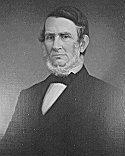
Historical · U.S. House · New Hampshire · At-Large
Ira Eastman
Former U.S. Representative · New Hampshire At-Large · 1839–1843 · Democratic
Ira Eastman represented New Hampshire's At-Large in the United States House of Representatives (1839–1843) for the Democratic party. The page below collects sourced biographical facts, term history, committee roles, and provenance for Eastman.
Bioguide ID: E000020
Key facts
- Full name
- Ira Eastman
- State
- New Hampshire
- District
- At-Large
- Party
- Democratic
- House service
- 1839–1843
- First House term
- 1839
- Status
- Left office
- Current term ends
- —
- Born
- 1809
- Bioguide ID
- E000020
- Committee assignments
- —
- Dataset version
- 1.20260606
Biographical narrative
915 words · sourced from the Wikipedia REST extract
Ira Eastman was an American politician and lawyer who served as a member of the United States House of Representatives, representing New Hampshire's at-large congressional district during the late 1830s and early 1840s. A member of the Democratic Party, Eastman's political career spanned various roles, including service in the New Hampshire House of Representatives and the judiciary. His contributions to state and national politics were marked by his legal expertise and leadership in legislative matters.
Early life and career
Ira Eastman was born on January 1, 1809, in Gilmanton, New Hampshire, to Stephen and Hannah Eastman. Growing up in a family that valued education, he attended local schools and furthered his studies at Gilmanton Academy. His academic pursuits culminated in his graduation from Dartmouth College in Hanover, New Hampshire, in 1829. Following his graduation, Eastman turned his attention to the legal profession. He studied law and was admitted to the bar in 1832, beginning his legal practice in Troy, New Hampshire.
In 1834, Eastman returned to his hometown of Gilmanton, where he continued to practice law. His involvement in local governance began shortly thereafter, as he was appointed clerk of the New Hampshire House of Representatives in 1835. This role provided him with valuable insights into the legislative process and helped him build connections within the political landscape of New Hampshire. Eastman's political career progressed when he was elected as a member of the New Hampshire House of Representatives, serving from 1836 to 1838. His leadership abilities were recognized when he was elected as speaker of the State House in both 1837 and 1838.
In addition to his legislative duties, Eastman served as the Register of Probate for Strafford County from 1836 until 1839. This position involved overseeing the probate court and managing the affairs of deceased estates, further solidifying his reputation as a capable and dedicated public servant. His experience in both the legal and political arenas laid a strong foundation for his subsequent election to the United States Congress.
House tenure
Ira Eastman was elected as a Democrat to the Twenty-sixth and Twenty-seventh Congresses, beginning his first term on March 4, 1839, and concluding his service on March 3, 1843. During his time in the House of Representatives, Eastman participated in various legislative activities and contributed to discussions on a range of issues pertinent to his constituents and the nation. His role as a congressman was marked by his commitment to the Democratic Party's principles and his dedication to representing the interests of New Hampshire residents.
In the Twenty-seventh Congress, Eastman served as the chairman of the United States House Committee on Revisal and Unfinished Business. This committee was responsible for reviewing legislation that had not been completed in previous sessions, highlighting Eastman's involvement in ensuring that important legislative matters were addressed and considered by Congress. His leadership in this capacity demonstrated his ability to navigate complex legislative processes and work collaboratively with fellow lawmakers.
Despite his contributions and active participation in Congress, Eastman chose not to seek renomination in 1842. His decision to step back from the political arena at that time marked the end of his congressional tenure, but it did not signify the conclusion of his public service career.
Legislative focus and committees
Throughout his time in the House of Representatives, Ira Eastman focused on various legislative issues that were significant to his constituents and the broader national context. While specific details regarding the legislation he supported or opposed are not provided, it is evident that his background in law and his experience in state governance informed his approach to legislative matters. As a member of the Democratic Party, Eastman likely aligned with the party's platform, which during this period emphasized issues such as states' rights, expansionism, and economic development.
Eastman's role as chairman of the Committee on Revisal and Unfinished Business was particularly noteworthy. This committee played a crucial role in managing the legislative calendar and ensuring that important bills and resolutions were revisited and addressed. As chairman, Eastman would have been responsible for guiding discussions and facilitating the legislative process, which required a deep understanding of both the law and the political landscape.
After his congressional service, Eastman continued to contribute to public life through his work in the judiciary. He served as a judge of the New Hampshire Court of Common Pleas from 1844 to 1849 and later as an associate justice of the New Hampshire Supreme Court from 1849 to 1855. He was appointed as a justice of the New Hampshire Supreme Court from 1855 to 1859, further demonstrating his legal expertise and commitment to public service.
In addition to his judicial roles, Eastman remained active in the legal profession after resigning from the bench. He practiced law in Concord and Manchester, New Hampshire, and continued to engage with the political landscape. His candidacy for governor of New Hampshire in 1863 and for United States Senator in 1866, although unsuccessful, reflected his ongoing interest in political affairs and his desire to serve the public.
Ira Eastman passed away on March 21, 1881, in Manchester, New Hampshire. His contributions to the state and nation were recognized through his various roles in public service, and he is interred in Valley Cemetery. Eastman's legacy is marked by his commitment to law, governance, and the Democratic principles that guided his political career. His family life included marriage to Jane Quackenbush, with whom he had two children, further connecting him to the community he served throughout his life.
Notable legislation
Sponsored and co-sponsored legislation for Ira Eastman is pending operator curation. The biographical narrative above carries the same provenance trail until per-bill rows are written.
Sources
- [1]https://en.wikipedia.org/wiki/Ira_Allen_EastmanWikipedia · retrieved 2026-06-06
Notable quotes
Sourced quotes for Ira Eastman are pending operator curation. Narrative-scope provenance remains attached below.
Sources
- [1]https://en.wikipedia.org/wiki/Ira_Allen_EastmanWikipedia · retrieved 2026-06-06
Key positions
Curated policy positions for Ira Eastman are pending operator review. The biographical narrative above carries the same provenance trail until per-topic positions are written.
Sources
- [1]https://en.wikipedia.org/wiki/Ira_Allen_EastmanWikipedia · retrieved 2026-06-06
Terms served
- 1839–1841U.S. House · Term 1 · Democratic
- 1841–1843U.S. House · Term 2 · Democratic
Sources & provenance
Every attributable claim above carries a per-section [N] marker that resolves to the corresponding URL below. Each entry records the upstream provider, the canonical URL, and the timestamp at which the source was retrieved by the ingest pipeline.
Key facts
- https://bioguide.congress.gov/search/bio/E000020bioguide · retrieved 2026-06-06
- https://www.govtrack.us/congress/members/403716govtrack · retrieved 2026-06-06
Biographical narrative
- https://en.wikipedia.org/wiki/Ira_Allen_Eastmanwikipedia · retrieved 2026-06-06
Find your representative
Every U.S. state elects representatives by district. Browse New Hampshire’s delegation, the full former-representative roster, or explore the role and term length.
Related on The Candidate
- Preceded by James FarringtonEarlier holder of the New Hampshire At-Large House seat · Democratic.Open
- Succeeded by Mace MoultonLater holder of the New Hampshire At-Large House seat · Democratic.Open
- Alonzo NuteFormer U.S. Representative · New Hampshire District 1 · RepublicanOpen
- Alphonse RoyFormer U.S. Representative · New Hampshire District 1 · DemocraticOpen
- Amos TuckFormer U.S. Representative · New Hampshire District 1 · WhigOpen
- Arthur JenksFormer U.S. Representative · New Hampshire District 1 · RepublicanOpen