
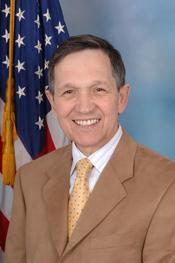
Historical · U.S. House · Ohio · District 10
Dennis Kucinich
Former U.S. Representative · Ohio District 10 · 1997–2013 · Democratic
Dennis Kucinich represented Ohio's District 10 in the United States House of Representatives (1997–2013) for the Democratic party. The page below collects sourced biographical facts, term history, committee roles, and provenance for Kucinich.
Bioguide ID: K000336
Key facts
- Full name
- Dennis Kucinich
- State
- Ohio
- District
- District 10
- Party
- Democratic
- House service
- 1997–2013
- First House term
- 1997
- Status
- Left office
- Current term ends
- —
- Born
- 1946
- Bioguide ID
- K000336
- Committee assignments
- —
- Dataset version
- 1.20260605
Biographical narrative
996 words · sourced from the Wikipedia REST extract
Dennis J. Kucinich is a former American politician who served as a U.S. Representative for Ohio's 10th congressional district from 1997 until 2013. A member of the Democratic Party, Kucinich is known for his progressive political stance and his advocacy for various liberal causes. His political career began in the late 1960s, and he has held multiple public offices, including a notable term as the mayor of Cleveland from 1977 to 1979. Kucinich is also recognized for his attempts to run for the presidency in the Democratic primaries during the 2004 and 2008 elections, where he campaigned on platforms that included opposition to the Iraq War and support for single-payer healthcare.
Early life and career
Dennis J. Kucinich was born on October 8, 1946, in the Tremont neighborhood of Cleveland, Ohio. He was the eldest of seven children in a family where his father, Frank J. Kucinich, worked as a truck driver and was affiliated with the Teamsters union, while his mother, Virginia, was a homemaker. Kucinich's upbringing was marked by frequent relocations, as his family moved 21 times during his childhood. This experience instilled in him a sense of responsibility, as he often took on the task of finding affordable housing for the family.
Kucinich completed his high school education at St. John Cantius High School in 1965. He then attended Cleveland State University from 1967 to 1970 before transferring to Case Western Reserve University, where he earned both a Bachelor and a Master of Arts degree in speech and communication in 1973. His academic background laid the groundwork for his future endeavors in public speaking and politics.
Kucinich's political career commenced in 1967 when he first ran for office, though he was unsuccessful. In 1969, he was elected to the Cleveland City Council at the age of 23, marking the beginning of his long-standing involvement in public service. He attempted to secure a seat in the U.S. House of Representatives in 1972 but lost narrowly to the incumbent Republican William E. Minshall Jr. After Minshall's retirement in 1974, Kucinich sought the Democratic nomination for the seat but was unsuccessful. He ran as an Independent candidate in the general election, finishing third.
In 1975, Kucinich was appointed clerk of the municipal court in Cleveland, a position he held for two years. His political trajectory took a significant turn when he was elected mayor of Cleveland in 1977, becoming the youngest mayor of a major U.S. city at the age of 31. His tenure as mayor was characterized by significant challenges, including a high-profile battle over the sale of the city's publicly owned electric utility, which garnered national attention and controversy.
House tenure
Kucinich's congressional career began when he was elected to the U.S. House of Representatives in 1996, representing Ohio's 10th congressional district. He took office in January 1997 and served for eight consecutive terms until January 2013. Throughout his time in Congress, Kucinich was recognized for his progressive views and often positioned himself as one of the most liberal members of the House. His political stance resonated with many constituents who valued his commitment to social justice, healthcare reform, and anti-war activism.
During his tenure, Kucinich was a vocal opponent of the Iraq War, which he actively campaigned against during his presidential runs in 2004 and 2008. His opposition to the war garnered him support from various anti-war activists and organizations. Despite not winning any primary contests, Kucinich remained a prominent figure in the Democratic Party, particularly among those advocating for a more progressive agenda.
Kucinich's congressional career was marked by his willingness to challenge both Republican and Democratic leadership on various issues. He was known for his outspoken criticism of then-President Barack Obama, particularly regarding military interventions and foreign policy decisions. Kucinich argued for the impeachment of Vice President Dick Cheney following the military intervention in Libya in 2011, reflecting his commitment to holding government officials accountable for their actions.
In 2012, Kucinich faced a significant political challenge due to redistricting that occurred after the 2010 census. The newly drawn congressional boundaries placed him in direct competition with fellow Democratic Representative Marcy Kaptur in the newly established 9th congressional district. Kucinich lost the Democratic primary to Kaptur, marking the end of his congressional career.
Legislative focus and committees
Throughout his time in the House, Kucinich served on several committees, where he focused on a variety of issues that aligned with his progressive values. His legislative priorities included healthcare reform, environmental protection, and civil rights. Kucinich was a strong advocate for single-payer healthcare, often promoting the idea of a national health insurance program that would provide coverage for all Americans.
In addition to healthcare, Kucinich was involved in efforts to address climate change and promote renewable energy sources. He frequently spoke about the importance of environmental sustainability and the need for comprehensive policies to combat global warming. His commitment to civil rights extended to various social justice issues, including advocating for the rights of marginalized communities and promoting equality across different sectors of society.
Kucinich's legislative initiatives often reflected his broader vision for a more equitable and just society. He introduced numerous bills aimed at reforming various aspects of government and society, including proposals for a "Department of Peace" that would focus on conflict resolution and non-violent approaches to international relations.
After leaving Congress, Kucinich continued to engage in public discourse through various platforms, including media appearances and political commentary. He ran for governor of Ohio in 2018 and participated in the 2021 Cleveland mayoral election, although he did not secure the nominations in either contest. In 2024, he ran as an independent candidate for Ohio's 7th congressional district, finishing third in the race.
Kucinich's political journey reflects a commitment to progressive ideals and a dedication to public service that has spanned several decades. His experiences in local and national politics have shaped his perspectives on governance and social issues, contributing to his legacy as a notable figure in American politics.
Notable legislation
Sponsored and co-sponsored legislation for Dennis Kucinich is pending operator curation. The biographical narrative above carries the same provenance trail until per-bill rows are written.
Sources
- [1]https://en.wikipedia.org/wiki/Dennis_KucinichWikipedia · retrieved 2026-06-05
Notable quotes
Sourced quotes for Dennis Kucinich are pending operator curation. Narrative-scope provenance remains attached below.
Sources
- [1]https://en.wikipedia.org/wiki/Dennis_KucinichWikipedia · retrieved 2026-06-05
Key positions
Curated policy positions for Dennis Kucinich are pending operator review. The biographical narrative above carries the same provenance trail until per-topic positions are written.
Sources
- [1]https://en.wikipedia.org/wiki/Dennis_KucinichWikipedia · retrieved 2026-06-05
Terms served
- 1997–1999U.S. House · Term 1 · Democratic
- 1999–2001U.S. House · Term 2 · Democratic
- 2001–2003U.S. House · Term 3 · Democratic
- 2003–2005U.S. House · Term 4 · Democratic
- 2005–2007U.S. House · Term 5 · Democratic
- 2007–2009U.S. House · Term 6 · Democratic
- 2009–2011U.S. House · Term 7 · Democratic
- 2011–2013U.S. House · Term 8 · Democratic
Sources & provenance
Every attributable claim above carries a per-section [N] marker that resolves to the corresponding URL below. Each entry records the upstream provider, the canonical URL, and the timestamp at which the source was retrieved by the ingest pipeline.
Key facts
- https://bioguide.congress.gov/search/bio/K000336bioguide · retrieved 2026-06-05
- http://kucinich.house.govhouse.gov · retrieved 2026-06-05
Biographical narrative
- https://en.wikipedia.org/wiki/Dennis_Kucinichwikipedia · retrieved 2026-06-05
Find your representative
Every U.S. state elects representatives by district. Browse Ohio’s delegation, the full former-representative roster, or explore the role and term length.
Related on The Candidate
- Preceded by Martin HokeEarlier holder of the Ohio District 10 House seat · Republican.Open
- Aaron PerryFormer U.S. Representative · Ohio District 1 · RepublicanOpen
- Alexander DuncanFormer U.S. Representative · Ohio District 1 · DemocraticOpen
- Bellamy StorerFormer U.S. Representative · Ohio District 1 · WhigOpen
- Bellamy StorerFormer U.S. Representative · Ohio District 1 · RepublicanOpen
- Democratic PartyFederal candidates and office holders on the Democratic line.Open