
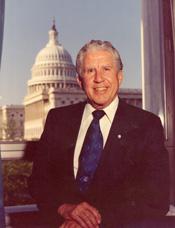
Historical · U.S. House · Ohio · District 12
Samuel Devine
Former U.S. Representative · Ohio District 12 · 1959–1981 · Republican
Samuel Devine represented Ohio's District 12 in the United States House of Representatives (1959–1981) for the Republican party. The page below collects sourced biographical facts, term history, committee roles, and provenance for Devine.
Bioguide ID: D000279
Key facts
- Full name
- Samuel Devine
- State
- Ohio
- District
- District 12
- Party
- Republican
- House service
- 1959–1981
- First House term
- 1959
- Status
- Left office
- Current term ends
- —
- Born
- 1915
- Bioguide ID
- D000279
- Committee assignments
- —
- Dataset version
- 1.20260605
Biographical narrative
920 words · sourced from the Wikipedia REST extract
Samuel L. Devine was an American politician and member of the Republican Party who served as a U.S. Representative for Ohio's 12th congressional district from January 3, 1959, until January 3, 1981. His tenure in the House of Representatives spanned over two decades, during which he held various leadership roles, including Chairman of the House Republican Conference during the 96th Congress. Devine's political career was preceded by a background in law and public service, and he was known for his involvement in state politics prior to his election to Congress.
Early life and career
Samuel L. Devine was born on December 21, 1915, in South Bend, Indiana. His family relocated to Columbus, Ohio, in 1920, where he spent much of his formative years. Devine attended Upper Arlington High School and later pursued higher education at Colgate University for a year before transferring to Ohio State University. He completed his undergraduate studies at Ohio State, earning a degree in 1937. Following his graduation, Devine continued his education at the University of Notre Dame, where he obtained both an LL.B. and a J.D. in 1940.
After being admitted to the bar in the same year, Devine began his legal career in Columbus. However, his path took a different direction when he was appointed as a special agent for the Federal Bureau of Investigation (FBI) in 1940. He served in this capacity until October 1945, after which he returned to private legal practice in Columbus.
Devine's political aspirations began to take shape in the early 1950s. He was elected to the Ohio House of Representatives in 1950, serving from 1951 to 1955. During his time in the state legislature, he held the position of chairman of the Ohio Un-American Activities Committee, a body that mirrored the federal House Un-American Activities Committee. Under his leadership, the committee conducted investigations into alleged Communist activities in Ohio, declaring that around 1,300 individuals in the state were members of the Communist Party. Devine played a significant role in advocating for legislation that imposed prison terms and fines on those identified as Communists, successfully pushing the state legislature to override a gubernatorial veto on this matter.
Following his tenure in the Ohio House, Devine served as the Prosecuting Attorney for Franklin County, Ohio, from 1955 until 1958. His legal and political experiences laid a strong foundation for his subsequent election to the United States Congress.
House tenure
Devine's congressional career began when he was elected to represent Ohio's 12th congressional district in 1958, taking office on January 3, 1959. He was re-elected multiple times, serving a total of 11 terms in the House of Representatives until his departure from office on January 3, 1981. Throughout his time in Congress, Devine was involved in various legislative initiatives and was known for his active participation in Republican leadership.
During the 96th Congress, he held the position of Chairman of the House Republican Conference, a role that placed him in a key leadership position within the party. In this capacity, he was responsible for coordinating party strategy and communication among Republican members of the House. His leadership role during this period was significant as it coincided with a time of shifting political dynamics in the United States.
Devine's tenure in Congress was marked by his commitment to his constituents and his engagement in national issues. He participated in debates and discussions that shaped legislation affecting Ohio and the broader United States. His long-standing service in the House allowed him to build relationships with fellow lawmakers and to influence policy decisions.
However, his congressional career came to an end when he was defeated in the 1980 election by Democrat Bob Shamansky. After serving in the House for over two decades, Devine's departure marked the conclusion of a significant chapter in his political life.
Legislative focus and committees
Throughout his time in Congress, Samuel L. Devine focused on a range of legislative issues that reflected the priorities of his constituents and the Republican Party. His work encompassed various areas, including law enforcement, civil rights, and economic policies. Given his background in law and his experience as a prosecutor, Devine often emphasized issues related to public safety and the legal system.
As a member of the House, he served on several committees that allowed him to influence legislation in meaningful ways. His roles on these committees provided him with opportunities to advocate for policies that aligned with his political beliefs and the interests of his district. Devine's involvement in committee work was integral to his legislative effectiveness and his ability to navigate the complexities of federal governance.
In addition to his legislative responsibilities, Devine was known for his engagement in the Republican Party's broader objectives. His leadership role as Chairman of the House Republican Conference positioned him as a key figure in shaping party strategy during a time of political transition. He worked to unify Republican members and to promote the party's agenda in the House.
Devine's legacy includes not only his contributions to the legislative process but also his impact on the political landscape in Ohio. His daughter, Carol Miller, has continued the family's political legacy, serving as a Republican member of the West Virginia House of Delegates and later being elected to Congress.
Samuel L. Devine passed away on June 27, 1997, from cancer in Upper Arlington, Ohio. His life and career reflect a commitment to public service and the political process, leaving a lasting imprint on the communities he served and the legislative history of the United States.
Notable legislation
Sponsored and co-sponsored legislation for Samuel Devine is pending operator curation. The biographical narrative above carries the same provenance trail until per-bill rows are written.
Sources
- [1]https://en.wikipedia.org/wiki/Samuel_L._DevineWikipedia · retrieved 2026-06-05
Notable quotes
Sourced quotes for Samuel Devine are pending operator curation. Narrative-scope provenance remains attached below.
Sources
- [1]https://en.wikipedia.org/wiki/Samuel_L._DevineWikipedia · retrieved 2026-06-05
Key positions
Curated policy positions for Samuel Devine are pending operator review. The biographical narrative above carries the same provenance trail until per-topic positions are written.
Sources
- [1]https://en.wikipedia.org/wiki/Samuel_L._DevineWikipedia · retrieved 2026-06-05
Terms served
- 1959–1961U.S. House · Term 1 · Republican
- 1961–1963U.S. House · Term 2 · Republican
- 1963–1965U.S. House · Term 3 · Republican
- 1965–1967U.S. House · Term 4 · Republican
- 1967–1969U.S. House · Term 5 · Republican
- 1969–1971U.S. House · Term 6 · Republican
- 1971–1973U.S. House · Term 7 · Republican
- 1973–1975U.S. House · Term 8 · Republican
- 1975–1977U.S. House · Term 9 · Republican
- 1977–1979U.S. House · Term 10 · Republican
- 1979–1981U.S. House · Term 11 · Republican
Sources & provenance
Every attributable claim above carries a per-section [N] marker that resolves to the corresponding URL below. Each entry records the upstream provider, the canonical URL, and the timestamp at which the source was retrieved by the ingest pipeline.
Key facts
- https://bioguide.congress.gov/search/bio/D000279bioguide · retrieved 2026-06-05
- https://www.govtrack.us/congress/members/403411govtrack · retrieved 2026-06-05
Biographical narrative
- https://en.wikipedia.org/wiki/Samuel_L._Devinewikipedia · retrieved 2026-06-05
Find your representative
Every U.S. state elects representatives by district. Browse Ohio’s delegation, the full former-representative roster, or explore the role and term length.
Related on The Candidate
- Preceded by John VorysEarlier holder of the Ohio District 12 House seat · Republican.Open
- Succeeded by Robert ShamanskyLater holder of the Ohio District 12 House seat · Democratic.Open
- Aaron PerryFormer U.S. Representative · Ohio District 1 · RepublicanOpen
- Alexander DuncanFormer U.S. Representative · Ohio District 1 · DemocraticOpen
- Bellamy StorerFormer U.S. Representative · Ohio District 1 · WhigOpen
- Bellamy StorerFormer U.S. Representative · Ohio District 1 · RepublicanOpen