
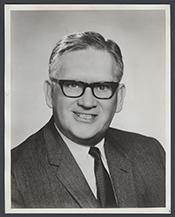
Historical · U.S. House · Ohio · District 13
Charles Mosher
Former U.S. Representative · Ohio District 13 · 1961–1977 · Republican
Charles Mosher represented Ohio's District 13 in the United States House of Representatives (1961–1977) for the Republican party. The page below collects sourced biographical facts, term history, committee roles, and provenance for Mosher.
Bioguide ID: M001031
Key facts
- Full name
- Charles Mosher
- State
- Ohio
- District
- District 13
- Party
- Republican
- House service
- 1961–1977
- First House term
- 1961
- Status
- Left office
- Current term ends
- —
- Born
- 1906
- Bioguide ID
- M001031
- Committee assignments
- —
- Dataset version
- 1.20260605
Biographical narrative
928 words · sourced from the Wikipedia REST extract
Charles A. Mosher was an American politician and newspaperman who served as a Republican member of the United States House of Representatives from Ohio's 13th congressional district. His congressional career spanned from 1961 to 1977, during which he was elected to eight consecutive terms. Mosher was known for his involvement in various legislative initiatives, particularly in the areas of civil rights and health care, and he played a significant role in the House Science Committee.
Early life and career
Charles Adams Mosher was born on May 7, 1906, in Sandwich, Illinois. He completed his secondary education at Sandwich High School before pursuing higher education at Oberlin College, where he graduated in 1928. Following his graduation, Mosher began his career in journalism, working for daily newspapers in Aurora, Illinois, and Janesville, Wisconsin, from 1929 until 1940. His experience in the newspaper industry laid the foundation for his later political career, as he developed skills in communication and public engagement.
In 1940, Mosher transitioned from journalism to entrepreneurship, becoming the president and manager of the Oberlin Printing Company. He also took on the role of editor and publisher of the Oberlin News-Tribune, a position he held until 1961. His involvement in local governance began in 1945 when he was elected as vice chairman of the Oberlin City Council, a position he maintained until 1951. This early engagement in local politics helped to establish his reputation as a community leader.
Mosher's political career continued to evolve as he served in the Ohio State Senate from 1951 to 1960. During this time, he was also a member of the Ohio Legislative Service Commission from 1947 to 1959 and served as vice chairman of the Ohio School Survey Commission from 1954 to 1955. His commitment to education was further demonstrated by his role as a delegate to the White House Conference on Education in 1955. Additionally, he contributed to local development efforts as a director of the Oberlin Improvement and Development Corporation and participated in the Presidential Commission on Marine Science, Engineering, and Resources from 1967 to 1969.
House tenure
Mosher's tenure in the U.S. House of Representatives began in 1961 when he was elected as a Republican to the Eighty-seventh Congress. He successfully won re-election to seven subsequent Congresses, serving a total of eight terms until he chose not to seek re-election in 1976. Throughout his time in Congress, Mosher was involved in various legislative activities and was known for his bipartisan approach to governance.
During his congressional career, Mosher voted in favor of significant civil rights legislation, including the Civil Rights Act of 1964 and the Voting Rights Act of 1965. He also supported the establishment of the Medicare program for the elderly and the Civil Rights Act of 1968. His commitment to health care reform was evident when he co-sponsored the Health Security Act of 1971, a bipartisan initiative aimed at creating a government health program that would provide coverage for all Americans. This legislation reflected his interest in expanding access to health care and addressing the needs of constituents.
In 1971, following the passing of the incumbent Ranking Member James G. Fulton, Mosher became the Ranking Member of the House Science Committee. In this role, he contributed to discussions and decisions regarding science and technology policy, which were increasingly important during a time of rapid advancements in these fields. His involvement in the committee underscored his commitment to fostering scientific research and innovation.
Legislative focus and committees
Throughout his congressional career, Mosher's legislative focus encompassed a range of issues, with particular emphasis on civil rights, health care, and science policy. His support for landmark civil rights legislation positioned him as a proponent of equality and social justice during a transformative period in American history. By voting in favor of key civil rights measures, he contributed to the progress of civil rights protections for marginalized communities.
In addition to his civil rights advocacy, Mosher's work on health care reform highlighted his concern for the well-being of American citizens, particularly the elderly. His co-sponsorship of the Health Security Act of 1971 illustrated his belief in the necessity of a comprehensive health care system that would ensure access to medical services for all individuals, regardless of their socioeconomic status.
Mosher's role as Ranking Member of the House Science Committee allowed him to influence policies related to scientific research and technological advancement. His participation in the committee was particularly relevant during the 1960s and 1970s, a period marked by significant developments in space exploration and scientific inquiry. His involvement in the Committee on Science and Astronautics, which contributed to the Brookings Report, further demonstrated his engagement with the implications of space exploration for American society.
After leaving Congress, Mosher continued to be active in public service and civic engagement. In 1977, he was elected to the Common Cause National Governing Board, reflecting his ongoing commitment to promoting democratic principles and civic participation. He served as the executive director of the House Science and Technology Committee in Washington, D.C., from 1977 to 1979, further contributing to the discourse on science policy.
Mosher's academic pursuits continued into his later years, as he became a fellow of the Woodrow Wilson Center at the Smithsonian Institution in 1980 and received his Master of Arts degree from Oberlin College in 1982. He remained a resident of Oberlin, Ohio, until his passing on November 16, 1984, at the age of 78. His legacy includes his contributions to journalism, local governance, and national legislation, as well as his commitment to advancing civil rights and health care reform.
Notable legislation
Sponsored and co-sponsored legislation for Charles Mosher is pending operator curation. The biographical narrative above carries the same provenance trail until per-bill rows are written.
Sources
- [1]https://en.wikipedia.org/wiki/Charles_Adams_MosherWikipedia · retrieved 2026-06-05
Notable quotes
Sourced quotes for Charles Mosher are pending operator curation. Narrative-scope provenance remains attached below.
Sources
- [1]https://en.wikipedia.org/wiki/Charles_Adams_MosherWikipedia · retrieved 2026-06-05
Key positions
Curated policy positions for Charles Mosher are pending operator review. The biographical narrative above carries the same provenance trail until per-topic positions are written.
Sources
- [1]https://en.wikipedia.org/wiki/Charles_Adams_MosherWikipedia · retrieved 2026-06-05
Terms served
- 1961–1963U.S. House · Term 1 · Republican
- 1963–1965U.S. House · Term 2 · Republican
- 1965–1967U.S. House · Term 3 · Republican
- 1967–1969U.S. House · Term 4 · Republican
- 1969–1971U.S. House · Term 5 · Republican
- 1971–1973U.S. House · Term 6 · Republican
- 1973–1975U.S. House · Term 7 · Republican
- 1975–1977U.S. House · Term 8 · Republican
Sources & provenance
Every attributable claim above carries a per-section [N] marker that resolves to the corresponding URL below. Each entry records the upstream provider, the canonical URL, and the timestamp at which the source was retrieved by the ingest pipeline.
Key facts
- https://bioguide.congress.gov/search/bio/M001031bioguide · retrieved 2026-06-05
- https://www.govtrack.us/congress/members/407998govtrack · retrieved 2026-06-05
Biographical narrative
- https://en.wikipedia.org/wiki/Charles_Adams_Mosherwikipedia · retrieved 2026-06-05
Find your representative
Every U.S. state elects representatives by district. Browse Ohio’s delegation, the full former-representative roster, or explore the role and term length.
Related on The Candidate
- Preceded by Albert Baumhart Jr.Earlier holder of the Ohio District 13 House seat · Republican.Open
- Succeeded by Donald PeaseLater holder of the Ohio District 13 House seat · Democratic.Open
- Aaron PerryFormer U.S. Representative · Ohio District 1 · RepublicanOpen
- Alexander DuncanFormer U.S. Representative · Ohio District 1 · DemocraticOpen
- Bellamy StorerFormer U.S. Representative · Ohio District 1 · WhigOpen
- Bellamy StorerFormer U.S. Representative · Ohio District 1 · RepublicanOpen