
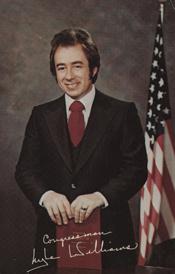
Historical · U.S. House · Ohio · District 17
Lyle Williams
Former U.S. Representative · Ohio District 17 · 1979–1985 · Republican
Lyle Williams represented Ohio's District 17 in the United States House of Representatives (1979–1985) for the Republican party. The page below collects sourced biographical facts, term history, committee roles, and provenance for Williams.
Bioguide ID: W000528
Key facts
- Full name
- Lyle Williams
- State
- Ohio
- District
- District 17
- Party
- Republican
- House service
- 1979–1985
- First House term
- 1979
- Status
- Left office
- Current term ends
- —
- Born
- 1942
- Bioguide ID
- W000528
- Committee assignments
- —
- Dataset version
- 1.20260605
Biographical narrative
857 words · sourced from the Wikipedia REST extract
Lyle Williams was an American politician who served as a U.S. Representative for Ohio's 17th congressional district from 1979 to 1985. A member of the Republican Party, Williams was known for his tenure during a time of significant political and social change in the United States. His career spanned three terms in Congress, where he navigated the complexities of representing a district characterized by its working-class roots and industrial backdrop.
Early life and career
Lyle Williams was born on August 23, 1942, in Philippi, West Virginia, to Dale and Frankie Williams. His early education took place in North Bloomfield, Ohio, where he graduated from Bloomfield High School in 1960. Following high school, Williams served in the United States Army Reserve from 1960 until 1968, a period that coincided with the Vietnam War and shaped his views on military and veteran affairs.
After his military service, Williams pursued a career as a barber, which provided him with insights into the everyday lives of his constituents. In 1964, he married Nancie Peterson, and together they raised four children. His initial foray into public service began at the local level when he was elected to the Bloomfield school board, where he served from 1970 to 1972. This role marked the beginning of his political career, allowing him to engage with educational issues and community concerns.
Williams's political ambitions grew, leading him to run for a position as a Trumbull County Commissioner, a role he held from 1972 to 1976. His local government experience laid the groundwork for his subsequent congressional campaign, as he became more familiar with the political landscape and the needs of his community.
House tenure
In 1978, Lyle Williams entered the race for the U.S. House of Representatives, representing Ohio's 17th congressional district. This district was known for its strong Democratic leanings, primarily due to its industrial cities, including Youngstown and Warren. Williams's campaign was marked by a competitive election against incumbent Democrat Charles J. Carney. Despite the challenges posed by the district's political demographics, Williams secured a narrow victory, marking the beginning of his congressional career in the Ninety-sixth Congress.
Williams's tenure in the House of Representatives lasted three terms, beginning in 1979 and concluding in 1985. During his time in office, he was reelected in 1980, defeating state Senator Harry Meshel, and again in 1982, overcoming George D. Tablack. His ability to win in a predominantly Democratic district was indicative of his political strategy and appeal to voters, as he focused on local issues and concerns that resonated with his constituents.
However, Williams's congressional career came to an end in 1984 when he faced a challenging reelection campaign against Mahoning County Sheriff James Traficant. Traficant's popularity and the shifting political landscape contributed to Williams's defeat, marking the conclusion of his time in the House.
Legislative focus and committees
Throughout his congressional career, Lyle Williams was involved in various legislative initiatives and served on several committees. His work in the House reflected the interests and needs of his constituents, particularly in areas related to economic development, labor, and local governance. Williams's background as a barber and local politician informed his approach to legislation, as he often prioritized issues that directly impacted the working-class population of his district.
While specific details about the bills he sponsored or supported are not available, it is known that Williams's legislative focus aligned with the Republican Party's priorities during the late 1970s and early 1980s. This period was marked by significant economic challenges, including inflation and unemployment, which influenced the political discourse of the time. Williams's efforts in Congress were likely aimed at addressing these pressing issues, advocating for policies that would benefit his constituents and promote economic stability.
After leaving Congress, Williams continued to engage in public service by joining the external affairs staff of the Office of Surface Mining within the U.S. Department of the Interior in 1987. His experience in this role allowed him to remain involved in issues related to mining and environmental policy, reflecting his ongoing commitment to public service.
Williams's political aspirations did not end with his congressional tenure. He made several attempts to return to public office, including a run for Ohio's 19th congressional district in 1992 and a rematch against Traficant in the 17th District in 2000. Despite these efforts, he faced challenges in securing the Republican nomination, ultimately losing to other candidates in the primaries.
In 2002, Williams sought to challenge Democratic Congressman Ted Strickland in Ohio's 6th congressional district. However, he again faced defeat in the Republican primary, this time to Columbiana County Commissioner Mike Halleck. These later attempts to reenter the political arena illustrate Williams's enduring interest in public service and his desire to contribute to the political landscape of Ohio.
Lyle Williams passed away on November 7, 2008, in Lordstown, Ohio, due to a heart attack. His life and career reflect the journey of a local leader who rose to national prominence, navigating the complexities of American politics during a transformative era. His legacy is marked by his commitment to his constituents and his efforts to address the challenges faced by the working-class communities he represented.
Notable legislation
Sponsored and co-sponsored legislation for Lyle Williams is pending operator curation. The biographical narrative above carries the same provenance trail until per-bill rows are written.
Sources
- [1]https://en.wikipedia.org/wiki/Lyle_WilliamsWikipedia · retrieved 2026-06-05
Notable quotes
Sourced quotes for Lyle Williams are pending operator curation. Narrative-scope provenance remains attached below.
Sources
- [1]https://en.wikipedia.org/wiki/Lyle_WilliamsWikipedia · retrieved 2026-06-05
Key positions
Curated policy positions for Lyle Williams are pending operator review. The biographical narrative above carries the same provenance trail until per-topic positions are written.
Sources
- [1]https://en.wikipedia.org/wiki/Lyle_WilliamsWikipedia · retrieved 2026-06-05
Terms served
- 1979–1981U.S. House · Term 1 · Republican
- 1981–1983U.S. House · Term 2 · Republican
- 1983–1985U.S. House · Term 3 · Republican
Sources & provenance
Every attributable claim above carries a per-section [N] marker that resolves to the corresponding URL below. Each entry records the upstream provider, the canonical URL, and the timestamp at which the source was retrieved by the ingest pipeline.
Key facts
- https://bioguide.congress.gov/search/bio/W000528bioguide · retrieved 2026-06-05
- https://www.govtrack.us/congress/members/411685govtrack · retrieved 2026-06-05
Biographical narrative
- https://en.wikipedia.org/wiki/Lyle_Williamswikipedia · retrieved 2026-06-05
Find your representative
Every U.S. state elects representatives by district. Browse Ohio’s delegation, the full former-representative roster, or explore the role and term length.
Related on The Candidate
- Preceded by Robert LeveringEarlier holder of the Ohio District 17 House seat · Democratic.Open
- Succeeded by James Traficant Jr.Later holder of the Ohio District 17 House seat · Democratic.Open
- Aaron PerryFormer U.S. Representative · Ohio District 1 · RepublicanOpen
- Alexander DuncanFormer U.S. Representative · Ohio District 1 · DemocraticOpen
- Bellamy StorerFormer U.S. Representative · Ohio District 1 · WhigOpen
- Bellamy StorerFormer U.S. Representative · Ohio District 1 · RepublicanOpen