
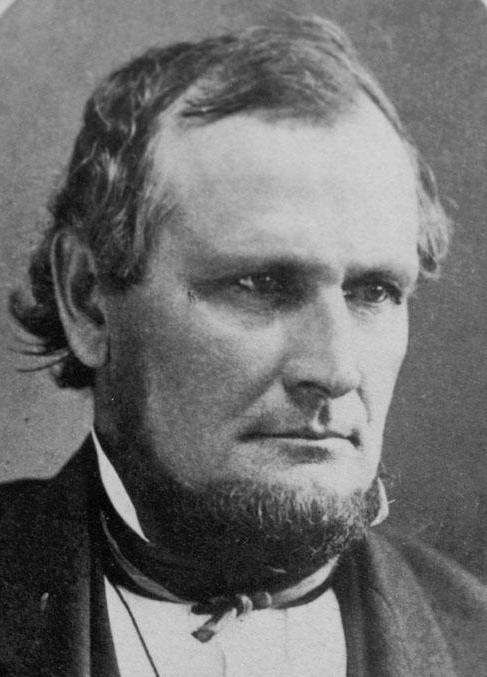
Historical · U.S. House · Ohio · District 3
John Smith
Former U.S. Representative · Ohio District 3 · 1873–1875 · Republican
John Smith represented Ohio's District 3 in the United States House of Representatives (1873–1875) for the Republican party. The page below collects sourced biographical facts, term history, committee roles, and provenance for Smith.
Bioguide ID: S000574
Key facts
- Full name
- John Smith
- State
- Ohio
- District
- District 3
- Party
- Republican
- House service
- 1873–1875
- First House term
- 1873
- Status
- Left office
- Current term ends
- —
- Born
- 1824
- Bioguide ID
- S000574
- Committee assignments
- —
- Dataset version
- 1.20260606
Biographical narrative
938 words · sourced from the Wikipedia REST extract
John Smith was a prominent American politician and farmer from Ohio, who served as a U.S. Representative for the state's Third Congressional District from 1873 to 1875. A member of the Republican Party, Smith's political career spanned various roles, including service in the Ohio Senate and House of Representatives, as well as a significant appointment as Commissioner of Indian Affairs. His tenure in Congress was marked by the political dynamics of the post-Civil War era, and he later transitioned to the Democratic Party, reflecting his evolving views on economic policy. Smith's life journey, from a farmer to a legislator, illustrates the interconnectedness of agriculture and politics in 19th-century America.
Early life and career
John Quincy Smith was born on November 5, 1824, in Warren County, Ohio, to Thomas Edward Smith and Mary Kennedy Whitehill, both of whom were originally from Virginia. Growing up on a family farm near Waynesville, Smith was immersed in agricultural life from an early age. His upbringing instilled in him a strong work ethic, but it also limited his formal education. Despite these constraints, Smith was a voracious reader, demonstrating a keen interest in learning. His father recognized the importance of education, which allowed Smith to attend Miami University for a brief period.
In July 1852, Smith married Lydia Emeline Evans, who also hailed from Warren County. The couple had six children, although they faced the tragedy of losing one child during infancy. In 1854, seeking new opportunities, Smith moved his family to Clinton County, Ohio, where he continued to engage in farming. This relocation marked a significant step in his life, as it provided him with a broader platform for his future political aspirations.
Smith's political career began to take shape in the late 1850s. In 1859, he was elected to the Ohio Senate as a Republican, a position that would introduce him to the political landscape of the state. During his time in Columbus, he shared living quarters with James A. Garfield, who would later become the 20th President of the United States. Smith's connections during this period included notable figures such as John Sherman and Ulysses S. Grant, which would influence his political trajectory.
In 1861, Smith transitioned to the Ohio House of Representatives, where he served for two years. His political involvement continued to grow, and in 1870, he was elected to the Ohio State Board of Equalization. This role further solidified his reputation within the Republican Party, leading to his re-election to the Ohio Senate in 1871.
House tenure
Smith's congressional career began when he was elected to the United States House of Representatives in 1872, representing Ohio's Third Congressional District. His election came during a time of significant political change in the United States, as the nation was still grappling with the aftermath of the Civil War and the complexities of Reconstruction. Smith's term in the House lasted from 1873 until 1875, during which he participated in the legislative processes that shaped the post-war landscape.
In 1874, Smith sought re-election to Congress but faced a challenge from John S. Savage, who ultimately defeated him. This loss marked the end of his time in the House, but it did not signify the end of his public service. Following his congressional tenure, Smith was appointed as Commissioner of Indian Affairs in December 1875, a role that placed him at the center of significant national issues regarding Native American policy and relations.
Legislative focus and committees
During his time in the House, Smith's legislative focus was likely influenced by the political and social issues of the era, including economic recovery, civil rights for formerly enslaved individuals, and the integration of Native American tribes into American society. Although specific details about his committee assignments or legislative initiatives are not documented, it is reasonable to infer that he engaged with the pressing matters of his time, particularly those that affected his constituents in Ohio.
As Commissioner of Indian Affairs, Smith's administration was marked by several controversies, including the Great Sioux War of 1876-77, which encompassed notable events such as the Battle of the Little Bighorn. His tenure was also characterized by the removal of the Ponca Indians to Indian Territory, a decision that faced significant opposition and scrutiny. Additionally, Smith's administration dealt with allegations of corruption involving his chief clerk, Samuel Galpin, which further complicated his role in the federal government.
Smith's time in the federal government concluded when he was removed from his position as Commissioner of Indian Affairs in September 1877. Following this, he was appointed by President Rutherford B. Hayes as the United States consul general to Montreal, Quebec, Canada. He served in this capacity from 1878 until his resignation in 1882, marking a transition from domestic politics to international representation.
In the years following his public service, Smith's political affiliations shifted. Initially a staunch Republican, he aligned himself with the Democratic Party during President Grover Cleveland's first administration, primarily due to his evolving views on tariff reform. His writings on this subject, published in the New York Evening Post, garnered national attention and were widely circulated, indicating his continued engagement with political discourse even after leaving office.
After retiring from public life, Smith returned to his agricultural roots, settling on his farm, known as "Sycamores," in Oakland, Ohio. He lived out the remainder of his life there, passing away on December 30, 1901. Smith's legacy is preserved in his contributions to Ohio's political landscape and his involvement in significant national issues of his time. He is buried in Miami Cemetery in Waynesville, Ohio, where he remains a part of the local history that shaped the region.
Notable legislation
Sponsored and co-sponsored legislation for John Smith is pending operator curation. The biographical narrative above carries the same provenance trail until per-bill rows are written.
Sources
- [1]https://en.wikipedia.org/wiki/John_Quincy_SmithWikipedia · retrieved 2026-06-06
Notable quotes
Sourced quotes for John Smith are pending operator curation. Narrative-scope provenance remains attached below.
Sources
- [1]https://en.wikipedia.org/wiki/John_Quincy_SmithWikipedia · retrieved 2026-06-06
Key positions
Curated policy positions for John Smith are pending operator review. The biographical narrative above carries the same provenance trail until per-topic positions are written.
Sources
- [1]https://en.wikipedia.org/wiki/John_Quincy_SmithWikipedia · retrieved 2026-06-06
Terms served
- 1873–1875U.S. House · Term 1 · Republican
Sources & provenance
Every attributable claim above carries a per-section [N] marker that resolves to the corresponding URL below. Each entry records the upstream provider, the canonical URL, and the timestamp at which the source was retrieved by the ingest pipeline.
Key facts
- https://bioguide.congress.gov/search/bio/S000574bioguide · retrieved 2026-06-06
- https://www.govtrack.us/congress/members/410056govtrack · retrieved 2026-06-06
Biographical narrative
- https://en.wikipedia.org/wiki/John_Quincy_Smithwikipedia · retrieved 2026-06-06
Find your representative
Every U.S. state elects representatives by district. Browse Ohio’s delegation, the full former-representative roster, or explore the role and term length.
Related on The Candidate
- Preceded by Lewis CampbellEarlier holder of the Ohio District 3 House seat · Democratic.Open
- Succeeded by John McMahonLater holder of the Ohio District 3 House seat · Democratic.Open
- Aaron PerryFormer U.S. Representative · Ohio District 1 · RepublicanOpen
- Alexander DuncanFormer U.S. Representative · Ohio District 1 · DemocraticOpen
- Bellamy StorerFormer U.S. Representative · Ohio District 1 · WhigOpen
- Bellamy StorerFormer U.S. Representative · Ohio District 1 · RepublicanOpen