
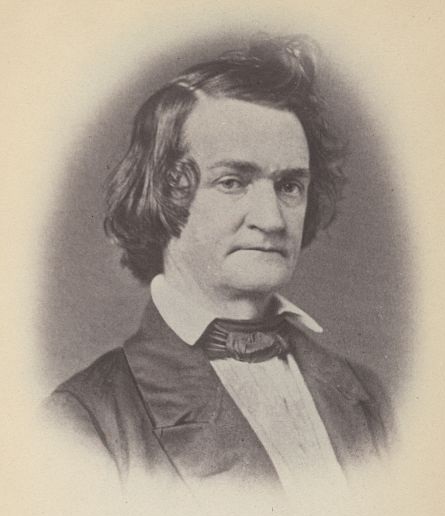
Historical · U.S. House · Ohio · District 3
Lewis Campbell
Former U.S. Representative · Ohio District 3 · 1849–1873 · Democratic
Lewis Campbell represented Ohio's District 3 in the United States House of Representatives (1849–1873) for the Democratic party. The page below collects sourced biographical facts, term history, committee roles, and provenance for Campbell.
Bioguide ID: C000096
Key facts
- Full name
- Lewis Campbell
- State
- Ohio
- District
- District 3
- Party
- Democratic
- House service
- 1849–1873
- First House term
- 1849
- Status
- Left office
- Current term ends
- —
- Born
- 1811
- Bioguide ID
- C000096
- Committee assignments
- —
- Dataset version
- 1.20260606
Biographical narrative
828 words · sourced from the Wikipedia REST extract
Lewis Campbell was an American politician who served as a U.S. Representative for Ohio's 3rd congressional district. His political career spanned multiple decades and included affiliations with several political parties, including the Whig Party, the Republican Party, the Know Nothing Party, and the Democratic Party. Campbell's tenure in the U.S. House of Representatives began in 1849 and concluded in 1873, during which he was known for his involvement in significant legislative debates and his leadership roles within Congress.
Early life and career
Lewis Campbell was born on August 9, 1811, in Franklin, Ohio. He received his education in local public schools, which laid the foundation for his future endeavors. From 1828 to 1831, he was apprenticed in the printing trade, which provided him with valuable skills that he later utilized in journalism. Following his apprenticeship, Campbell became the assistant editor of the Cincinnati Gazette, where he honed his writing and editorial skills. In addition to his work in journalism, Campbell published a newspaper called The Hamilton Intelligencer in Hamilton, Ohio, from 1831 to 1835, which aligned with the Whig Party and its principles.
In 1835, Campbell pursued a legal career by studying law and was subsequently admitted to the bar. He practiced law in Hamilton until 1850 while also engaging in agricultural activities. His marriage to Jane Reily took place on January 5, 1836, in Butler County, Ohio. Throughout his early career, Campbell was involved in various business ventures, including serving as a director and secretary of the Hamilton and Rossville Hydraulic Company, which was established in 1841 to construct a canal in Hamilton to provide water power for local industries. Additionally, he played a significant role in the development of the Cincinnati, Hamilton and Dayton Railroad Company, which was built between 1846 and 1852, serving as its incorporator and president.
House tenure
Campbell's political career in the U.S. House of Representatives began when he was elected as a Whig in 1848 to represent Ohio's 2nd District in the 31st Congress. He was re-elected in 1850, demonstrating his growing influence within the party. Following redistricting after the 1850 census, Campbell found himself representing Ohio's 3rd District, where he was again elected as a Whig in 1852. As the Whig Party began to decline, Campbell aligned himself with the Anti-Nebraska movement, which opposed the expansion of slavery into the territories. This shift led to his election to the 34th Congress in 1854, where he became the chairman of the influential House Committee on Ways and Means.
During his time in Congress, Campbell was known for his active participation in debates, particularly those surrounding the contentious Kansas-Nebraska Act of 1854. As a free-soiler, he engaged in a notable filibuster that heightened tensions between northern and southern representatives. This confrontation was marked by heated exchanges and nearly escalated into physical violence on the House floor. In 1856, Campbell was re-elected by a narrow margin and served as a Republican member-elect until May 25, 1858, when a contested election resulted in his removal from office. He subsequently ran against Clement L. Vallandigham in the 1858 election but was unsuccessful.
With the onset of the Civil War, Campbell took a leave from his political career to serve in the Union Army. He was appointed colonel of the 69th Regiment, Ohio Volunteer Infantry, in 1861 and served until 1862 when health issues compelled him to resign.
Legislative focus and committees
After the Civil War, Campbell returned to public service when he was appointed by President Andrew Johnson as Envoy Extraordinary and Minister Plenipotentiary to Mexico in May 1866. His mission involved providing moral support to President Benito Juárez and offering military assistance to restore order in Mexico, which was under threat from French forces. However, Campbell's efforts were ultimately unsuccessful, and he resigned from this diplomatic position in June 1867.
In 1869, Campbell was elected to the Ohio Senate but resigned the following year to return to Congress, this time as a Democrat. He was elected to the 42nd Congress, where he continued to engage in legislative activities until he chose not to seek re-election in 1872. Following his congressional career, Campbell participated as a delegate in the third Ohio State constitutional convention in 1873 and resumed his agricultural pursuits.
Throughout his political career, Campbell was known for his commitment to various issues, particularly those related to civil rights and economic development. His leadership roles in key committees, especially the Committee on Ways and Means, positioned him to influence significant legislation during a transformative period in American history.
Lewis Campbell passed away on November 26, 1882, in Hamilton, Ohio, at the age of 71. He was interred in Greenwood Cemetery. His legacy includes his contributions to Ohio's political landscape and his involvement in pivotal moments in U.S. history, particularly during the antebellum period and the Civil War. His nephew, James E. Campbell, later served as a U.S. Representative for Ohio's 3rd District from 1885 to 1887, continuing the family's political lineage.
Notable legislation
Sponsored and co-sponsored legislation for Lewis Campbell is pending operator curation. The biographical narrative above carries the same provenance trail until per-bill rows are written.
Sources
- [1]https://en.wikipedia.org/wiki/Lewis_D._CampbellWikipedia · retrieved 2026-06-06
Notable quotes
Sourced quotes for Lewis Campbell are pending operator curation. Narrative-scope provenance remains attached below.
Sources
- [1]https://en.wikipedia.org/wiki/Lewis_D._CampbellWikipedia · retrieved 2026-06-06
Key positions
Curated policy positions for Lewis Campbell are pending operator review. The biographical narrative above carries the same provenance trail until per-topic positions are written.
Sources
- [1]https://en.wikipedia.org/wiki/Lewis_D._CampbellWikipedia · retrieved 2026-06-06
Terms served
- 1849–1851U.S. House · Term 1 · Whig
- 1851–1853U.S. House · Term 2 · Whig
- 1853–1855U.S. House · Term 3 · Whig
- 1855–1857U.S. House · Term 4 · Ind. Republican-Democrat
- 1857–1859U.S. House · Term 5 · Republican
- 1871–1873U.S. House · Term 6 · Democratic
Sources & provenance
Every attributable claim above carries a per-section [N] marker that resolves to the corresponding URL below. Each entry records the upstream provider, the canonical URL, and the timestamp at which the source was retrieved by the ingest pipeline.
Key facts
- https://bioguide.congress.gov/search/bio/C000096bioguide · retrieved 2026-06-06
- https://www.govtrack.us/congress/members/402251govtrack · retrieved 2026-06-06
Biographical narrative
- https://en.wikipedia.org/wiki/Lewis_D._Campbellwikipedia · retrieved 2026-06-06
Find your representative
Every U.S. state elects representatives by district. Browse Ohio’s delegation, the full former-representative roster, or explore the role and term length.
Related on The Candidate
- Preceded by Patrick GoodeEarlier holder of the Ohio District 3 House seat · Whig.Open
- Succeeded by John SmithLater holder of the Ohio District 3 House seat · Republican.Open
- Aaron PerryFormer U.S. Representative · Ohio District 1 · RepublicanOpen
- Alexander DuncanFormer U.S. Representative · Ohio District 1 · DemocraticOpen
- Bellamy StorerFormer U.S. Representative · Ohio District 1 · WhigOpen
- Bellamy StorerFormer U.S. Representative · Ohio District 1 · RepublicanOpen