
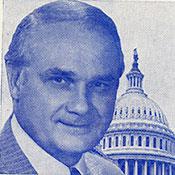
Historical · U.S. House · Ohio · District 5
Delbert Latta
Former U.S. Representative · Ohio District 5 · 1959–1989 · Republican
Delbert Latta represented Ohio's District 5 in the United States House of Representatives (1959–1989) for the Republican party. The page below collects sourced biographical facts, term history, committee roles, and provenance for Latta.
Bioguide ID: L000116
Key facts
- Full name
- Delbert Latta
- State
- Ohio
- District
- District 5
- Party
- Republican
- House service
- 1959–1989
- First House term
- 1959
- Status
- Left office
- Current term ends
- —
- Born
- 1920
- Bioguide ID
- L000116
- Committee assignments
- —
- Dataset version
- 1.20260605
Biographical narrative
994 words · sourced from the Wikipedia REST extract
Delbert L. Latta was an American lawyer and politician who served as a U.S. Representative for Ohio's 5th congressional district from 1959 until 1989. A member of the Republican Party, Latta was notable for his lengthy tenure in Congress, spanning 15 terms, making him one of the longest-serving politicians in Ohio's history. His political legacy continued through his son, Bob Latta, who succeeded him in the same congressional seat in 2007.
Early life and career
Delbert Leroy Latta was born on March 5, 1920, in Weston, Ohio. He was the son of Bessie Viola Thompson and Lester Latta. Growing up in a small town, Latta attended public schools in North Baltimore, Ohio, and graduated from McComb High School in 1938. His early education laid the groundwork for his future pursuits in law and politics. Following high school, he attended Findlay College for a brief period from 1939 to 1940 before transferring to Ohio Northern University, where he earned his Bachelor of Laws (LL.B) in 1943 and a Bachelor of Arts (A.B.) in 1945.
Latta's commitment to service began early in his life. He served in the Ohio National Guard and the United States Army's 37th Division from 1938 to 1941. His military career continued during World War II when he joined the United States Marine Corps Reserve in 1942 and 1943. After his military service, he was admitted to the bar in 1944, marking the beginning of his legal career.
Before entering Congress, Latta was involved in state politics, serving as a member of the Ohio Senate from 1953 to 1958. During his three terms in the state legislature, he gained valuable experience in governance and public policy. In addition to his political career, Latta practiced law and contributed to academia by teaching at Ohio Northern University. His involvement in the Republican Party was further solidified when he served as a delegate to the 1968 Republican National Convention.
House tenure
Delbert Latta was elected to the United States House of Representatives as a Republican in 1958, beginning his first term on January 3, 1959. He would go on to serve a total of 15 consecutive terms, concluding his congressional career on January 3, 1989. Throughout his tenure, Latta was known for his dedication to his constituents and his active participation in various legislative matters.
During his time in the House, Latta was appointed to several important committees, including the Agriculture Committee and the Rules Committee. His role on these committees allowed him to influence significant legislation affecting agriculture, one of Ohio's key industries. Additionally, he was appointed to the House Judiciary Committee during the Watergate hearings, a pivotal moment in American political history. Latta was one of ten Representatives on the Judiciary Committee who initially supported President Richard Nixon during the impeachment proceedings. However, his stance shifted after the release of the infamous "smoking gun" tape, which revealed Nixon's involvement in the cover-up of the Watergate scandal. Latta later expressed his intention to vote for impeachment when the articles were presented to the full House, reflecting a significant change in his position.
Latta also served as the ranking Republican on the House Budget Committee from 1975 until his retirement in 1989. In this capacity, he played a crucial role in shaping budgetary policies and fiscal legislation during a time of economic transition in the United States. His involvement in budgetary matters was particularly significant given the economic challenges faced by the country during the late 1970s and 1980s.
One of Latta's notable legislative achievements was his co-sponsorship of the Gramm-Latta Omnibus Reconciliation Bill in 1981. This legislation was instrumental in implementing President Ronald Reagan's economic program, which included increased military spending and various cuts in discretionary and mandatory spending. The bill also mandated the Economic Recovery Tax Act of 1981, which became known as the Kemp-Roth Tax Cut. This legislation aimed to stimulate economic growth through tax reductions and was a significant component of Reagan's broader economic strategy.
Legislative focus and committees
Throughout his congressional career, Delbert Latta focused on a range of issues that were important to his constituents and the nation. His work on the Agriculture Committee highlighted his commitment to supporting Ohio's agricultural sector, which is a vital part of the state's economy. Latta's efforts in this area included advocating for policies that would benefit farmers and promote agricultural development.
In addition to his work on agriculture, Latta's role on the House Judiciary Committee during the Watergate hearings placed him at the center of one of the most significant political events in American history. His initial support for Nixon's presidency and subsequent change of heart regarding impeachment illustrated the complexities of political loyalty and accountability during a time of crisis.
As the ranking Republican on the House Budget Committee, Latta was involved in discussions and decisions regarding federal spending and fiscal policy. His experience in this role allowed him to contribute to debates on budgetary priorities and the allocation of resources, which were particularly contentious during the economic challenges of the 1980s.
Latta's legislative focus extended beyond agriculture and budgetary matters. He was involved in various issues that affected his constituents, including healthcare, education, and infrastructure. His long tenure in Congress provided him with the opportunity to build relationships with colleagues across the aisle and to advocate for policies that aligned with his constituents' needs.
Latta's contributions to American politics and his dedication to public service were recognized posthumously. In 2003, the Bowling Green, Ohio, Post Office was designated the Delbert L. Latta Post Office Building, honoring his legacy and service to the community.
Delbert L. Latta passed away on May 12, 2016, at a nursing home in Bowling Green, Ohio. His legacy continues through his family, particularly his son Bob Latta, who represents the same congressional district that Delbert served for three decades. Latta's long career in public service and his commitment to his constituents have left a lasting impact on Ohio politics and the U.S. Congress.
Notable legislation
Sponsored and co-sponsored legislation for Delbert Latta is pending operator curation. The biographical narrative above carries the same provenance trail until per-bill rows are written.
Sources
- [1]https://en.wikipedia.org/wiki/Del_LattaWikipedia · retrieved 2026-06-05
Notable quotes
Sourced quotes for Delbert Latta are pending operator curation. Narrative-scope provenance remains attached below.
Sources
- [1]https://en.wikipedia.org/wiki/Del_LattaWikipedia · retrieved 2026-06-05
Key positions
Curated policy positions for Delbert Latta are pending operator review. The biographical narrative above carries the same provenance trail until per-topic positions are written.
Sources
- [1]https://en.wikipedia.org/wiki/Del_LattaWikipedia · retrieved 2026-06-05
Terms served
- 1959–1961U.S. House · Term 1 · Republican
- 1961–1963U.S. House · Term 2 · Republican
- 1963–1965U.S. House · Term 3 · Republican
- 1965–1967U.S. House · Term 4 · Republican
- 1967–1969U.S. House · Term 5 · Republican
- 1969–1971U.S. House · Term 6 · Republican
- 1971–1973U.S. House · Term 7 · Republican
- 1973–1975U.S. House · Term 8 · Republican
- 1975–1977U.S. House · Term 9 · Republican
- 1977–1979U.S. House · Term 10 · Republican
- 1979–1981U.S. House · Term 11 · Republican
- 1981–1983U.S. House · Term 12 · Republican
- 1983–1985U.S. House · Term 13 · Republican
- 1985–1987U.S. House · Term 14 · Republican
- 1987–1989U.S. House · Term 15 · Republican
Sources & provenance
Every attributable claim above carries a per-section [N] marker that resolves to the corresponding URL below. Each entry records the upstream provider, the canonical URL, and the timestamp at which the source was retrieved by the ingest pipeline.
Key facts
- https://bioguide.congress.gov/search/bio/L000116bioguide · retrieved 2026-06-05
- https://www.govtrack.us/congress/members/406622govtrack · retrieved 2026-06-05
Biographical narrative
- https://en.wikipedia.org/wiki/Del_Lattawikipedia · retrieved 2026-06-05
Find your representative
Every U.S. state elects representatives by district. Browse Ohio’s delegation, the full former-representative roster, or explore the role and term length.
Related on The Candidate
- Preceded by Cliff ClevengerEarlier holder of the Ohio District 5 House seat · Republican.Open
- Succeeded by Paul GillmorLater holder of the Ohio District 5 House seat · Republican.Open
- Aaron PerryFormer U.S. Representative · Ohio District 1 · RepublicanOpen
- Alexander DuncanFormer U.S. Representative · Ohio District 1 · DemocraticOpen
- Bellamy StorerFormer U.S. Representative · Ohio District 1 · WhigOpen
- Bellamy StorerFormer U.S. Representative · Ohio District 1 · RepublicanOpen