
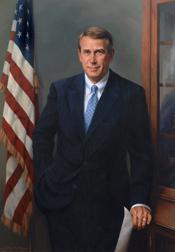
Historical · U.S. House · Ohio · District 8
John Boehner
Former U.S. Representative · Ohio District 8 · 1991–2015 · Republican
John Boehner represented Ohio's District 8 in the United States House of Representatives (1991–2015) for the Republican party. The page below collects sourced biographical facts, term history, committee roles, and provenance for Boehner.
Bioguide ID: B000589
Key facts
- Full name
- John Boehner
- State
- Ohio
- District
- District 8
- Party
- Republican
- House service
- 1991–2015
- First House term
- 1991
- Status
- Left office
- Current term ends
- —
- Born
- 1949
- Bioguide ID
- B000589
- Committee assignments
- —
- Dataset version
- 1.20260605
Biographical narrative
919 words · sourced from the Wikipedia REST extract
John A. Boehner is a retired American politician and lobbyist who served as a U.S. Representative for Ohio's 8th congressional district from 1991 until 2015. A member of the Republican Party, he held various leadership positions throughout his congressional career, including serving as the 53rd Speaker of the United States House of Representatives from 2011 to 2015. Boehner's tenure in Congress spanned 13 terms, during which he became known for his involvement in key legislative initiatives and his role in Republican leadership.
Early life and career
John Andrew Boehner was born on November 17, 1949, in Reading, Ohio. He was the second of twelve children in a family with modest means, raised by his parents, Mary Anne and Earl Henry Boehner. His father had German roots, while his mother had both German and Irish ancestry. The family lived in a two-bedroom house in Cincinnati, where they shared a single bathroom among all the siblings. Boehner's early life was marked by hard work; he began working at his family's bar at the age of eight, a business established by his grandfather in 1938. He has spent his entire life in Southwest Ohio.
Boehner attended Moeller High School in Cincinnati, where he played as a linebacker on the football team, coached by future Notre Dame coach Gerry Faust. After graduating from high school in 1968, Boehner enlisted in the United States Navy during a time when the Vietnam War was escalating. However, he was honorably discharged after eight weeks due to a back injury. He later pursued higher education, earning a Bachelor of Arts in business administration from Xavier University in 1977. Boehner was the first member of his family to attend college, a journey that took him seven years to complete as he worked multiple jobs to fund his education.
Following his graduation, Boehner began his professional career at Nucite Sales, a small company in the plastics industry, where he quickly ascended to the position of president. He resigned from this role in 1990 to enter politics, having previously served on the board of trustees for Union Township in Butler County, Ohio, from 1981 to 1984, and as a member of the Ohio House of Representatives from 1985 to 1990.
House tenure
Boehner entered the U.S. House of Representatives in 1991 after winning a competitive Republican primary against incumbent congressman Buz Lukens, who was facing scandal. Despite being relatively unknown and significantly outspent, Boehner secured 49 percent of the vote. He subsequently defeated his Democratic opponent, Greg Jolivette, in the general election. Over the course of his congressional career, Boehner was re-elected twelve additional times, consistently winning by substantial margins.
His most competitive races occurred in 2006, when he received 64 percent of the vote against Democratic candidate Mort Meier; in 2008, when he garnered 68 percent against Nicholas Von Stein; and in 2010, when he achieved 66 percent in a four-way race that included candidates from the Democratic, Constitution, and Libertarian parties.
Boehner's early congressional career included membership in the "Gang of Seven," a group of lawmakers focused on exposing the House banking scandal and investigating the Congressional Post Office, which ultimately led to the indictment of Congressman Dan Rostenkowski. He was also instrumental in the development of the "Contract with America," a political platform that helped the Republican Party gain a majority in Congress during the 1994 elections, marking a significant shift in the political landscape after decades of Democratic control.
In the late 1990s, Boehner held the position of House Republican Conference Chairman, making him the fourth-ranking Republican in the House. During this time, he advocated for the Freedom to Farm Act, which aimed to reform agricultural policy by simplifying direct payment programs and eliminating certain government price supports for milk. His leadership was tested in 1997 when a faction of House Republicans sought to replace Speaker Newt Gingrich due to concerns about his public image. Although the attempt ultimately failed, it highlighted the internal dynamics within the Republican Party.
Boehner's influence within the party grew, and he was appointed as House Majority Leader from 2006 to 2007, followed by his election as House Minority Leader until 2011. His leadership culminated in his election as Speaker of the House in January 2011, a position he held until his resignation in October 2015, which was prompted by increasing opposition from within the Republican conference.
Legislative focus and committees
Throughout his time in Congress, Boehner focused on various legislative issues, particularly those related to fiscal policy, education, and labor. As Chairman of the Committee on Education and Labor, he played a significant role in shaping education policy and advocating for reforms aimed at improving the educational system in the United States. His leadership in this committee allowed him to influence key legislation and engage with stakeholders in the education sector.
Boehner's tenure as Speaker was marked by significant legislative challenges, including budget negotiations, healthcare reform, and issues surrounding the national debt. His leadership style and approach to governance were often characterized by a focus on consensus-building within the Republican Party, although he faced considerable challenges from more conservative factions within the party.
After resigning from Congress, Boehner transitioned into the private sector, joining the lobbying firm Squire Patton Boggs in September 2016. He also became a board member of Reynolds American, reflecting his continued engagement in political and business affairs following his congressional career. Boehner's long-standing involvement in politics and his leadership roles have left a lasting impact on the legislative landscape of the United States.
Notable legislation
Sponsored and co-sponsored legislation for John Boehner is pending operator curation. The biographical narrative above carries the same provenance trail until per-bill rows are written.
Sources
- [1]https://en.wikipedia.org/wiki/John_BoehnerWikipedia · retrieved 2026-06-05
Notable quotes
Sourced quotes for John Boehner are pending operator curation. Narrative-scope provenance remains attached below.
Sources
- [1]https://en.wikipedia.org/wiki/John_BoehnerWikipedia · retrieved 2026-06-05
Key positions
Curated policy positions for John Boehner are pending operator review. The biographical narrative above carries the same provenance trail until per-topic positions are written.
Sources
- [1]https://en.wikipedia.org/wiki/John_BoehnerWikipedia · retrieved 2026-06-05
Terms served
- 1991–1993U.S. House · Term 1 · Republican
- 1993–1995U.S. House · Term 2 · Republican
- 1995–1997U.S. House · Term 3 · Republican
- 1997–1999U.S. House · Term 4 · Republican
- 1999–2001U.S. House · Term 5 · Republican
- 2001–2003U.S. House · Term 6 · Republican
- 2003–2005U.S. House · Term 7 · Republican
- 2005–2007U.S. House · Term 8 · Republican
- 2007–2009U.S. House · Term 9 · Republican
- 2009–2011U.S. House · Term 10 · Republican
- 2011–2013U.S. House · Term 11 · Republican
- 2013–2015U.S. House · Term 12 · Republican
- 2015–2015U.S. House · Term 13 · Republican
Sources & provenance
Every attributable claim above carries a per-section [N] marker that resolves to the corresponding URL below. Each entry records the upstream provider, the canonical URL, and the timestamp at which the source was retrieved by the ingest pipeline.
Key facts
- https://bioguide.congress.gov/search/bio/B000589bioguide · retrieved 2026-06-05
- http://johnboehner.house.govhouse.gov · retrieved 2026-06-05
Biographical narrative
- https://en.wikipedia.org/wiki/John_Boehnerwikipedia · retrieved 2026-06-05
Find your representative
Every U.S. state elects representatives by district. Browse Ohio’s delegation, the full former-representative roster, or explore the role and term length.
Related on The Candidate
- Preceded by Donald LukensEarlier holder of the Ohio District 8 House seat · Republican.Open
- Aaron PerryFormer U.S. Representative · Ohio District 1 · RepublicanOpen
- Alexander DuncanFormer U.S. Representative · Ohio District 1 · DemocraticOpen
- Bellamy StorerFormer U.S. Representative · Ohio District 1 · WhigOpen
- Bellamy StorerFormer U.S. Representative · Ohio District 1 · RepublicanOpen
- Republican PartyFederal candidates and office holders on the Republican line.Open